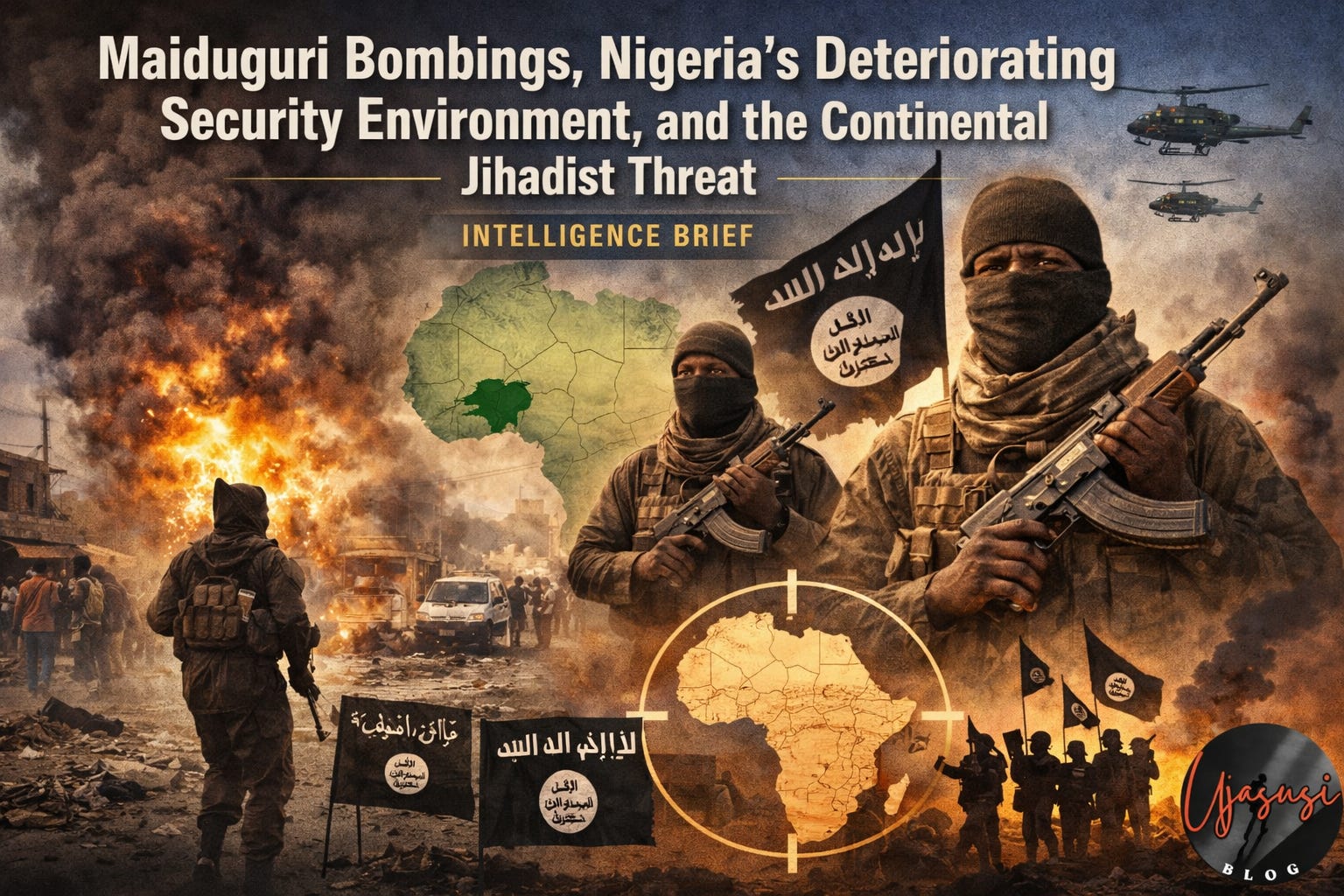
Maiduguri Bombings, Nigeria’s Deteriorating Security Environment, and the Continental Jihadist Threat | Intelligence Brief
Ujasusi Blog’s Terrorism Monitoring Desk | 17 March 2026 | 0145 GMT
KEY JUDGEMENTS
The 16 March 2026 Maiduguri bombings are the latest peak in a documented escalatory trajectory that claimed over 100 Nigerian soldiers in the single week of 3–9 March 2026, one of the deadliest seven-day periods for the Nigerian military since the 2018 Metele massacre.
ISWAP has demonstrated a level of operational sophistication, including simultaneous multi-vector attacks, systematic weapons seizures from overrun military bases, and intact command-and-control structures, that current Nigerian counterterrorism capacity cannot sustainably contain.
The Nigerian Army’s active suppression of casualty reporting, including a documented paid social media campaign against independent media, constitutes an institutional information management failure with direct implications for public accountability and operational credibility.
The security deterioration presents a credible threat to President Tinubu’s political viability ahead of the February 2027 presidential election, though a pre-election collapse of the administration remains contingent on variables that are presently unresolved.
Nigeria’s crisis is analytically inseparable from a continent-wide jihadist expansion. Over two-thirds of the Islamic State’s global activity in the first half of 2025 was recorded in Africa. The pattern observable across the Sahel, Somalia, the DRC, and Mozambique reflects a deliberate IS strategic pivot toward the continent.
A wholesale jihadist takeover of African states is not the proximate threat. The more accurate threat model is one of progressive state hollowing: governments that nominally survive whilst ceasing to exercise meaningful authority over expanding portions of their territory.
SITUATION REPORT
The Maiduguri Attacks, 16 March 2026
In the early hours of 16 March, at approximately 12:45 AM, suspected Boko Haram and ISWAP fighters attacked a military base in Maiduguri’s Ajilari Cross district, situated kilometres from the city’s international airport. Security forces repelled the assault; residents counted four dead attackers on the ground. A separate infiltration attempt was simultaneously repelled along the Damboa-Maiduguri Road to the south.
Nineteen hours later, the city paid a considerably heavier price. At 7:20 PM, shortly after the Ramadan iftar meal, suicide bombers struck simultaneously at the Monday Market, the Post Office area, and the main gate of the University of Maiduguri Teaching Hospital. Volunteer Mohammed Hassan evacuated ten bodies personally from the blast sites and confirmed that many more victims died after reaching the hospital. Eyewitness Bagoni Alkali counted over 200 injured receiving care in the accident and emergency department within the first hour. An AFP correspondent found multiple bodies covered in sheets on the pavement outside the hospital entrance.
Governor Zulum attributed the escalation directly to military operations in the Sambisa Forest, assessing the bombings as displacement pressure from insurgents being pushed out of rural strongholds. That assessment carries analytical weight, but does not diminish the operational significance of the attack. Maiduguri had been largely spared since 2021. Its targeting again indicates that ISWAP retains both the intent and the capacity to return the conflict to the urban centre.
The Preceding Week: Over 100 Soldiers Dead
The Maiduguri bombings cannot be assessed without accounting for what preceded them. Between 3 and 9 March 2026, coordinated ISWAP and Boko Haram attacks across Borno State killed over 100 soldiers in seven days. Among the confirmed dead were two Lieutenant Colonels, SI Iliyasu and Umar Farouq; two Majors, Segun Amusan and Ibrahim Mairiga; and Lieutenant Ejeh. A military source quoted directly by Sahara Reporters stated: “Over 100 of our men were killed last week alone. Seems we have lost the war while the army authorities keep deceiving the public.” More than 40 soldiers remained unaccounted for following the assault on Ngoshe town, their fate unknown at the time of reporting.
Over the weekend of 7–9 March, Islamic extremist groups launched at least six attacks across Borno, Yobe, and the wider Lake Chad region, seizing military hardware from overrun bases. ISWAP subsequently published videos of captured weaponry, ammunition, motorcycles, and vehicles. Security researcher Malik Samuel of Good Governance Africa identified the strategic logic plainly: as long as military bases remain vulnerable to being overrun, ISWAP does not need to procure arms through other means.
Security analyst Vincent Foucher of France’s National Centre for Scientific Research assessed the attacks as demonstrating a remarkable level of coordination, noting it was the first time in recent history that ISWAP had successfully launched simultaneous operations of this scale across the region. An investigation by the International Centre for Investigative Reporting found that a former senior ISWAP commander attributed the operational resurgence partly to the Nigerian government’s failure to honour reintegration commitments made to fighters who had previously surrendered, including promises of housing and vocational training.
The Army’s Information Suppression Campaign
A dimension of the March 2026 security crisis that merits separate analytical attention is the Nigerian Army’s institutional response to independent reporting of its losses. Rather than address the substance of the casualty figures, military authorities commissioned a paid social media campaign targeting Sahara Reporters and its founder Omoyele Sowore, whose organisation had been reporting battlefield accounts from multiple military sources. The official military statement, issued by Lieutenant Colonel Sani Uba of Operation HADIN KAI, claimed troops were not overrun and accused the newspaper of ignoring soldiers’ gallant efforts. That position was directly contradicted when ISWAP released a lengthy video on Monday confirming the attacks on four military camps, with footage of weapons seizures and burning military installations.
An institutional pattern of official denial followed by independent corroboration, culminating in jihadist propaganda confirming what the army denied, is analytically significant beyond its immediate subject matter. It indicates a command culture in which the management of domestic political perception takes precedence over operational transparency, with consequences for both internal military morale and the credibility of any future official assessment of the insurgency’s trajectory.
ASSESSMENT I: TINUBU’S POLITICAL SURVIVAL
The attacks have generated significant public dissatisfaction, with many Nigerians accusing the Tinubu government of prioritising the 2027 presidential election over the security of citizens in the northeast. Several structural factors compound that political pressure.
The narrative of military failure is now difficult to manage institutionally. Each official denial of casualty figures subsequently contradicted by independent sources deepens public loss of confidence in both the military and the administration it serves. Nigeria has risen to sixth place globally on the Global Terrorism Index, with Amnesty International recording more than ten thousand people killed by jihadist groups and criminal gangs in the country’s north and centre in the two years since Tinubu assumed office.
The economic dimension reinforces rather than offsets the security problem. The Tinubu administration’s macroeconomic reforms have drawn consistent praise from the IMF and the World Bank, yet 75.5 percent of rural Nigerians and 41.3 percent of urban Nigerians continue to live below the poverty line. A population experiencing simultaneous economic hardship and deteriorating security is a structurally volatile political constituency.
For Tinubu, who has already secured his party’s endorsement for re-election, the security file now directly threatens his foreign policy credibility and domestic political legacy. As a politician from Nigeria’s predominantly Christian south, he must avoid alienating the predominantly Muslim north whilst demonstrating to international partners that his government is committed to addressing large-scale violence with measurable results.
The Arewa Youth Consultative Forum has warned that no level of political endorsement can guarantee electoral success if the security situation remains unchanged, drawing an explicit comparison with former President Goodluck Jonathan, who received strong gubernatorial support ahead of the 2015 election yet lost decisively to Muhammadu Buhari due to public loss of confidence in his security record.
A pre-election removal of Tinubu by constitutional or extra-constitutional means nonetheless requires conditions not yet present. Nigeria was shaken by a foiled coup attempt in late September 2025, resulting in the arrest of dozens of suspects including senior military officers. That episode confirmed both that institutional pressure on the presidency exists and that it has, for now, been contained. Opposition coalitions lack the unity and organisational coherence to convert public dissatisfaction into a credible electoral challenge; the leading opposition figures carry individual liabilities that materially constrain coalition-building.
The security crisis nonetheless poses a direct structural threat to the integrity of the 2027 electoral process itself. Insurgency, banditry, communal conflicts, and organised criminal violence continue to extend the geography of insecurity, with the Independent National Electoral Commission potentially constrained from organising elections in volatile or ungoverned spaces, and voters in conflict zones at material risk of disenfranchisement.
The more plausible scenario is a presidency that survives to 2027 in a weakened condition, with security as the primary line of attack available to opposition candidates, and with a northeast that has slipped further from effective government control than at any point since the mid-2010s.
ASSESSMENT II: THE CONTINENTAL JIHADIST THREAT
The Sahel
The Sahel region accounted for 51 per cent of all terrorism-related fatalities globally in 2024. Burkina Faso, Mali, and Niger, the three central Sahel states governed by military juntas following coups driven partly by public loss of confidence in civilian governments’ security performance, are losing ground despite the presence of Russian Africa Corps forces that replaced expelled French and American contingents.
Russian forces have failed to degrade the strengthening jihadist insurgencies in the Sahel, leaving partner governments increasingly vulnerable and in mounting need of regime security support. Mali and Niger’s capitals have come under direct threat in the years since Russian forces first arrived. In February 2026, JNIM launched a broad coordinated offensive against state forces across the central Sahel and into Benin, involving more than 30 attacks in Burkina Faso alone, killing more than 120 soldiers, forest guards, and state-backed volunteers. Governments that expelled Western forces on sovereignty grounds are now more exposed to the insurgencies that precipitated those coups.
Somalia
Somalia is at a critical juncture. Al-Shabaab, eighteen years into its insurgency against the federal government, remains a major threat. External backing for the fight is under sustained strain, with traditional security partners expressing reduced patience and the African Union Support Mission for Somalia continuing to face structural funding constraints. IS-Somalia has attracted foreign fighters from Ethiopia, Djibouti, Kenya, and the Somali diaspora in Western countries, with demonstrated ambitions extending well beyond Somali territory.
DRC
The Allied Democratic Forces, operating as the Islamic State’s Central Africa Province, caused over 650 civilian fatalities between June and November 2024, having evolved from a local Ugandan insurgency into one of the Islamic State’s most operationally active affiliates globally. This coexists with the M23 insurgency in eastern DRC, backed by Rwanda and driven by a distinct set of strategic objectives, producing a layered security collapse that exceeds the response capacity of any single institution.
Mozambique
Islamic State Mozambique, also known as Ahlu Sunna Waljama’a, has received operational and financial support from IS-Somalia to systematically target critical infrastructure in northern Cabo Delgado, including the $20 billion TotalEnergies LNG project, whose suspension in 2021 produced significant disruption to international energy markets. As of February 2026, ISM remained on the offensive in the Catupa forest, having overrun two Mozambican Armed Forces positions and continued targeting commercial convoys, killing civilians, including a child in a highway ambush on the N380 road. Rwanda’s deployment of over 4,000 troops has constrained but not defeated the insurgency.
The Continental Strategic Picture
The Islamic State’s African affiliates, spanning ISWAP in the Lake Chad Basin, ISSP in the Sahel, IS-Somalia in the Horn, ISCAP in the DRC, and ISM in Mozambique, are not operating in isolation. They share doctrine, propaganda frameworks, financing mechanisms, and in some cases operational coordination through the IS global network.
The operational landscape is becoming progressively more sophisticated. Jihadist actors are leveraging unmanned aerial systems, transnational smuggling networks, and illicit resource extraction to finance their campaigns, whilst deliberate attacks on civilian populations and targeted governance disruption remain central to a strategy of destabilising fragile states and advancing jihadist proto-statebuilding.
The structural conditions producing violence across these theatres are consistent: governance vacuums in peripheral regions, security forces without the capacity for sustained operations, failed reintegration programmes that return former combatants to the battlefield, and economic marginalisation that sustains recruitment pipelines independently of battlefield attrition. These conditions are not being addressed at a scale commensurate with the threat. A wholesale territorial seizure of African states is not the near-term trajectory. The more accurate prognosis, absent a fundamental reorientation of governance and development strategy in conflict-affected regions, is one of progressively expanding ungoverned spaces: governments that control capitals but not the countryside, and civilian populations exposed to violence that state institutions cannot prevent or consistently respond to. The Maiduguri bombings of 16 March 2026 are one data point in that trajectory. They are not the last.
OUTLOOK
Sources: Sahara Reporters, Associated Press, AFP, Channels Television, PM News Nigeria, Washington Times, Africanews, International Centre for Investigative Reporting, ACLED, International Crisis Group, The Soufan Centre, Critical Threats, Council on Foreign Relations, Atlantic Council, The Africa Report, Observer Research Foundation, Bloomsbury Intelligence and Security Institute.
Independent intelligence analysis takes time and resources — if this work matters to you, please consider supporting it by donating HERE