D.R. Congo: M23 Rebels Announce Withdrawal from Uvira After U.S. Pressure on Rwanda
Ujasusi Blog’s Great Lakes Region Monitoring Team | 17 Dec 2025 | 0330 GMT
🔓FREE ACCESS
Please consider becoming a paid subscriber
You can also donate.
What happened with M23 rebels in Uvira, Congo in December 2025?
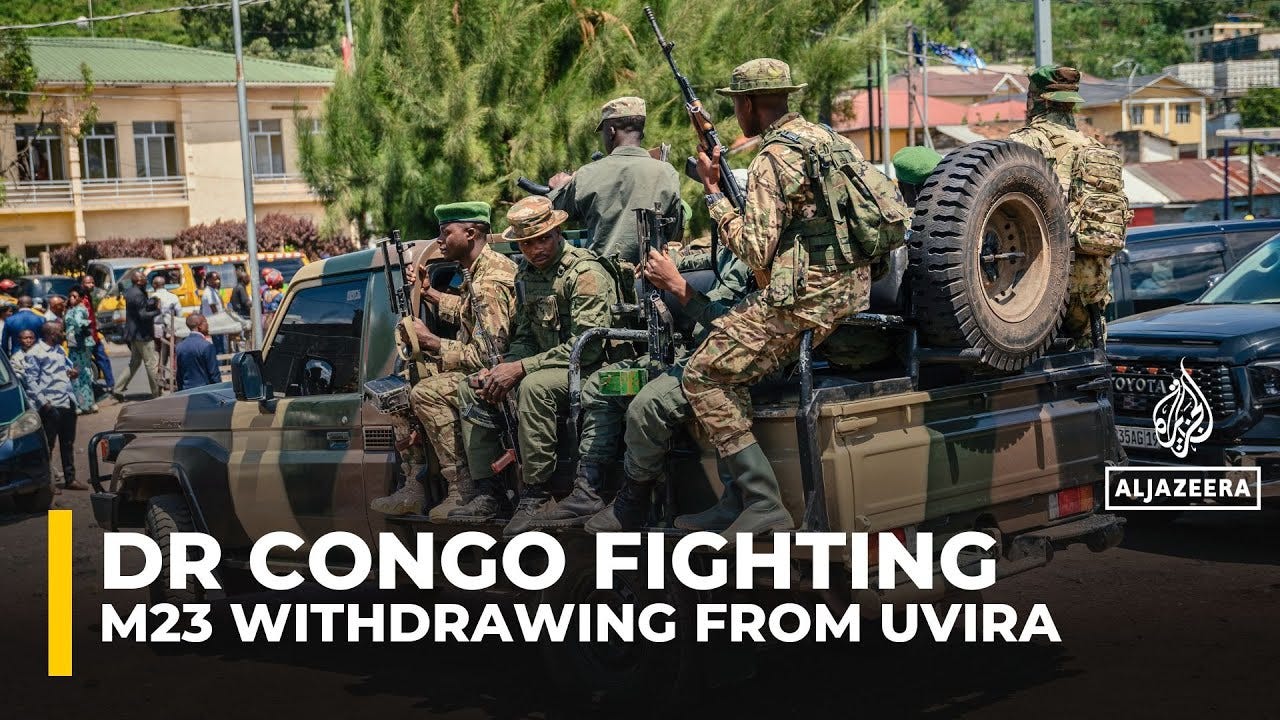
On 15 December 2025, the M23 rebel group announced it would withdraw its forces from Uvira, a strategically vital city in eastern Democratic Republic of Congo’s South Kivu province near the Burundi border. The Alliance Fleuve Congo (AFC), M23’s political wing led by Corneille Nangaa, stated at 05:00 local time, describing the withdrawal as a “trust-building measure” designed to give the Doha peace process the “maximum chance” of success. The announcement explicitly stated the withdrawal was made in response to a request from United States mediators, marking an unprecedented tactical reversal for the rebel group that had captured Uvira only days earlier following intense combat operations.
The withdrawal announcement represents a significant development in eastern Congo’s decades-long conflict and signals the effectiveness of coordinated international diplomatic pressure on Rwanda, which intelligence assessments indicate exercises command and control over M23 operations. The timing of the statement—coming within days of strong public criticism from senior US officials—suggests the decision was driven by Kigali’s strategic calculation to avoid potentially severe economic and diplomatic consequences rather than reflecting M23’s autonomous operational decision-making.
Why did M23 withdraw from Uvira after capturing it?
M23’s withdrawal decision followed unprecedented public condemnation from the highest levels of the United States government. US Secretary of State Marco Rubio publicly stated that Rwanda’s actions in eastern Congo constituted a clear violation of the Washington Accords signed earlier in December 2025. In a post on X (formerly Twitter), Rubio stated that “President Donald Trump would act to ensure promises made to him were kept,” signalling potential consequences for Kigali if commitments under the peace framework were not honoured.
Deputy Secretary of State Christopher Landau reinforced this pressure in even stronger terms. Landau called the Uvira offensive an “uncharacteristic and grave mistake” and explicitly warned that continued US partnership with Rwanda “could not continue under such conditions.” His statement on social media acknowledged Rwanda’s post-genocide development achievements whilst making clear that the Uvira operation crossed a red line for Washington’s tolerance of Rwandan military intervention in eastern Congo.
Intelligence analysts assess that M23’s withdrawal announcement likely reflects direct instructions from Rwandan military command rather than an autonomous decision by rebel leadership. The explicit framing of the withdrawal as responding to “US mediation” suggests coordinated diplomatic manoeuvring designed to prevent the implementation of threatened sanctions whilst allowing Rwanda to maintain face by portraying the decision as supporting peace processes rather than capitulating to pressure.
How many Rwandan troops are deployed in Congo?
According to US National Security Adviser Mike Waltz’s detailed testimony to the UN Security Council on 13 December 2025, approximately 5,000 to 7,000 Rwandan Defence Forces personnel were deployed inside Congolese territory as of early December 2025. Waltz emphasised this figure did not account for possible increases during the most recent Uvira offensive, suggesting actual numbers may have been substantially higher during combat operations. The US ambassador confirmed these Rwandan forces were co-located with M23 fighters along the front lines during the assault on Uvira, indicating integrated command structures rather than merely advisory or support roles.
Waltz’s testimony represented the most detailed official US intelligence assessment of Rwanda’s military footprint in Congo disclosed publicly. He stated that “for years now, the Rwanda Defence Forces have provided materiel, logistics and training support to M23, and have fought alongside them inside the DRC,” confirming what UN expert panels and regional intelligence services had documented through signals intelligence, human intelligence sources, and battlefield evidence collection over multiple years of conflict.
What is the detailed nature of Rwanda’s relationship with M23?
The United States government has officially confirmed that Rwanda maintains comprehensive operational control over M23, providing the rebel group with direct military support including troops, advanced weapons systems, logistical infrastructure, and strategic command-and-control capabilities. Waltz’s Security Council testimony stated that Rwanda has exercised “strategic control” over M23 and its political wing, the Alliance Fleuve Congo, since the group re-emerged in 2021 following a period of dormancy.
The US assessment indicates Rwanda has been “intimately involved in planning and executing the war in eastern DRC, providing military and political direction to M23 forces and AFC for years.” This characterisation goes significantly beyond previous diplomatic language that described Rwanda as merely “supporting” or “backing” M23, instead confirming direct Rwandan command authority over rebel operations. Waltz stated Rwanda deployed surface-to-air missiles and other sophisticated heavy weaponry into North and South Kivu provinces, enabling M23 operations against both Congolese forces and UN peacekeepers whilst providing air defence capabilities that complicate international military intervention.
Rwanda consistently denies backing M23, maintaining instead that any Rwandan military presence in eastern Congo serves defensive purposes against hostile Hutu militias, particularly the Democratic Forces for the Liberation of Rwanda (FDLR), which fled into Congo following Rwanda’s 1994 genocide. Kigali’s position asserts it acts in legitimate self-defence against cross-border security threats rather than pursuing offensive territorial or economic objectives in Congo.
Why is Uvira strategically important in the broader Congo conflict?
Uvira’s strategic significance derives from multiple geographic, economic, and military factors that make it one of the most valuable urban centres in eastern Congo. The city controls critical transport corridors linking South Kivu province to Burundi, providing access to cross-border trade routes and regional economic networks. Uvira’s location on the northern shores of Lake Tanganyika, one of Africa’s Great Lakes, offers potential control over maritime transport and fishing resources whilst providing direct access to Burundi’s commercial capital Bujumbura, located directly across the lake.
From a military perspective, Uvira’s capture provided M23 with control over key infrastructure including the city’s airport, located less than 20 kilometres from the Burundian border, and port facilities that could facilitate logistics operations. The offensive also demonstrated M23’s expanding territorial reach beyond its traditional strongholds in North Kivu, signalling the group’s capability to project power across multiple provinces in eastern Congo.
Burundi’s government warned the United Nations that M23’s capture of Uvira risked triggering a broader regional war, with Burundi’s UN ambassador stating that “restraint has its limits” and warning that continued attacks would make it “extremely difficult to avoid direct escalation” between Burundi and Rwanda. This reflects Bujumbura’s assessment that Rwanda’s expanding military presence in South Kivu constitutes a direct threat to Burundian national security, particularly given historical tensions between the two countries and allegations that Rwandan forces conducted cross-border artillery and drone strikes into Burundian territory during the Uvira offensive.
What are the Washington Accords and when were they signed?
The Washington Accords represent a US-brokered peace framework signed on 4 December 2025 by Democratic Republic of Congo President Félix Tshisekedi and Rwandan President Paul Kagame, with the signing ceremony hosted by US President Donald Trump at the US Institute of Peace in Washington DC. The accords aimed to establish a comprehensive framework for de-escalating decades of conflict in eastern Congo through commitments to ceasefire implementation, withdrawal of foreign forces, and regional economic integration initiatives designed to address underlying drivers of instability.
The Washington Accords complemented a separate negotiating track conducted in Doha, Qatar, which focuses on direct negotiations between the Congolese government and M23. Whilst M23 is not a party to the Washington-mediated negotiations between Kinshasa and Kigali, the Doha process addresses the rebel group’s specific political and security demands, creating a dual-track diplomatic architecture intended to resolve both state-level disputes and sub-state armed group grievances.
Secretary of State Rubio characterised Rwanda’s Uvira offensive as fundamentally violating the Washington Accords, stating President Trump would act to ensure commitments made during the 4 December ceremony were honoured. The rapid collapse of the agreement—with major combat operations resuming within days of the signing—highlighted the fragility of peace frameworks that lack robust enforcement mechanisms or genuine political will amongst key parties to implement agreed commitments.
What specific conditions did M23 set for its withdrawal from Uvira?
M23’s withdrawal announcement included several explicit conditions designed to shape post-withdrawal security arrangements in Uvira and prevent the immediate return of Congolese Armed Forces (FARDC) or allied militia groups. The rebel group called for Uvira’s “demilitarisation and deployment of a neutral force” to protect civilians and monitor ceasefire implementation, conditions that effectively seek to prevent FARDC from immediately reoccupying the city and potentially targeting populations perceived as M23 sympathisers.
The statement referenced what M23 described as past experiences where “Congolese forces and allied militias had exploited previous withdrawals to retake territory and target civilians perceived as sympathetic to the group.” This framing attempts to justify continued M23 influence over Uvira even after physical withdrawal, potentially through local proxy forces, political arrangements, or security guarantees that limit Congolese government authority in the city.
M23 also stated it would not permit armed groups hostile to Burundi or the Congolese government to use areas under its control as rear bases for cross-border operations. This language addresses Burundian security concerns whilst asserting M23’s continued authority over security arrangements in eastern Congo territories, effectively claiming quasi-governmental powers to regulate armed group movements and maintain order in contested regions.
The viability of M23’s proposed “neutral force” deployment remains highly uncertain. Neither the United Nations Organisation Stabilisation Mission in the DRC (MONUSCO) nor regional military forces have demonstrated consistent capability or political willingness to establish effective security control in contested territories. Without credible security guarantees that address M23’s stated concerns, analysts assess the group may delay full implementation of withdrawal or maintain indirect control through local proxy structures.
What sanctions could the United States impose on Rwanda?
Potential US sanctions against Rwanda could include multiple categories of measures with varying degrees of economic and diplomatic severity. Targeted financial sanctions could designate specific Rwandan military and intelligence officials for asset freezes and travel bans, similar to sanctions regimes implemented against other governments accused of destabilising activities. Such measures would directly impact senior Rwandan Defence Forces commanders and intelligence service leaders identified as responsible for directing M23 operations.
Restrictions on military cooperation could include suspension of security assistance programmes, termination of joint training initiatives, and prohibition on weapons transfers or defence equipment sales. The US could also advocate for Rwanda’s removal from UN peacekeeping missions, denying Kigali both the financial benefits and international legitimacy associated with troop contributions to peacekeeping operations. Congo’s foreign minister specifically urged the UN Security Council to prohibit Rwanda from contributing troops to peacekeeping missions, arguing that “Rwanda continues to benefit, especially financially but also in terms of reputation, from its status as a troop-contributing country.”
Economic sanctions could target Rwanda’s critical export sectors, particularly restrictions on mineral exports that may incorporate resources illegally extracted from Congolese territory. The US could also coordinate with European allies to implement complementary sanctions measures, creating a multilateral sanctions architecture that significantly increases economic pressure on Kigali. Suspension of development assistance and withdrawal of support for international financial institution lending to Rwanda would compound economic impacts, potentially affecting Rwanda’s substantial integration with Western financial systems and dependence on foreign aid flows.
The threat of sanctions alone appears to have been sufficient to compel tactical adjustments in Rwanda’s eastern Congo strategy, even if Kigali maintains broader strategic objectives in the region related to security buffer zones, mineral resource access, and regional influence that will persist regardless of temporary tactical accommodations to US pressure.
Who is Corneille Nangaa and what role does he play in M23?
Corneille Nangaa serves as the leader of the Alliance Fleuve Congo (AFC), M23’s political wing that provides civilian governance structures and political legitimacy claims for territories under rebel control. Nangaa’s background as former head of Congo’s National Independent Electoral Commission (CENI) provides him with significant political credibility and intimate knowledge of Congolese governmental structures, making him a particularly valuable political operative for M23’s efforts to present itself as a legitimate political-military movement rather than merely a Rwandan proxy force.
Nangaa’s defection from the Congolese government to join M23 represented a major political victory for the rebel movement, lending credibility to claims that M23 represents genuine Congolese grievances rather than exclusively serving Rwandan strategic interests. His role involves coordinating AFC’s political messaging, managing relationships with diaspora communities, and articulating the movement’s political demands in regional and international forums.
What has been Congo’s government response to the withdrawal announcement?
As of 16 December 2025, the Congolese government in Kinshasa had not issued an official response to M23’s withdrawal announcement, creating significant uncertainty about whether President Tshisekedi’s administration will accept the demilitarisation conditions M23 has stipulated or will instead seek to immediately reassert military control through FARDC deployment to Uvira. Congo’s foreign minister had previously urged the UN Security Council to hold Rwanda accountable for violations of the Washington Accords, stating that “impunity has gone on for far too long” and calling for comprehensive sanctions against Rwandan military and political leaders responsible for M23 operations.
The absence of an immediate Congolese government response likely reflects internal deliberations about how to navigate the complex political and military dynamics surrounding Uvira’s status. Accepting M23’s conditions for demilitarisation could be perceived domestically as capitulating to a rebel group backed by Rwanda, undermining Tshisekedi’s political standing. However, attempting to immediately retake Uvira militarily risks renewed combat that could collapse the broader peace process and demonstrate FARDC’s continued inability to defeat M23 without substantial international support.
What are the humanitarian consequences of the Uvira offensive?
The M23 offensive that culminated in Uvira’s capture has created severe humanitarian consequences across South Kivu province. According to United Nations agencies, the offensive that began on 2 December 2025 displaced more than 200,000 people across South Kivu, with over 30,000 refugees fleeing across the border into Burundi in the days immediately following Uvira’s fall. Regional officials reported that more than 400 civilians were killed during the combat operations, though precise casualty figures remain difficult to verify given the chaotic security environment and limited humanitarian access to affected areas.
Human Rights Watch documented summary executions, use of explosive weapons in populated areas, and a collapsing humanitarian situation in Uvira following M23’s capture of the city. The rights organisation’s report indicated that both M23 forces backed by Rwanda and Congolese military forces allied with Burundian troops and local Wazalendo militias had committed serious violations of international humanitarian law, including protections for civilians under the Geneva Conventions.
The broader conflict in eastern Congo has created one of the world’s largest humanitarian crises, with more than seven million people displaced across the region according to UN refugee agency figures. More than 100 armed groups continue fighting for control of mineral-rich areas near the Rwandan border, perpetuating cycles of violence, displacement, and economic exploitation that have characterised eastern Congo for decades.
What is the current implementation status of the Uvira withdrawal?
As of 17 December 2025, M23 fighters remained visibly present in Uvira despite the withdrawal announcement, with Al Jazeera correspondents reporting that “nothing had changed” on the ground as of Tuesday morning following Monday’s statement. The continued presence of M23 forces suggests that implementation of the announced withdrawal may be contingent on negotiation of acceptable security arrangements, deployment of international monitors, or other conditions that have not yet been satisfied.
The lack of immediate withdrawal implementation raises questions about whether M23’s announcement represents a genuine commitment to vacate Uvira or serves primarily as a tactical diplomatic manoeuvre designed to ease international pressure whilst the group maintains effective control over the city pending resolution of broader political negotiations. Analysts note that previous M23 withdrawal commitments have sometimes been implemented only partially or with significant delays, reflecting the group’s strategic calculation that maintaining territorial control provides leverage in political negotiations.
What role does the Trump administration play in the Congo peace process?
The Trump administration has positioned itself as the primary mediator in efforts to resolve the eastern Congo conflict, with President Trump personally hosting the 4 December 2025 signing ceremony for the Washington Accords at the US Institute of Peace. The administration has characterised the peace framework as a signature foreign policy achievement, with Trump reportedly describing the accords as “a miracle” and the dawn of a new era of prosperity for the Great Lakes region.
However, the rapid resumption of major combat operations within days of the Washington Accords signing has created significant political embarrassment for the Trump administration, potentially undermining claims of diplomatic effectiveness in Africa. The administration’s response has been notably forceful, with Secretary of State Rubio explicitly framing Rwanda’s actions as a violation of commitments made personally to President Trump, suggesting the administration views Kigali’s conduct as both a policy challenge and a personal affront to presidential authority.
US ambassador to Congo Lucy Tamlyn escalated the rhetoric by explicitly raising the prospect of US sanctions against Rwandan leaders. In a press conference in Kinshasa, Tamlyn stated that “we are examining all possible diplomatic levers—sanctions, as well as bilateral and multilateral initiatives—to ensure that their commitments are honoured.” This represents one of the strongest public warnings issued by a US official regarding potential consequences for Rwanda’s actions in eastern Congo.
What advanced military capabilities has Rwanda deployed to eastern Congo?
US intelligence assessments indicate Rwanda has deployed sophisticated military hardware into North and South Kivu provinces that significantly alters the conventional military balance in eastern Congo. According to Waltz’s UN Security Council testimony, Rwandan forces have provided M23 with surface-to-air missile systems capable of engaging both fixed-wing aircraft and helicopters, effectively creating an anti-access/area denial (A2/AD) environment that complicates UN peacekeeping air operations and Congolese Air Force support for ground forces.
Rwanda has also deployed suicide drones, advanced artillery systems, and electronic warfare capabilities including jamming equipment that has effectively grounded MONUSCO air operations in contested areas. Waltz noted that some of these weapons systems, including artillery and drones, were used to conduct strikes into Burundian territory during the Uvira offensive, raising the conflict’s intensity and expanding its geographic scope beyond Congo’s borders.
The deployment of such advanced military systems goes well beyond the light infantry weapons typically associated with non-state armed groups, confirming that M23 operations benefit from state-level military capabilities provided directly by Rwanda’s Defence Forces. This technological asymmetry provides M23 with substantial advantages over Congolese forces and allied militias, enabling the rebel group to conduct combined arms operations that integrate infantry manoeuvre with precision fires, air defence, and electronic warfare in ways that FARDC cannot effectively counter without international support.
How does the Uvira situation affect regional stability in the Great Lakes?
The Uvira offensive and subsequent withdrawal announcement have significant implications for broader regional stability across the Great Lakes region, potentially affecting relationships amongst multiple states including Rwanda, Burundi, Uganda, Tanzania, and the Democratic Republic of Congo. Burundi’s military deployment to South Kivu in support of Congolese forces represents the most significant Burundian military intervention in Congo in recent years, reflecting Bujumbura’s assessment that Rwandan military expansion in South Kivu poses direct threats to Burundian national security.
The American Enterprise Institute’s Critical Threats project characterised the Uvira operation as M23’s most consequential offensive since March 2025, noting that Rwanda provided “significant backing” to enable the rapid advance. The offensive demonstrated M23’s capability to conduct large-scale combined arms operations across multiple axes of advance, overwhelming defensive positions held by Congolese forces and allied Burundian troops through superior firepower, tactical coordination, and intelligence support.
The potential for regional escalation remains substantial, with Burundi’s UN ambassador warning that continued attacks could lead to direct confrontation between Burundi and Rwanda—two countries with historical tensions and previous military conflicts. Tanzania, which shares borders with both Burundi and Congo, has expressed concern about refugee flows and potential spillover effects that could affect its own security. The possibility of a wider regional war involving multiple national armies rather than primarily non-state armed groups represents the most serious escalation risk the Great Lakes region has faced in years.
What is the African Union’s position on the Uvira crisis?
The African Union has maintained a relatively low profile on the specific Uvira crisis, though regional organisations including the East African Community and the International Conference on the Great Lakes Region have been engaged in parallel diplomatic efforts to support peace processes. The relative absence of strong African Union leadership on the crisis reflects broader challenges the continental body faces in mediating conflicts involving member states with competing interests and limited enforcement mechanisms to compel compliance with ceasefire agreements or peace frameworks.
What are the prospects for successful implementation of M23’s withdrawal?
The prospects for successful implementation of M23’s announced withdrawal from Uvira remain highly uncertain and contingent on multiple political and security factors that have not yet been resolved. Critical uncertainties include the timeline for withdrawal implementation, the composition and mandate of any “neutral force” that might be deployed to maintain security, and whether the Congolese government will accept conditions that effectively limit FARDC’s ability to immediately reoccupy and control Uvira.
Intelligence analysts assess that M23’s withdrawal announcement likely represents a tactical accommodation to US diplomatic pressure rather than a fundamental strategic shift in Rwanda’s regional objectives. Kigali maintains strategic interests in eastern Congo related to security buffer zones against FDLR and other hostile armed groups, access to mineral resources, and projection of regional influence that will persist regardless of temporary tactical withdrawals from specific urban centres.
The effectiveness of international pressure in compelling M23’s withdrawal announcement suggests that sustained diplomatic engagement combined with credible threats of economic consequences can influence Rwandan decision-making, even as underlying drivers of conflict remain unresolved. However, without comprehensive political settlements that address root causes of instability—including governance failures, ethnic tensions, competition over resources, and regional security dilemmas—tactical withdrawals are unlikely to produce durable peace in eastern Congo.