

Ujasusi East Africa Monitoring Team | 11 June 2026 | 0315 BST
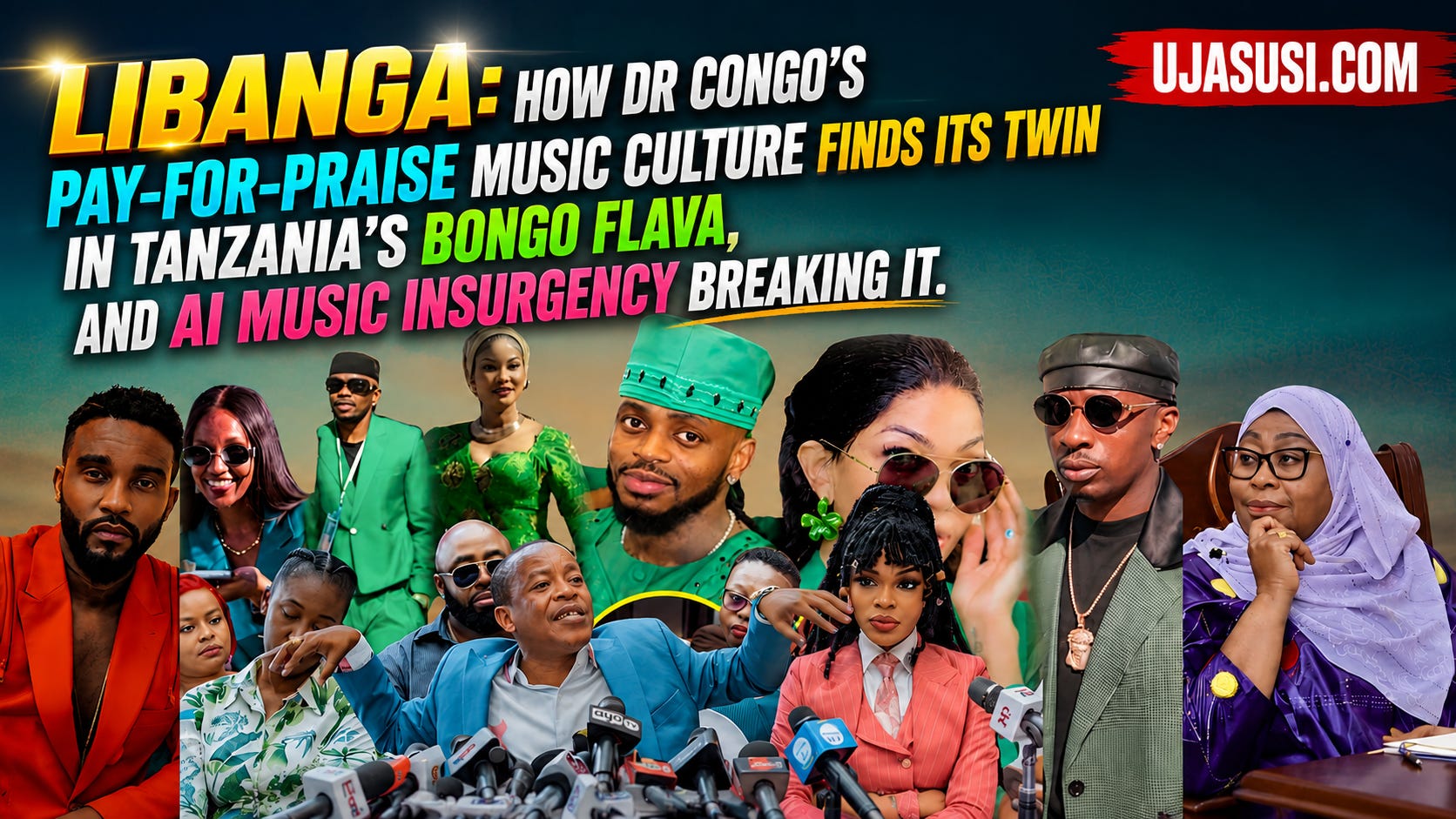
D.R. Congo’s libanga, the practice of paid lyrical praise for politicians, has a structural twin in Tanzania, where the majority of Bongo Flava artists, led by household names Diamond Platnumz, Ali Kiba and Harmonize, function as Chama Cha Mapinduzi’s (CCM) informal endorsement wing. After the 29 October 2025 massacres, that influence apparatus failed publicly for the first time, and AI-generated protest music is now eroding BASATA’s censorship monopoly.
🎤 Libanga Built DR Congo’s Pay-for-Praise Music Economy
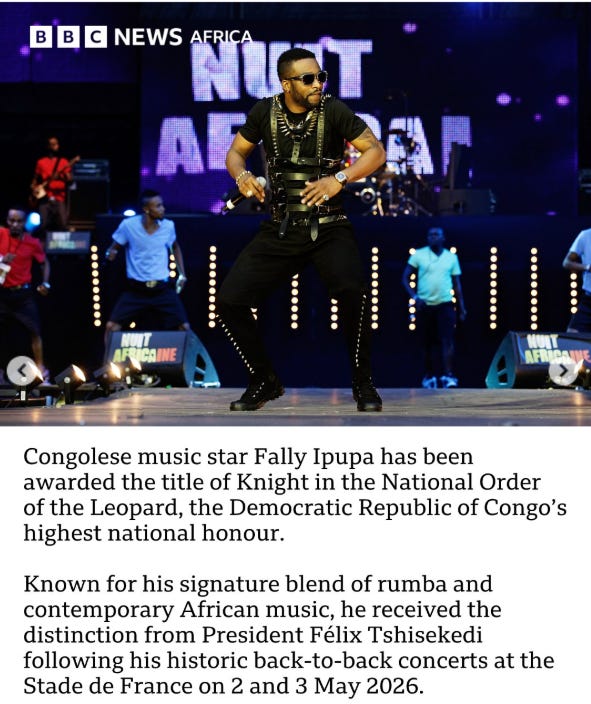
The BBC’s recent profile of Congolese rumba star Fally Ipupa, knighted into the National Order of the Leopard, returned attention to libanga: the entrenched practice of musicians accepting payment to name-check politicians, corporations and power brokers in song. Ipupa told Kenya’s Trace FM he could earn €10,000 per mention. Congolese musicians describe themselves as the pioneers of paid dedications, a survival strategy in an industry hollowed out by piracy and a dysfunctional touring circuit. It carried a price: diaspora communities in Paris, Brussels and London blocked concerts for a decade, treating proximity to Kinshasa’s ruling class as collaboration.
For intelligence analysts, libanga is not an entertainment story. It is a case study in how semi-authoritarian states acquire cultural legitimacy at retail prices. A musician with tens of millions of followers is a pre-positioned influence asset: cheaper than state media, more credible than party officials, and deniable when the relationship sours.
🇹🇿 Bongo Flava Functions as CCM’s Informal Endorsement Wing
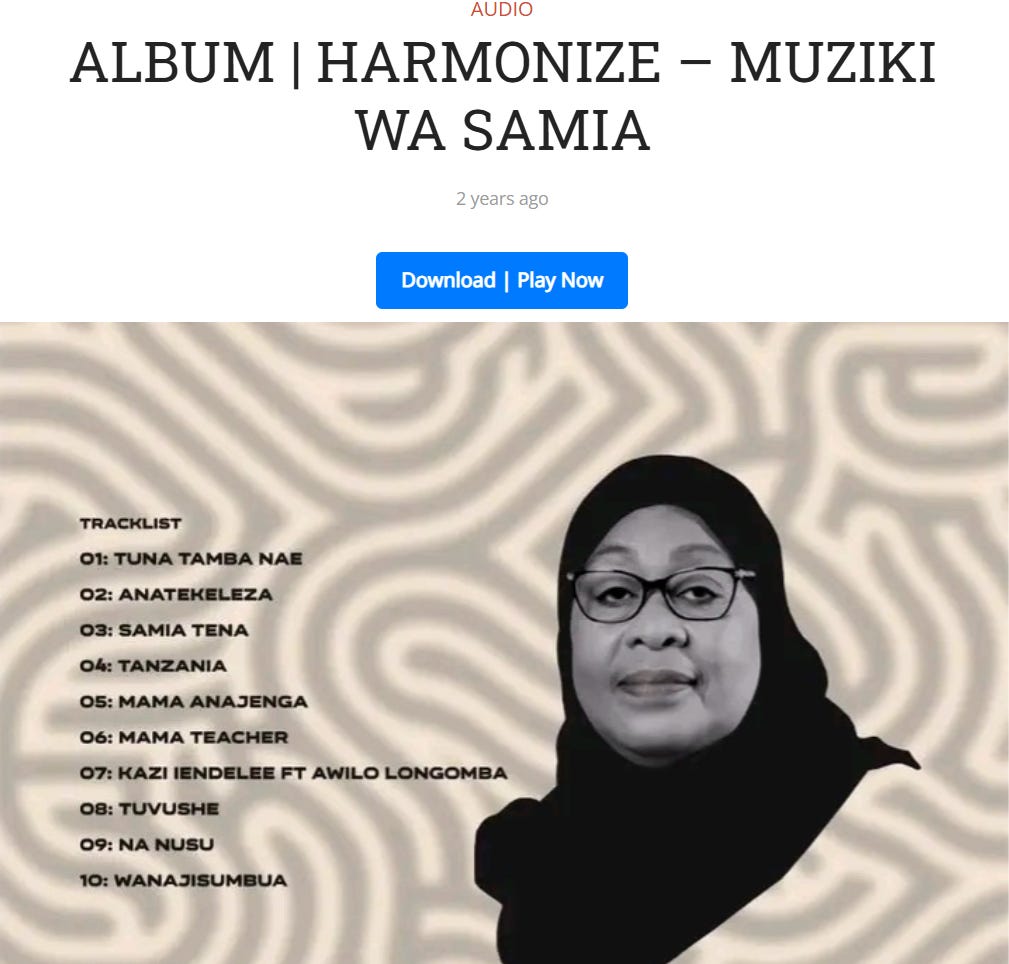
Tanzania never coined a word for the practice, but it is identical in function and arguably deeper in penetration, because it is not confined to a handful of stars. The overwhelming majority of Tanzania’s A-list, with Diamond Platnumz, Ali Kiba, Harmonize, Zuchu, Rayvanny, Nandy, Marioo, Juma Jux and Billnass among them, has openly supported the administration of President Samia Suluhu Hassan and her party. Harmonize released an entire fifth studio album, Muziki wa Samia, launched in May 2024 with the President as guest of honour.
Ali Kiba recorded CCM tribute anthems including Waambieni, and the wider roster endorsed her re-election bid through songs, rally performances and coordinated social media tributes ahead of the 29 October 2025 polls. The same dynamic runs through “Bongo movies”, Tanzania’s answer to Nollywood, whose actors populate CCM platforms with equal reliability.

The pattern extends beyond campaigning into atrocity management. Before the protests, much of this celebrity class amplified anti-demonstration messaging and openly mocked plans for the 29 October action. After security forces killed approximately 10,000 Tanzanians in the post-election crackdown, the same figures pivoted to calls for “national healing”, a framing that conspicuously omitted any condemnation of the perpetrators or demand for accountability. Diamond Platnumz deleted his endorsement posts as the bodies mounted, then restored them once Samia was sworn in. The sequencing matters: these were not artistic positions but transactional ones, recalibrated against political risk in real time.
🔇 Ubuyu Celebrity Gossip Culture Blunted the Post-Massacre Boycott
The fury was real and indiscriminate. It targeted the entire pro-CCM celebrity class rather than individual stars, and artists across the board began losing thousands of followers within days. Yet organised boycott campaigns of the kind that shut down Congolese concerts across Europe have repeatedly failed to take institutional form in Tanzania.
READ ALSO
Introducing “A Spy’s Guide to Deception” — The First in the Spy Guide Series

Intelligence work is built on deception. Every service that has ever run an agent, mounted a cover operation, or manufactured a false narrative has done so through principles that remain largely invisible to the public. Not because they are secret, but because no one has taken the time to explain them plainly.
The explanatory variable is cultural: ubuyu, the national pastime of celebrity rumour consumption. Tanzania’s stars are not merely musicians; they are the primary content engines of the gossip economy, serial protagonists of the very stories their critics consume daily. A consumer cannot sustain a boycott of an artist whose private life she follows as entertainment. The gossip cycle converts political outrage into spectacle within days, structurally protecting the praise economy from the audience behaviour that should punish it. The Congolese diaspora, geographically removed from Kinshasa’s gossip ecology and politically organised, faced no such buffer.
What has emerged instead is quieter and possibly more corrosive: a silent yet loud boycott, expressed through comment sections and vanishing ticket sales rather than coordinated campaigns, with end-of-year shows cancelled and releases shelved. Industry figures have urged fans to reconsider, warning of sector-wide instability.
⚖️ BASATA and TCRA Enforce the Price of Musical Dissent
The inverse case proves the system’s coercive architecture. Rapper Ney wa Mitego, the most consistent musical critic of successive governments, saw BASATA ban Amkeni from airwaves in 2023 for calling the government corrupt, and later faced four charges over Nitasema, a track on enforced disappearances. Roma Mkatoliki carries the heavier scars: abducted from his studio and tortured for three days in 2017, then swept up when the TCRA banned 13 songs outright in 2018, with a minister barring him from performing entirely. Both men command devoted audiences among Tanzanians opposed to the ruling party precisely because their catalogues echo lived repression.
The economics are deliberately asymmetric. Praise pays, in appearance fees, state-adjacent sponsorship and regulatory peace. Dissent costs: bans, charges, cancelled shows, abduction risk. BASATA’s function within this architecture is not cultural stewardship; it is price enforcement on the dissent side of the ledger.
🤖 AI-Generated Protest Music Inverts the Censorship Cost Equation
Here the Tanzanian story diverges from Congo’s, and the divergence is strategically significant. Since late 2025, Tanzanians with no musical training have used generative AI to produce a growing corpus of anti-regime songs. This author was among the earliest practitioners in a country where such technology remains a luxury of the privileged few, producing “October 29, Hatutosahau” and “Shujaa Tundu Lissu”.
The analytical inference, and the original contribution of this assessment, is this: AI music is the first technology to invert the cost asymmetry on which Tanzania’s praise economy depends. The state’s enforcement model assumes music requires studios, registered artists, BASATA vetting and broadcast access, all of which are chokepoints regulators can squeeze. AI production requires none of them. A song can be conceived in Glasgow, generated in minutes, published on platforms outside TCRA jurisdiction, and consumed in Mwanza by morning. There is no artist to charge, no studio to raid, no airplay to withhold. The toolkit that bans songs and prosecutes rappers addresses a production model that dissident content no longer uses, in a state that already treats protests as coup attempts.
Forecast
Within the next 12 months, expect BASATA and TCRA to move jointly towards regulating AI-generated audio, likely through online content amendments requiring registration, attribution or platform takedown cooperation. Analysts should further assume TISS’s information-monitoring function now treats viral AI protest music as a SOCMINT collection priority, mapping the human networks behind anonymous uploads; diaspora creators are the obvious first attribution targets. The operational recommendation for creators follows directly: separate creative identity from legal identity at infrastructure level, using dedicated devices and non-Tanzanian platform accounts, with no reuse of personal email, numbers or payment instruments, because the regulatory gap will be closed through attribution, not censorship.
The accountability context sharpens the stakes. An 82-page ICC dossier submitted by Intelwatch and international jurists, and a domestic Commission of Inquiry report the government refuses to publish in full, make the October 29 record contested terrain. Anonymous songs are now evidence-adjacent artefacts, preserving names, dates and grievances in a form the state cannot quietly delete.
Tanzania’s praise economy bought CCM a decade of cultural cover at retail prices, and the massacres exposed its limits: the celebrity class’s silence on accountability is now itself the message. The next contest will not be fought over endorsements but over anonymous, AI-generated Swahili audio that BASATA cannot ban, TCRA cannot trace, and ubuyu cannot neutralise. Watch for the regulatory counter-move, the first prosecution attempt against an AI-music creator, and the moment a major Bongo Flava name defects from the praise economy. That defection, when it comes, will signal that the political cost of Tanzania’s libanga finally exceeds its price.