


Regional counterterrorism forces and the Nigerian Army have increased the rate of operations targeting Salafi-jihadi havens since April 2023, but they are unlikely to permanently weaken Islamic State – West Africa Province (ISWAP) in northeastern Nigeria. The number of secured or cleared locations included in security force readouts has nearly doubled since the beginning of April, indicating an increase in counterterrorism activity.
The Nigerian army and regional forces typically increase operations during spring before the rainy season begins in July, and the most recent operations have targeted the same areas that counterterrorism forces targeted in spring 2022. The Nigerian army and regional forces have favored a “mow the grass” approach to counterterrorism operations, aiming to degrade rural ISWAP havens with air strikes and ground forces stationed in garrison towns, since at least 2021.
The lack of sustainable security prevents the locals and government from resettling and developing the cleared areas, which allows the insurgents to return and reestablish their havens. Climate change further exacerbates this cycle by increasing resource scarcity and unlivable cycles of drought and flooding in the Lake Chad Basin, further dissuading civilians from returning.
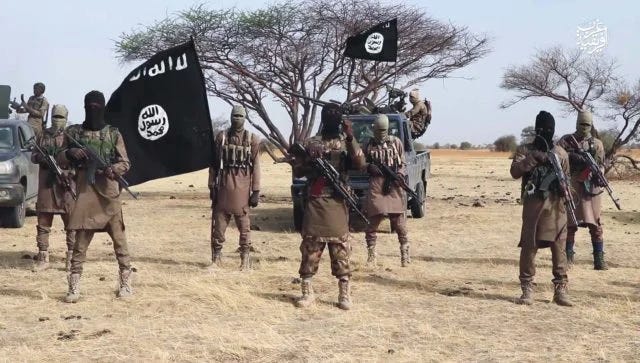
ISWAP is investing in defending its havens in northeastern Nigeria. The group has launched two suicide vehicle-borne improvised explosive device (SVBIED) ambushes targeting patrolling security forces and claimed a third since May 11.The media releases did not provide any visual evidence of the attacks or the aftermath, which undermines ISWAP’s claims that at least one of the attacks killed over 50 troops. The group has previously used SVBIEDs to repel counterterrorism forces. It used at least three SVBIEDs and claimed a fourth in a two-week span while fighting security forces in March and April 2022.
ISWAP also has been fighting a rival Salafi-jihadi faction of Boko Haram militants in the Lake Chad region since January 2023, which likely will contribute to the temporary weakening of ISWAP capabilities in northeastern Nigeria for several months.
Fighting with Boko Haram and counterterrorism forces has degraded ISWAP’s support zones in the Lake Chad marshes and reduced its manpower and weapon resources. The Boko Haram faction has captured several island strongholds in the Lake Chad marshes that housed ISWAP armories and prisons and killed hundreds of fighters from both sides. The clashes have also fanned internal divisions in ISWAP, leading several hundred ISWAP fighters to defect to Boko Haram.
However, ISWAP will be able to recover in the months after the Boko Haram clashes and counterterrorism operations subside in the absence of regional governments providing sustainable security and governance.
ISWAP is still in a stronger position and presents a greater threat to US interests than does Boko Haram. ISWAP has severely degraded, if not eliminated, Boko Haram’s presence in the Sambisa Forest. ISWAP also has more sophisticated capabilities and is more internationally minded than is Boko Haram.
ISWAP generated a credible terror threat to the Nigerian capital and the US embassy in 2022 for the first time since 2017, and it attempted to assassinate the Nigerian president in 2022. The group also maintains connections to the Islamic State network that have brought it millions of dollars and veteran trainers since it became an Islamic State affiliate in 2015.
ISWAP will likely increase the rate and geographic scope of its attacks in other parts of Nigeria in response to pressure in the Lake Chad Basin. ISWAP has historically increased operations outside its traditional areas of operation in northeastern Nigeria when facing increased counterterrorism pressure in the past.
The group did this last year, claiming attacks in four new states outside the northeast by June 2022. ISWAP is a key part of IS propaganda, and attacks outside its typical areas of operation provide high propaganda value that can either take the place of baseline ISWAP activity or distract from counterterrorism activity in its base areas.
The group has already claimed an attack in one new state, Jigawa, in northern Nigeria in April 2023 and is likely behind an explosion on May 14 that occurred in an area of eastern Nigeria where the group was active in 2022.