

Ujasusi Blog’s East Africa Monitoring Team | 02 February 2026 | 0145 GMT
Table of Contents
In Brief
What Defines the Current Intelligence Trajectories of Kenya and Tanzania?
How Does Kenya’s NIS Demonstrate AI-Driven Modernisation Through NIRU?
Scale and Participation Metrics
Technical Challenge Domains
Mentorship and Capability Development
What Catastrophic Failures Define Tanzania’s TISS?
Documented Atrocities and State Violence
Casualty Documentation and Evidence
Pre-Election Systematic Repression
Who Controls Tanzania’s Intelligence Apparatus?
Abdul Halim Hafidh Ameir’s Alleged TISS Control
Official TISS Leadership Instability
What Are the Operational Implications of TISS’s Institutional Collapse?
How Do Global Intelligence AI Adoption Trends Contextualise These Divergent Paths?
What Regional Security Implications Emerge From This Intelligence Asymmetry?
Conclusion
In Brief
Kenya’s National Intelligence Service demonstrated strategic modernisation through the National Intelligence and Research University’s AI Hackathon 2025, mobilising 5,656 participants and 2,467 proposals aligned with global intelligence AI adoption. Concurrently, Tanzania’s Intelligence and Security Service faces existential collapse following documented orchestration of October 2025 post-election massacres claiming approximately 10,000 lives, systematic abductions, and alleged operational control by President Samia Suluhu Hassan’s son, representing catastrophic intelligence failure.
What Defines the Current Intelligence Trajectories of Kenya and Tanzania?
Two neighbouring East African intelligence services occupy diametrically opposed positions in late 2025. Kenya’s National Intelligence Service, operating through the National Intelligence Research University, exemplifies forward-looking intelligence modernisation aligned with global AI adoption trends amongst Western and advanced intelligence services. Tanzania’s Intelligence and Security Service represents comprehensive institutional failure, transformed from national security apparatus into alleged instrument of mass political violence and state terror.
The strategic divergence reflects fundamental differences in:
Institutional governance: Kenya’s NIS operates within constitutional frameworks and parliamentary oversight; Tanzania’s TISS allegedly functions under extralegal control by presidential family members
Technological orientation: Kenya invests in AI capabilities for legitimate security functions; Tanzania’s TISS deploys resources for political repression and civilian targeting
International alignment: Kenya positions itself within global intelligence cooperation networks; Tanzania faces isolation and potential International Criminal Court investigations
Human capital development: Kenya cultivates indigenous AI talent through structured programmes; Tanzania experiences systematic brain drain as professionals flee political persecution
Operational legitimacy: Kenya maintains public trust through transparent innovation initiatives; Tanzania’s TISS faces domestic and international designation demands as terrorist entity
🚀 How Does Kenya’s NIS Demonstrate AI-Driven Modernisation Through NIRU?
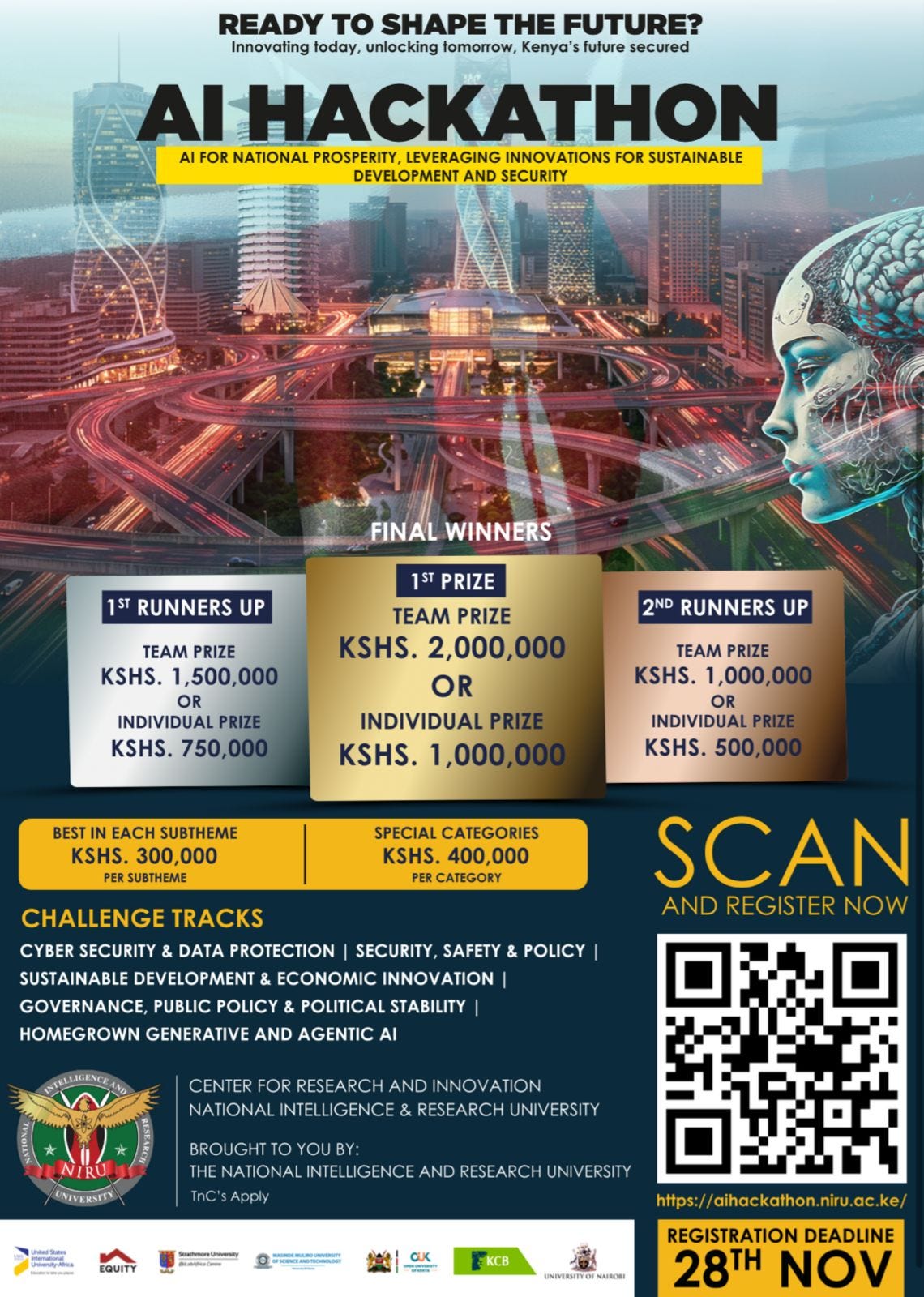
The National Intelligence and Research University, established as a component college of the National Defence University-Kenya, launched the AI Hackathon in October 2025 under the theme “AI for National Prosperity: Leveraging Innovation for Sustainable Development and Security.” This flagship initiative positions Kenya’s intelligence community within the broader global trend of intelligence services integrating artificial intelligence capabilities for enhanced analytical capacity, predictive intelligence, and operational efficiency.
Scale and Participation Metrics
The hackathon attracted 5,656 registrations and 2,467 proposals, representing unprecedented national mobilisation around AI-driven security solutions. This response exceeds participation rates in comparable regional initiatives, signalling Kenya’s rapidly maturing innovation ecosystem and public appetite for technology-led problem-solving.
Participation demographics demonstrated national inclusivity:
Cross-county representation from all 47 Kenyan counties
Age diversity spanning secondary school students to senior professionals
Institutional variety including universities, private sector firms, and independent innovators
Professional backgrounds encompassing computer science, engineering, security studies, and domain experts
Technical Challenge Domains
The technical evaluation team categorised submissions across five priority intelligence and security domains:
Security and Policing (215 proposals): Solutions addressing predictive crime analytics, threat pattern recognition, border security automation, counter-terrorism intelligence, and law enforcement decision-support systems
Cybersecurity (191 proposals): Proposals developing AI-powered threat detection, automated incident response, digital forensics enhancement, critical infrastructure protection, and cyber threat intelligence platforms
Governance and Policy (163 proposals): Applications for AI-driven public administration, regulatory compliance automation, policy impact simulation, and governance transparency mechanisms
Sustainable Development (189 proposals): Security-adjacent solutions tackling food security through precision agriculture, healthcare delivery optimisation, education access, and climate adaptation with security implications
Generative and Agentic AI (184 proposals): Homegrown large language models, context-aware reasoning systems, and autonomous agents tailored to Kenyan security contexts, languages, and operational requirements
Mentorship and Capability Development
From 2,467 submissions, 185 teams entered mentorship in Nairobi, receiving:
Technical guidance from AI researchers and industry practitioners
Policy insights from senior government officials including Prof. Shaukat Abdulrazak (Principal Secretary for Science, Research, and Innovation)
Industry partnership support from Microsoft, Google, and domestic technology firms
Minimum viable product development frameworks
Ethical AI and governance training emphasising responsible deployment
Strategic Alignment with National AI Policy
NIRU’s initiative operates within Kenya’s National AI Strategy 2025-2030, launched in March 2025 by the Ministry of Information, Communications and Digital Economy. The strategy positions Kenya as Africa’s leading AI hub through three foundational pillars:
AI Digital Infrastructure: Modernised national digital infrastructure, accessible computing resources, and data centre capacity
Data Ecosystem: Robust, sustainable data infrastructure supporting AI training and deployment
Research and Innovation: Indigenous AI model development, cutting-edge solutions, and thriving R&D ecosystems
The hackathon’s prize pool exceeding KSh 10 million (KSh 2 million for winning teams, KSh 1 million for top individuals) represents significant government commitment. More importantly, NIRU pledged incubation, mentorship, and deployment pathways, embedding the initiative within Kenya’s broader AI talent pipeline rather than treating it as isolated competition.
⚠️ What Catastrophic Failures Define Tanzania’s TISS in 2025?
Whilst Kenya’s intelligence apparatus advances strategic modernisation, Tanzania’s Intelligence and Security Service faces comprehensive institutional collapse following documented orchestration of the October 2025 election massacres. The agency stands accused of coordinating systematic state violence claiming approximately 10,000 lives according to intelligence networks and medical documentation, representing the gravest humanitarian catastrophe in Tanzania’s post-independence history.
