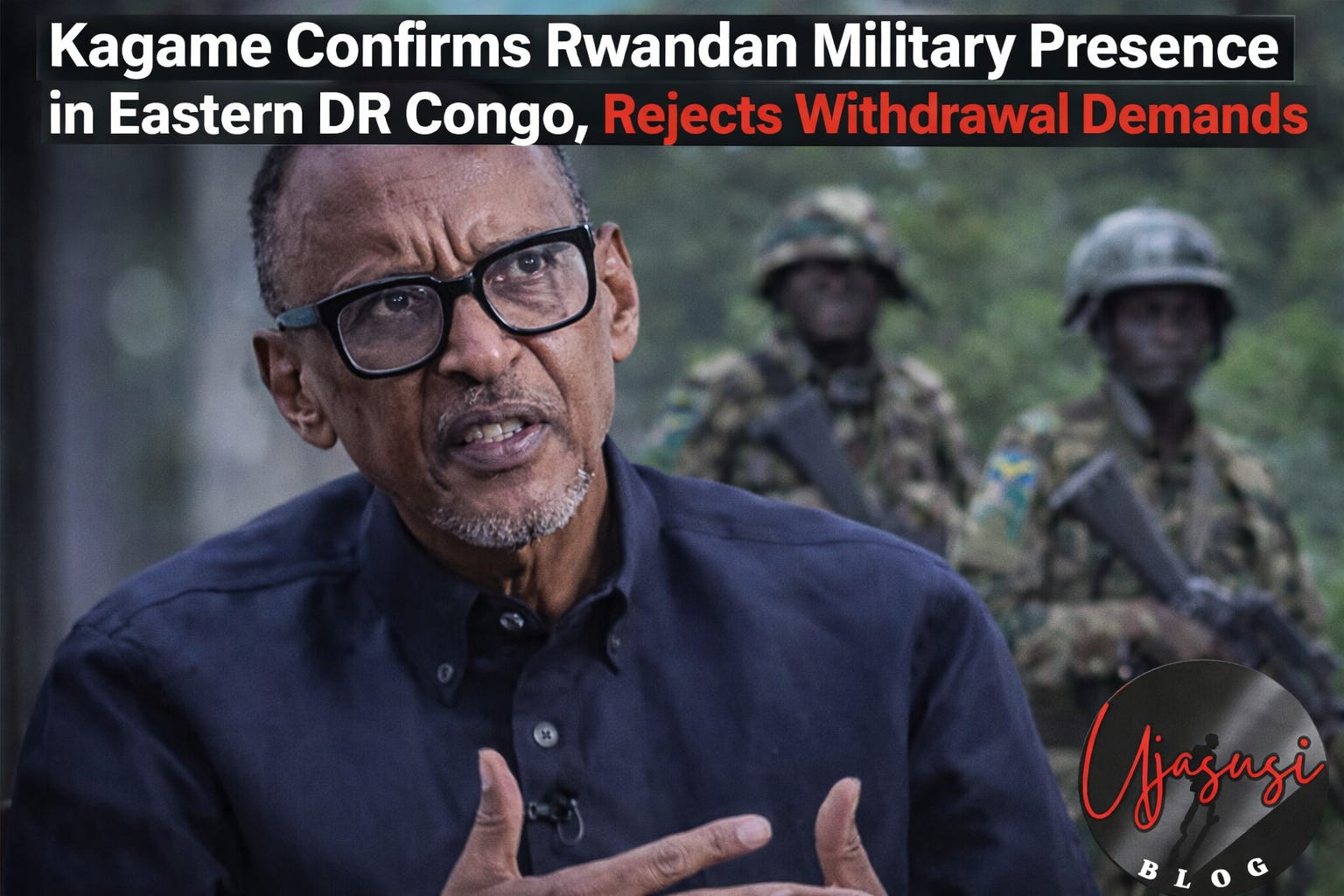
Paul Kagame Confirms Rwandan Military Presence in Eastern DR Congo, Rejects Withdrawal Demands
Ujasusi Blog’s Great Lakes Monitoring Team | 04 April 2026 | 0400 BST
Rwandan President Paul Kagame has publicly confirmed that Rwanda’s military operations in eastern Democratic Republic of Congo include troop deployments beyond Rwandan territory and has declared that those forces will not be withdrawn until Kinshasa neutralises the Democratic Forces for the Liberation of Rwanda (FDLR). Speaking to Jeune Afrique at Urugwiro Village on 26 March 2026, Kagame described these operations as a “defensive measure” — a framing that resolves months of official ambiguity while doing nothing to alter the military reality. The confirmation places Rwanda in open breach of the Washington Accord it signed on 4 December 2025.
The Washington Accord and Rwanda’s Broken 90-Day Deadline
The 4 December 2025 agreement, signed at the White House with US Secretary of State Marco Rubio presiding, required Rwanda to withdraw its forces from eastern DRC within 90 days and obligated Kinshasa to sever ties with the FDLR. The deal followed three days of Washington talks in June 2025 between Congolese and Rwandan delegations — talks that did not include the M23/Alliance Fleuve Congo movement itself.
The accord was never implemented. By September 2025, UN monitoring confirmed that Rwandan troops had not withdrawn. M23/AFC captured Uvira on 10 December 2025 — six days after the White House signing — prompting the United States to impose sanctions on the Rwanda Defence Force (RDF) and four of its generals on 2 March 2026. US Senior Adviser for Africa Massad Boulos told the UN Security Council that month that Rwanda’s continued presence “constitutes a direct violation of its obligations.”
Diplomatic Milestone Date Outcome Washington preliminary talks June 2025 Peace framework agreed Washington Accord signed 4 December 2025 90-day RDF withdrawal deadline set M23/AFC captures Uvira 10 December 2025 Deal immediately undermined US sanctions on RDF 2 March 2026 Four generals designated Kagame Jeune Afrique interview 26 March 2026 Withdrawal refused; presence confirmed
What Kagame Actually Said in the Jeune Afrique Interview
Asked whether Rwanda’s ambassador’s January 2026 statement — that Kigali was “engaged in security coordination with AFC/M23” — constituted an acknowledgement that Rwandan troops were operating inside DRC, Kagame replied: “Yes, that makes sense.” He elaborated: “What do we mean by defensive measures? It means defending our territory and our borders against what threatens us, which may involve several possibilities, such as the use of our military equipment, the deployment of troops on the ground, or other things.”
He continued: “If I am defending my border and, to do so, I must deal with the threat 5, 10, or 20 kilometres beyond it, that remains a defensive measure.”
His subsequent statement left no room for diplomatic interpretation: “Do not expect me to lift our defensive measures while you do nothing to put an end to what threatens my country.”
This is a material departure from the position Kagame held in February 2025, when he told CNN he did not know whether Rwandan troops were in the DRC, despite holding constitutional command authority over the RDF as commander-in-chief.
Rwanda’s Security Calculus: The FDLR Justification
Kagame’s stated casus belli remains the FDLR, the armed group formed from remnants of those who carried out the 1994 genocide against the Tutsi, in which approximately 800,000 people were killed. Kigali regards the FDLR’s continued presence in eastern DRC — operating in areas under FARDC jurisdiction — as an existential threat rather than a residual insurgency.
In the Jeune Afrique interview, Kagame dismissed Kinshasa’s stated commitments to neutralise the FDLR as “declarations made for public relations purposes.” He argued that in territories controlled by M23/AFC — including Goma, seized in January 2025, and Bukavu, seized in February 2025 — the FDLR had been suppressed, while in FARDC-controlled areas including Masisi and Walikale they operated “in complicity with the government.”
He also rejected numerical estimates of FDLR strength as analytically irrelevant: “It does not matter. They may be a few hundred or a few thousand. What matters is what they represent, their ideology, and the fact that they benefit from the support of the government of DRC.”
Rwanda’s Defiance of US Pressure and the Limits of Sanctions
Kagame’s posture toward Washington in the interview was confrontational. He described US sanctions as “nothing more than insults thrown in my country’s face” and accused the Trump administration of applying “heavy pressure” to Rwanda while treating the DRC “gently” — a pointed allusion, widely read in Kigali diplomatic circles, to American commercial interests in Congolese mineral supply chains.
He also drew a comparison with Uganda, which has been fighting the Allied Democratic Forces (ADF) inside Congolese territory for years with Tshisekedi’s consent. Kagame asked why that precedent attracted no equivalent sanction pressure. The argument is self-serving but not analytically incoherent — and it is precisely the kind of framing that complicates any Western effort to build a unified diplomatic response.
Strategic Assessment: A Deliberate Escalation of Candour
Kagame’s decision to confirm the RDF’s operational presence in a major Francophone publication was not an accidental disclosure. His February 2025 claim of ignorance about his own forces was already implausible; the March 2026 Jeune Afrique interview represents a calculated shift — from deniability to declared conditionality. By reframing the RDF presence as a “defensive measure” tied explicitly to FDLR neutralisation, Kagame has constructed a compliance threshold that Kinshasa, given its own institutional constraints and internal political dynamics, is structurally unlikely to meet on any timeline Kigali would accept.
The Washington Accord’s 90-day withdrawal clause is now functionally void. What remains is a conflict whose diplomatic architecture was signed but never operationalised, a rebel movement that controls two provincial capitals and rejects the accord’s terms, and a Rwandan government that has publicly redefined treaty non-compliance as legitimate self-defence. For analysts tracking Great Lakes security, the interview marks not a new phase of the conflict, but the open acknowledgement of a phase that has been underway since at least January 2025.
Independent intelligence analysis takes time and resources — if this work matters to you, please consider supporting it by donating HERE