
Profile of a Spymaster: José Condungua Pacheco, Director-General of Mozambique's Intelligence Service SISE

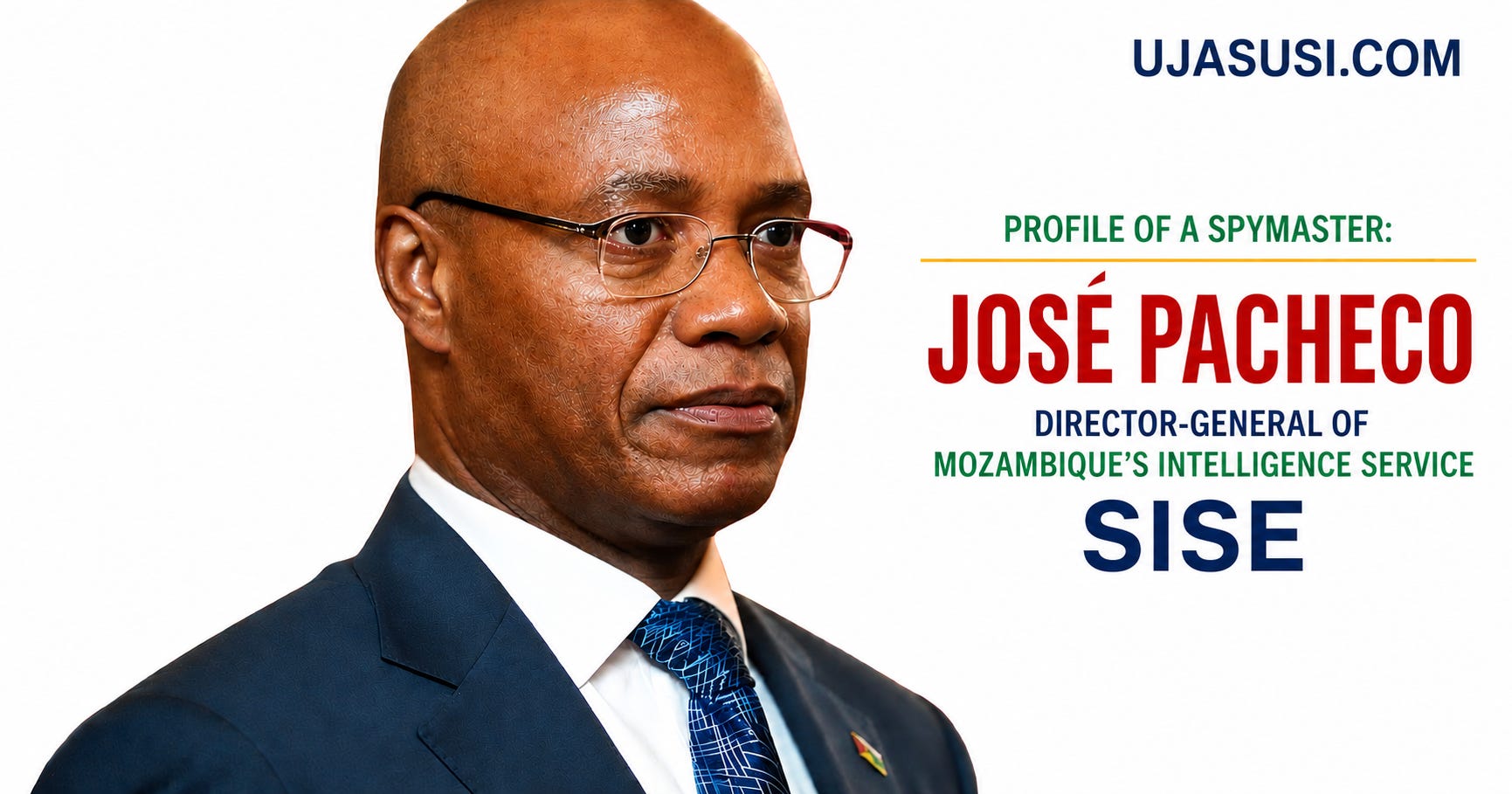
Profile of a Spymaster | Ujasusi Originals
President Daniel Chapo appointed José Pacheco as Director-General of the State Intelligence and Security Service in June 2025, seven months after the previous intelligence chief died in a car accident. The appointment completed Chapo’s comprehensive restructuring of Mozambique’s Defence and Security Forces — a strategic reset that had already produced new commanders at both the police and the armed forces. Pacheco’s elevation to the apex of the country’s intelligence architecture was not the product of an intelligence career. It was a political calculation rooted in institutional loyalty, regime survival, and a specific operational requirement: Cabo Delgado.
Pacheco’s Career Spans Territorial Administration, Internal Security, and Foreign Affairs
Pacheco is a certified engineer who attended Wye College at the University of London and the universities of Minnesota and Wisconsin-Madison in the United States. His academic formation is technocratic, not military — a profile that initially appears incongruent with the directorship of a state security service. The incongruence dissolves when one maps his trajectory through the Frelimo apparatus.
He served as Minister of Foreign Affairs from 2017 to 2020, Minister of Agriculture and Food Security from 2015 to 2017, Minister of Agriculture from 2010 to 2014, and Minister of the Interior from 2005 to 2010. Prior to the ministerial track, he served as Governor of Cabo Delgado from 1998 to 2005 and as Vice Minister of Agriculture from 1995 to 1998. The breadth of that portfolio — territorial administration, internal security, agriculture, foreign policy — is less a record of policy specialism than an index of Frelimo’s preference for generalist loyalists who can be deployed wherever the system requires reinforcement.
He is trusted and powerful within Frelimo. He is from Sofala and thus is not part of any of the main regional factions — a geographic neutrality that makes him a manageable appointment in a party whose internal dynamics are shaped heavily by regional and ethnic patronage networks.
Pacheco Governed Cabo Delgado During a Period of Documented State Violence
The Cabo Delgado governorship from 1998 to 2005 is the most contested chapter of Pacheco’s record. During his tenure, approximately one hundred Renamo members and sympathisers were killed by asphyxiation inside the cells of the Montepuez district prison. The Montepuez massacre remains one of the most serious documented incidents of state violence in post-independence Mozambique. Pacheco has never been formally charged in connection with the killings, and no Mozambican government has pursued accountability for the incident. His appointment to lead SISE without any reckoning with that period tells its own story about the limits of institutional reform under Chapo.
SISE Enters the Pacheco Era Weakened by Scandal and Leadership Instability
The service Pacheco inherited is structurally compromised. Director-General Gregório Leão and Economic Intelligence head António Carlos do Rosário were sentenced to 12 years in prison for their roles in the hidden debt scandal, released on parole in June 2025. The previous Director-General was killed in a car crash in remote Mapai, Gaza province, in November 2024, in circumstances that remain officially unexplained.
The hidden debt scandal was not a peripheral embarrassment. SISE dominated the shareholding structure of Proindicus, Ematum, and MAM — the three fraudulent companies at the heart of the scheme — and used the cover of national security to conceal the personal enrichment of senior figures. The contamination ran deep: during trial proceedings, the former head of economic intelligence stated that SISE used methods “not in the law, although not necessarily illegal,” and claimed the service routinely operated through commercial front companies — sometimes without the owners’ knowledge. That operational culture — opaque, commercially entangled, and judicially evasive — is the institutional inheritance Pacheco must now either dismantle or perpetuate.
Chapo Has Tasked Pacheco Directly with Resolving the Cabo Delgado Insurgency
The primary operational mandate is unambiguous. Chapo instructed Pacheco to identify with concrete evidence the masterminds, leaders, sources of funding, leadership structures, motivations, operatives, and internal and external connections of the Cabo Delgado insurgency. That is an intelligence collection and assessment brief of considerable scope — one that presupposes SISE has the human intelligence penetration, technical collection capability, and analytical capacity to produce such a product. Given the service’s decade of institutional decay, that presupposition is contestable.
Pacheco retains contact across Cabo Delgado’s political and economic landscape — from the oligarchs who control resource wealth to figures closer to the insurgency itself. Analysts assessing the conflict note that any durable settlement will require concessions on land, employment, and revenue distribution, not merely military containment. Pacheco’s value to Chapo may therefore lie less in intelligence tradecraft than in network capital — his capacity to function as a back-channel broker in a conflict that has resisted purely military resolution since 2017.
Pacheco’s Foreign Ministry Tenure Produced a Strategic China Orientation
One dimension of Pacheco’s record that warrants analytical attention is his role in reorienting Mozambique’s external relationships during the hidden debt crisis. His appointment as Foreign Minister in December 2017 was read in some quarters as signalling Nyusi’s intent to strengthen ties with Beijing, given the networks Pacheco had developed with Chinese officials and business figures — primarily through his agriculture and provincial governance roles, though the precise depth of those connections has not been independently corroborated. The appointment came at a moment when Western donors had suspended support following disclosure of the hidden debts. That history carries forward into the SISE role: a Director-General with established Beijing-facing relationships brings a specific set of foreign liaison orientations — ones that will shape, and potentially constrain, intelligence sharing with Western partner services on counterterrorism.
Pacheco Faces a Dual Mandate: Operational Delivery and Institutional Reconstruction
Chapo prioritised trust and reliability over operational flair and intelligence experience in selecting Pacheco. That framing is analytically significant. It confirms that SISE’s primary function in the Chapo architecture is political rather than professionally autonomous — an instrument of regime security managed by a figure whose loyalty is beyond question, rather than a service governed by independent tradecraft standards.
Pacheco has been discreetly reorienting SISE towards combating organised crime — a mandate that overlaps substantially with the Cabo Delgado brief, given the documented intersection of the insurgency with transnational narcotics trafficking and illicit resource-extraction networks operating along the northern Mozambican coastline.
Pacheco’s SISE Tenure Represents a High-Stakes Test for Mozambican State Capacity
The structural challenge confronting Pacheco is not reducible to personnel or policy. He leads a service whose senior leadership was imprisoned for using intelligence cover to execute state-level financial fraud; whose subsequent Director-General died in circumstances never officially explained; and which must now produce actionable intelligence on one of sub-Saharan Africa’s most complex active insurgencies — while simultaneously rebuilding the institutional confidence of partner services that have every reason to distrust it.
Upon his appointment, Pacheco left the Frelimo Central Committee after more than two decades of membership. The formal separation from the party’s highest deliberative body is procedurally conventional for a security chief. Whether it signals genuine insulation from party politics — or merely a cosmetic appearance — will become clear in how Pacheco handles the intelligence dimensions of Mozambique’s post-electoral crisis, the Cabo Delgado file, and the residual institutional contamination from the hidden-debt era.
He is, by any analytical measure, one of the most consequential intelligence appointments in southern Africa in 2025. The question is whether consequence translates into competence.