

Ujasusi Terrorism Monitor Desk | 05 June 2026 | 1800 BST
Identity and Personal Background
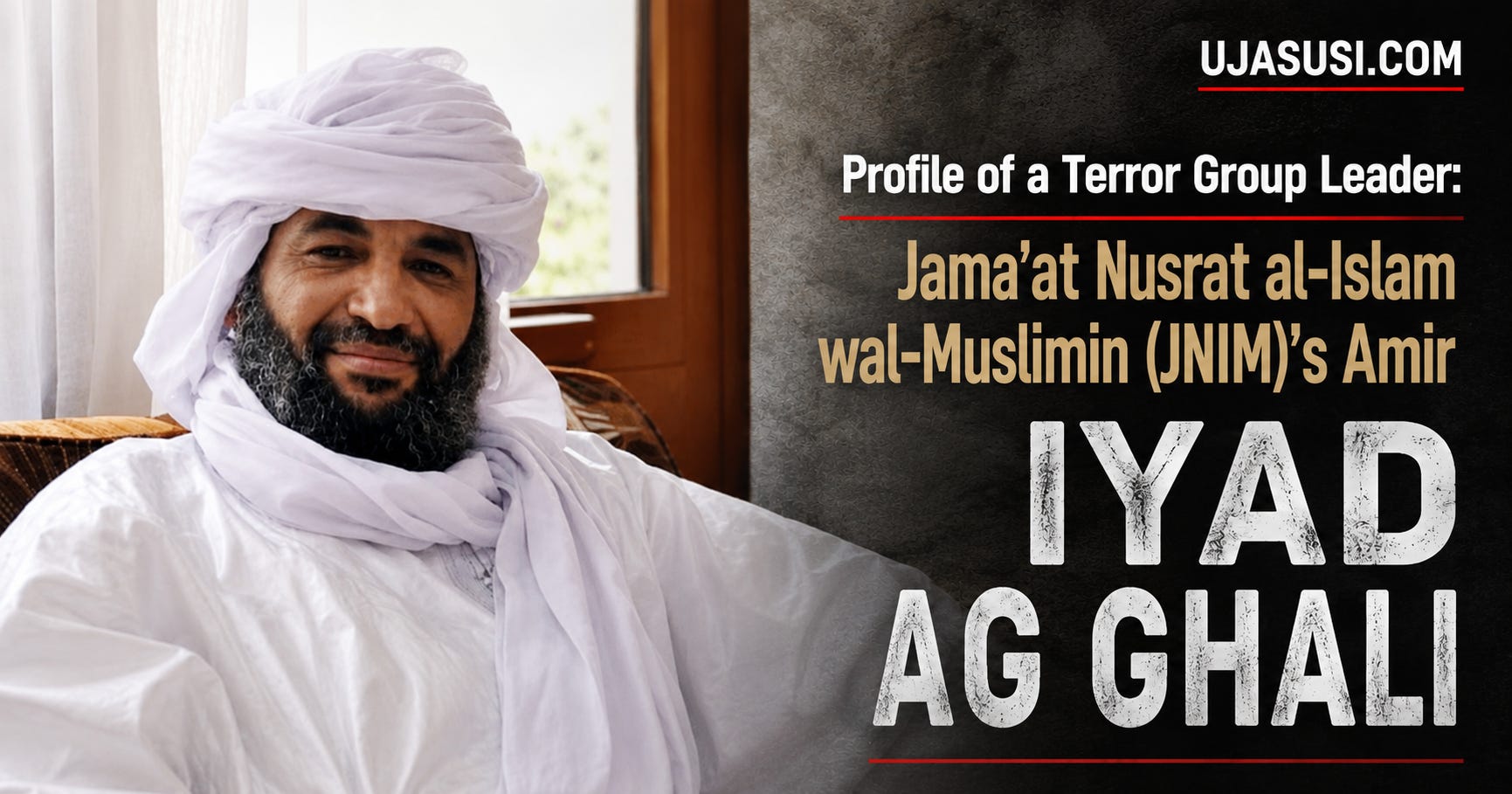
Iyad Ag Ghali is the founding amir of Jama’at Nusrat al-Islam wal-Muslimin (JNIM), al-Qaeda’s primary Sahel affiliate and the most consequential jihadist organisation operating in sub-Saharan Africa. Also known by the nom de guerre Abu al-Fadl, he is a Malian Tuareg from the Ifoghas tribal elite of the Kidal region, born in Abeïbara. His birth year is contested: most Western intelligence databases and sanctions registries record 1954 as his birth year, while Ag Ghali himself stated in a 2017 al-Qaeda interview that he was born in 1958. The discrepancy remains unresolved across primary sources.
His Ifoghas lineage is not merely biographical. The Ifoghas confederation constitutes a dominant noble clan within northern Malian Tuareg society, historically controlling prestige, land, and inter-community arbitration in Kidal and its hinterland. This tribal standing functions as Ag Ghali’s primary protective architecture: in the eyes of many northern communities, he remains an Ifoghas notable before he is a jihadist amir, a layering of identity that cash bounties and arrest warrants cannot simply dissolve. Before his radicalisation, he was a founding member and lyricist associated with the Tuareg musical collective Tinariwen, a former diplomat, and a rebel commander trusted by both Bamako and Western governments for hostage negotiations.
Career Chronology
Ag Ghali received military training in Libya from 1978 to 1990 within Gaddafi’s Pan-Africanist Islamic Corps structures, and fought in Lebanon against Israel from 1981 to 1983. He founded the Popular Movement for the Liberation of Azawad (MPLA) in 1988 and directed MPLA attacks on Tidermène and Ménaka in June 1990 that initiated the renewed Tuareg rebellion. Following the Tamanrasset Accords, by 1991 he led the reconstituted Popular Movement of Azawad as secretary-general, the primary formation under his direct command through the 1996 ceasefire.
His radicalisation followed two distinct phases. The first came in 1999, when Tablighi Jama’at missionaries active in the Sahel drew him toward strict Salafi practice; he travelled to the movement’s Pakistan headquarters, though his neighbours in Kidal treated this as a personal eccentricity. The operational turn came through his role as a GSPC hostage negotiator from 2003 onward, which embedded him structurally within Algeria’s Salafist networks that later became AQIM. Each negotiation deepened his jihadist relationships while his diplomatic cover remained intact.
The decisive radicalisation node was his Saudi diplomatic posting, where he served as Mali’s consul general from 2008. Riyadh expelled him by 2010 for contacts with extremists in the kingdom. Returning to Mali without a political role, and excluded from the leadership of the secular National Movement for the Liberation of Azawad, he founded Ansar Dine in late 2011 as an explicitly Islamist vehicle. By 2012, Ansar Dine and AQIM jointly controlled Timbuktu; the ICC subsequently documented his forces’ conduct during this period as constituting war crimes and crimes against humanity.
In March 2017, Ag Ghali unified Ansar Dine, the Katiba al-Furqan, the Katiba Macina, and al-Mourabitoun into JNIM, pledging allegiance to al-Qaeda and assuming the position of amir. The merger eliminated inter-group competition, created a federated structure delegating operational authority to ethnic-specific katibas, and positioned JNIM to exploit the security vacuum left by the gradual French and UN disengagement from Mali.
Organisational Position and Command Structure
Ag Ghali’s authority within JNIM is best understood as arbitration rather than direct command. Having gone permanently underground since at least 2017, he operates through a majlis al-shura whose full composition remains opaque. His strategic value to the coalition is not battlefield tactics but institutional legitimacy: his Ifoghas lineage, al-Qaeda affiliation, and four decades of operational experience hold together an otherwise decentralised alliance of Tuareg, Fulani, and Arab militias.
His principal deputies are as follows. Amadou Koufa commands Katiba Macina and controls the Fulani mobilisation networks across central Mali; his ability to recruit from communities marginalised by state violence makes him operationally indispensable to JNIM’s expansion into Mali’s agricultural heartland. Sedane Ag Hita, operating under the kunya Abou Abdelhakim al-Kidali, has served as JNIM’s second-in-command since March 2019, succeeding Djamel Okacha who was killed by French forces in February 2019; however, on 27 May 2026 Russia’s Africa Corps struck a JNIM position near Diabaly in the Ségou region where Ag Hita was present, and as of the date of this profile his death has not been officially confirmed or definitively denied. The succession position within JNIM’s command structure is therefore currently uncertain.
JNIM’s estimated fighter strength has grown from 2,000 to 3,000 in 2022, to 5,000 to 6,000 in 2024, to approximately 10,000 in 2026. This trajectory represents a fivefold expansion in four years, without parallel among al-Qaeda affiliates globally.
Doctrine, Tactics and Financing
JNIM under Ag Ghali’s guidance applies a dual-track doctrine: armed violence against state and foreign military actors, combined with governance provision for civilian populations. Ag Ghali has stated publicly that JNIM signs local agreements and distributes material resources to communities, out-competing weak state justice systems with sharia courts and dispute resolution mechanisms. In areas of territorial control, this creates embedded legitimacy that military operations cannot reverse without addressing the underlying governance vacuum.
Tactically, JNIM employs complex multi-site ambushes, suicide vehicle-borne IEDs, targeted assassinations, and sustained convoy interdiction. The organisation uses Starlink satellite communications for command coordination, having found commercial satellite internet more reliable and affordable than older satellite phone infrastructure.
Financially, the UN assesses JNIM as the wealthiest al-Qaeda affiliate after al-Shabaab. Revenue streams are locally diversified: taxation of artisanal gold mining sites and transit routes, roadside tolls, kidnap-for-ransom, cattle rustling, and coercive zakat collection calibrated by region. In Burkina Faso and Niger, zakat is framed as voluntary with redistribution to communities; in parts of Mali it is openly coercive. This calibrated approach reflects a sophisticated understanding of legitimacy economics.
Geographic Expansion
From its northern Malian base, JNIM has extended operational reach across Burkina Faso and Niger, with violence in coastal borderlands increasing 86 per cent between 2024 and 2025 and related fatalities surging over 260 per cent. In November 2025, JNIM claimed its first attack in Nigeria, near the border with Benin, introducing a third al-Qaeda-linked actor into a theatre already contested by Boko Haram and ISWAP.
Legal and Sanctions Status
The ICC arrest warrant for Ag Ghali was issued under seal on 18 July 2017 and unsealed on 21 June 2024; the suspect remains at large. The warrant covers war crimes and crimes against humanity committed in northern Mali between January 2012 and January 2013, including murder of soldiers hors de combat at Aguelhoc, rape, sexual slavery, torture, attacks on protected religious and historic buildings, and gender-based persecution. The seven-year sealing period reflected an ICC judgment that disclosure would not assist apprehension; the 2024 unsealing followed the collapse of the French targeting architecture that had previously provided the primary intelligence framework for that calculation.
The US State Department designated Ag Ghali a Specially Designated Global Terrorist on 26 February 2013; the UN Security Council listed him the day prior, triggering asset freezes, travel bans, and arms embargoes under member-state obligations.
The 5 June 2026 Bounty — Analytical Assessment
On 5 June 2026, Mali’s military-run security ministry announced a 2 billion CFA franc bounty (approximately €3 million / $3.5 million) for information leading to Ag Ghali’s “capture or neutralisation,” alongside 1.5 billion CFA francs for Amadou Koufa and separate rewards for Tuareg rebel leaders including Alghabass Ag Intalla. The announcement followed the 25 April 2026 offensive, the largest JNIM operation since the 2012 rebellion, which struck Bamako, Kati, Kidal, Gao, Sévaré and Mopti simultaneously. Defence Minister Sadio Camara was killed by a suicide VBIED at his Kati residence; intelligence chief Modibo Koné was wounded; and Malian and Russian Africa Corps forces subsequently withdrew from Kidal, Aguelhok, Tessalit, Tessit, and Ber.
The bounty announcement carries several analytical inferences. It is first an admission of operational failure: with Russian Africa Corps intelligence support and nearly a decade of accumulated targeting data, the junta has failed to fix Ag Ghali’s location through conventional means. A broadcast cash reward signals precisely this. It is simultaneously a domestic political product designed to project resolve following Camara’s killing, which stripped the junta of its most prominent figure and the principal architect of the Mali-Russia security relationship.
The inclusion of Alghabass Ag Intalla on the list is the analytically significant element. Alghabass is the son of the late amenokal Intalla Ag Attaher and brother of the current Ifoghas amenokal Mohamed Ag Intalla, who succeeded their father in December 2014. A former National Assembly deputy and prominent figure within the Coordination of Azawad Movements, Alghabass occupies the upper register of the same tribal social architecture that insulates Ag Ghali. By placing a bounty on him alongside Ag Ghali, the junta is explicitly targeting the political-tribal canopy that protects JNIM’s leadership — a more sophisticated targeting logic than the headline sum implies, though whether it will prove effective is a different question.
The financial differential between the two primary bounties carries its own intelligence value. Pricing Koufa at 75 per cent of Ag Ghali’s figure reflects a junta assessment that Koufa’s Fulani mobilisation networks are nearly as indispensable to JNIM as Ag Ghali himself. Should Ag Ghali be neutralised without simultaneous degradation of Koufa’s Katiba Macina infrastructure, JNIM would lose its Tuareg legitimising figurehead but retain substantial operational capacity across Mali’s agricultural centre.
Threat Assessment and Forward Indicators
Ag Ghali represents a strategic, not merely operational, threat to the Goïta junta. The April 2026 offensive demonstrated that JNIM can penetrate the most secure garrison in Mali, kill a sitting minister, and compel territorial concessions from Russian-backed forces in a single coordinated operation. His organisational resilience derives from his tribal protection network, JNIM’s decentralised command architecture, and a war economy that functions independently of any state banking or supply system.
Critically, Ag Ghali’s removal would not decapitate JNIM. The majlis al-shura and the federated katiba structure mean the organisation would survive, though a leadership contest and potential Tuareg-Fulani friction would follow. The probable incapacitation of Sedane Ag Hita in the 27 May Africa Corps strike, if confirmed, further complicates the succession picture and may accelerate internal competition for the number-two position before any transition at the top is even triggered. This makes the current command layer the most fluid it has been since JNIM’s formation in 2017.
Forward indicators to monitor: official confirmation or denial of Sedane Ag Hita’s death and any announced succession; whether the Ag Intalla bounty produces informant activity or deepens Ifoghas estrangement from Bamako; whether Ag Ghali issues a public statement through al-Qaeda media channels in response to the bounty; and whether President Goïta’s self-assumption of the defence portfolio represents command consolidation or dangerous over-centralisation. The strategic trajectory points toward continued JNIM expansion unless a political process engages the governance vacuum that Ag Ghali’s organisation has spent a decade filling. A €3 million bounty is not that process.