

Ujasusi Blog’s Digital Intelligence Desk | 12 March 2026 | 0005 GMT
Israel’s surveillance dominance in Africa refers to Tel Aviv’s export of sophisticated cyber-espionage and digital forensics tools — including Pegasus, Circles, Predator and Cellebrite — to African governments seeking to monitor dissidents, intercept communications and suppress political opposition. Several African states are confirmed operators; Tanzania’s involvement centres on confirmed Cellebrite purchases and credible, if unverified, allegations of Pegasus deployment under former President John Magufuli.
📡 What does Israel’s surveillance footprint in Africa entail?
Israel has built a formidable cyber-security export industry, with firms such as NSO Group, Circles, Intellexa and Cellebrite selling covert surveillance software and hardware to governments across the globe. In Africa, the consequences for civil liberties and political opposition have been severe.
Pegasus (NSO Group) can turn any mobile phone into a remote listening device, harvesting data and activating the microphone without user interaction. It exploits zero-day vulnerabilities, meaning the target need not click anything for infection to occur.
Circles — an NSO Group subsidiary — exploits weaknesses in the SS7 signalling protocol to intercept calls and SMS messages and locate phones in real time across global cellular networks, without requiring physical access to the device.
Predator (Intellexa, founded by former Israeli officer Tal Dilian) is delivered via malicious links and grants full access to a device’s camera, microphone and stored data.
Cellebrite UFED is forensic hardware and software that physically unlocks and extracts all data from seized devices, including deleted files, messages, location history and app data from thousands of phone models.
Citizen Lab’s 2020 investigation identified Circles clients in at least 25 countries, with African operators including Botswana, Equatorial Guinea, Kenya, Morocco, Nigeria, Zambia and Zimbabwe. The Pegasus Project identified five African states — Rwanda, Morocco, Egypt, Zambia and Mozambique — as likely Pegasus operators. Research by the Africa Center for Strategic Studies notes that more than a dozen African governments have deployed surveillance devices without adequate oversight, acquiring technology primarily from private firms in Israel, the UK, Germany and Italy.
Israeli surveillance exports also serve a diplomatic function. Tel Aviv’s Ministry of Defence controls export licences, effectively making spyware a foreign-policy instrument. Analysts at Jewish Voice for Labour argue that Israel leverages Pegasus and Circles sales to African governments to secure supportive votes at the United Nations and African Union, blurring the boundary between private commerce and state policy.
🛰️ How do Israeli surveillance tools work?
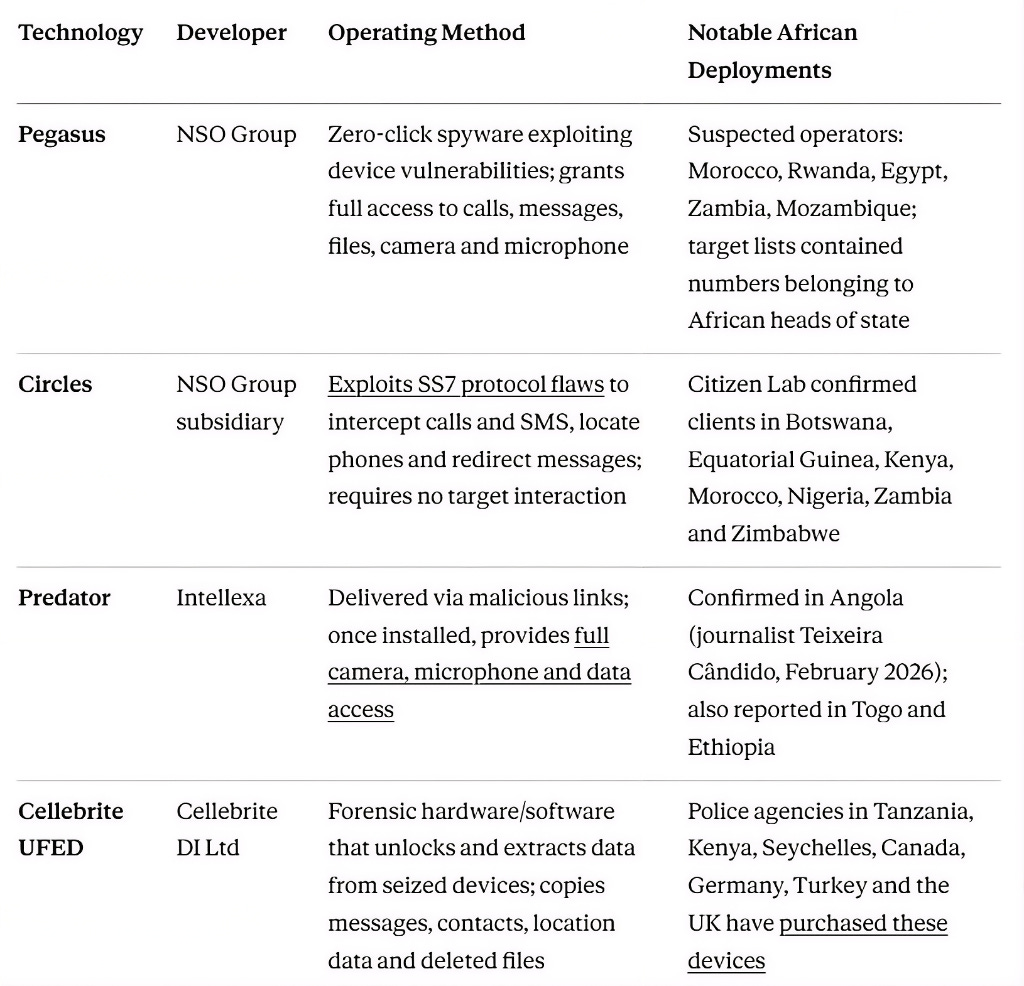
Note: Multiple products may be integrated. Circles merged with NSO Group following a private-equity takeover, creating a vertically integrated surveillance platform spanning both network-level interception and device exploitation.
📈 Which African governments are documented users of Israeli surveillance technology?
The following summarises public evidence of African states acquiring or deploying Israeli surveillance systems. Where possible, the specific technology and documented purpose are identified.
Kenya: Citizen Lab confirmed that the Directorate of Criminal Investigations used Cellebrite to extract data from Boniface Mwangi’s phone whilst he was in custody. Kenya has also been linked to Circles surveillance for intercepting calls and texts. Authorities deployed these tools amid widespread protests and extrajudicial killings, raising significant human rights concerns.
Morocco: A major Pegasus operator; Moroccan intelligence reportedly targeted up to 10,000 numbers. Notably, the number of King Mohammed VI appeared in the leaked Pegasus dataset, though analysts attribute this to suspected foreign targeting rather than domestic Moroccan surveillance. Moroccan agencies also engaged Circles for SS7-based interception.
Rwanda: Rwandan authorities used Pegasus to monitor at least 3,500 activists, journalists and politicians. The tool was also deployed for cross-border espionage against South African President Cyril Ramaphosa and exiled opposition leader Kayumba Nyamwasa.
Nigeria and Zambia: Citizen Lab listed both states as Circles clients. Nigeria’s government spent over US $2.7 billion on surveillance technologies over the last decade. Zambia, despite its democratic-leaning posture, may also operate Pegasus.
Botswana: The Directorate of Intelligence and Security procured both Circles and Cellebrite equipment, enabling SS7 interception and phone data extraction despite weak domestic privacy protections.
Angola: Reuters and Amnesty International documented the infection of journalist Teixeira Cândido‘s phone with Predator spyware, in a report published on 18 February 2026. This represents the first confirmed Predator case in Angola.
Zimbabwe, Equatorial Guinea and Zambia: Listed among SS7-exploitation clients in Citizen Lab’s Circles investigation.
South Sudan, Cameroon, Uganda and others: Investigative reporting and human rights records note Israeli training and surveillance support to these regimes, often explicitly to prop up authoritarian governments.
Tanzania (circumstantial evidence): Tanzania does not appear in confirmed lists of Pegasus or Circles operators. However, police agencies have purchased Cellebrite devices, and there are credible reports of security officials boasting about using Israeli technology during detentions — discussed in full in the case study below.
🕵️ Why do African governments buy Israeli surveillance technology?
Perceived efficiency: Israeli products offer turnkey surveillance capabilities that require minimal domestic technical expertise. Pegasus, in particular, provides a user-friendly platform enabling simultaneous tracking of dissidents and foreign officials.
Cost and legal asymmetry: Developing offensive cyber tools domestically is prohibitively expensive. Many African governments opt for relatively affordable foreign-vendor spyware rather than investing in robust national cybersecurity infrastructure.
Diplomatic exchange: Israel’s Ministry of Defence uses export licences as a diplomatic instrument — rewarding compliant clients and, in principle, withholding licences from states that challenge Israeli interests at multilateral forums. The surveillance-for-votes arrangement has been documented across the AU and UN.
Authoritarian utility: Surveillance tools enable regimes to pre-empt protests, track political opponents and manipulate electoral processes. The Africa Center for Strategic Studies warns that the proliferation of remote-control hacking tools across the continent — predominantly via Israeli firms — is accelerating democratic decline.
🇹🇿 Case Study — Tanzania’s Relationship with Israeli Surveillance
The case of Tanzania illustrates both the subtlety of Israeli surveillance influence and the persistent challenges of forensic attribution in environments with weak press freedom and opaque security services.