

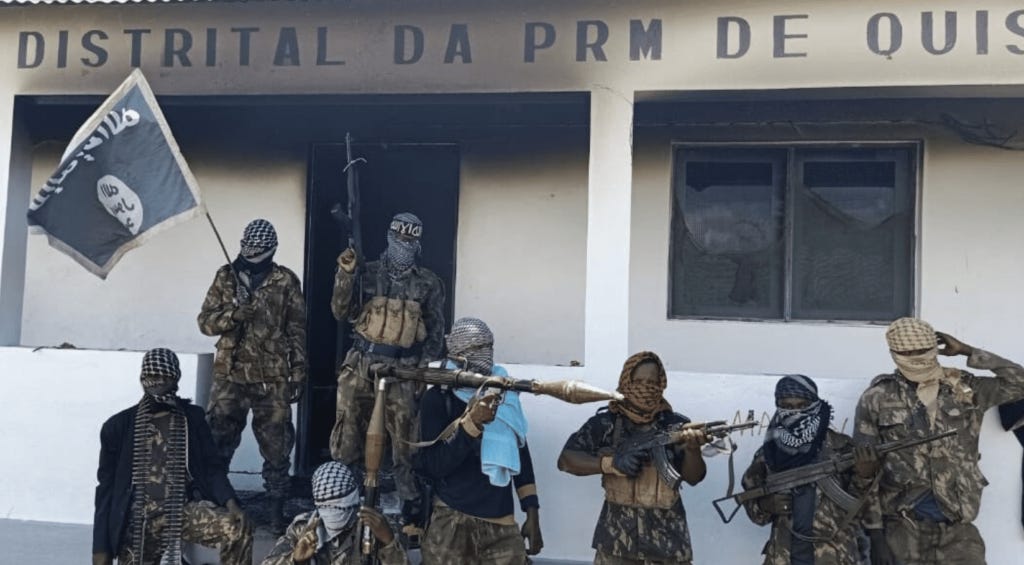
Date of Incident: 17 March 2025 Location: Iba Village, Meluco District, Cabo Delgado Province, Mozambique
Introduction
On 17 March 2025, militants affiliated with Islamic State Mozambique (IS-M), alternatively known as the Shabaab Cult or Wilayat Muzinbik, launched a brazen armed assault on the Christian village of Iba in Meluco District, Cabo Delgado Province, Mozambique. This meticulously orchestrated attack culminated in the killing of one civilian and the deliberate incineration of over 40 homes, sending shockwaves through local communities and drawing global attention to the persistent instability plaguing northern Mozambique.
This act of targeted violence is emblematic of IS-M’s broader insurgency campaign, which seeks to destabilise state authority, enforce ideological conformity, and reshape the demographic landscape through systematic terror against religious minorities.
Context: Insurgency in Northern Mozambique
Since 2017, Cabo Delgado has emerged as the epicentre of a brutal Islamist insurgency led by IS-M, a faction that pledged allegiance to the Islamic State and was later subsumed under the broader Islamic State Central Africa Province (ISCAP). Despite intermittent military offensives by the Mozambican government, with support from regional forces such as the Southern African Development Community Mission in Mozambique (SAMIM) and the Rwandan Defence Forces, the insurgency has proven remarkably resilient.
Meluco District, where Iba village is situated, has historically been a contested zone, strategically valuable due to its proximity to key transit routes and resource-rich areas. The latest attack underscores the region’s vulnerability and the continued inability of Mozambican security forces to assert sustained control over rural areas.
Details of the Attack
The assault on Iba occurred during broad daylight, a significant operational choice that reflects a high degree of confidence among IS-M militants. Reports indicate that the attackers arrived heavily armed, methodically set fire to homes using petrol and accelerants, and executed at least one resident who attempted to resist. The scale of destruction—over 40 homes razed—suggests prior reconnaissance and planning, indicating a premeditated campaign rather than a random act of terror.
Eyewitness accounts from displaced villagers describe scenes of chaos, with flames engulfing dwellings, gunfire echoing through the streets, and families fleeing into the bush with little more than the clothes on their backs. The absence of an immediate military or police response, despite the visibility of the attack, further illustrates the logistical and strategic shortcomings of the Mozambican security apparatus.
Strategic and Ideological Significance
This attack is not simply an act of violence; it forms part of IS-M's deliberate strategy of religious and cultural cleansing. By specifically targeting a Christian village, the militants reinforce their ideological agenda—one that seeks the imposition of an ultra-conservative interpretation of Islam and the eradication of religious pluralism in territories under their influence.
The destruction of homes is particularly symbolic. In many African cultures, the home is more than a shelter; it is the centre of familial life, heritage, and identity. By razing these structures, IS-M aims not only to displace individuals but to erase collective memory and community cohesion. The result is a form of demographic engineering designed to create homogeneous zones conducive to jihadist governance.
Moreover, such attacks are calculated to coincide with religious observances and seasonal vulnerabilities. With the Muslim festival of Eid expected around 30 or 31 March 2025, there is an elevated risk of further violence either as a demonstration of ideological fervour or as a strategic distraction.
Operational Implications and Security Gaps
The daylight nature of the attack suggests a troubling trend: IS-M feels secure enough to operate openly without fear of immediate retaliation. This signals a breakdown in intelligence gathering, patrol logistics, and rapid-response capabilities within the Mozambican security forces.
Despite regional and international support, including tactical assistance from private military contractors and intelligence-sharing arrangements with global partners, Mozambique's counterinsurgency efforts remain hampered by corruption, poor coordination, inadequate training, and insufficient equipment.
Furthermore, IS-M has proven adept at exploiting local grievances, particularly around resource marginalisation, youth unemployment, and inter-communal tensions. These socio-economic vulnerabilities create fertile ground for recruitment and local complicity, further complicating efforts to stem the insurgency.
Regional and International Ramifications
This attack has broader implications beyond Mozambique’s borders. It reaffirms the growing threat posed by IS-affiliated groups across Sub-Saharan Africa, where fragile states, porous borders, and weak governance structures provide ample opportunity for extremist expansion.
In neighbouring Tanzania, Malawi, and even as far afield as the Democratic Republic of Congo, there are rising concerns about ideological spillover and cross-border militancy. The regional security architecture remains reactive rather than preventive, raising questions about long-term strategic vision and sustainability.
Moreover, the targeting of Christian populations mirrors similar patterns observed in Nigeria (by Boko Haram and ISWAP), the Sahel (by JNIM and Islamic State Sahel Province), and the DRC (by ADF/ISCAP). These attacks should not be viewed in isolation but as components of a coordinated strategy by IS to assert global relevance through regional destabilisation.
TRAC Assessment and Forecast
The Terrorism Research & Analysis Consortium (TRAC) assesses that IS-M will likely continue and possibly escalate its attacks in the coming weeks, particularly as it seeks to reinforce internal cohesion, attract new recruits, and assert dominance over contested areas. The attack on Iba is a prototype operation, designed to send a dual message: to local populations, that resistance is futile; to the government, that it is incapable of providing security.
There is also a psychological dimension to these attacks. By choosing symbolic targets and timing operations to coincide with religious events or agricultural cycles, IS-M maximises its disruptive impact. The fear of further attacks during Eid celebrations may compel mass displacements, further undermining the state’s legitimacy and complicating humanitarian responses.
Conclusion
The assault on Iba village is a chilling reminder of the protracted and complex nature of Mozambique’s insurgency. More than a mere tactical operation, it is a manifestation of IS-M’s broader strategic calculus—to erode state authority, polarise communities, and impose an extremist ideological order.
As international attention remains fixated on other global hotspots, the crisis in Cabo Delgado continues to fester. Addressing this challenge requires more than military intervention. It demands a comprehensive, multidimensional approach encompassing governance reform, community engagement, economic development, and regional cooperation.
The people of Cabo Delgado deserve more than fleeting headlines; they require sustained global solidarity and a long-term commitment to peace, security, and justice.
SOURCES: TRAC, OSINT