

Ujasusi Blog’s Global Affairs Desk | 06 March 2026 | 0015 GMT
The Iran conflict launched on 28 February 2026 — Operation Epic Fury — shares structural DNA with Vietnam: an undeclared war, ambiguous objectives, asymmetric adversary doctrine, domestic political fractures, and no defined exit strategy. However, critical distinctions in terrain, duration, and technology make the analogy imperfect but analytically instructive for assessing long-term quagmire risk.
🔍 What Is Operation Epic Fury and How Did It Begin?
On 28 February 2026, the United States and Israel launched coordinated airstrikes against Iran, initiating what the Trump administration named Operation Epic Fury. The strikes followed a 10-day diplomatic deadline issued by President Trump on 20 February, after three rounds of indirect nuclear negotiations in Geneva collapsed without a substantive agreement.
The strategic pretext was composite. Secretary of State Marco Rubio stated that Washington acted preemptively because Israel had been preparing its own military strike, and that US casualties would have been higher had Washington not moved first. Trump himself offered a different justification — that Iran had been preparing to strike first — a contradiction that analysts at the Stimson Centre flagged as evidence the administration had no coherent strategic objective.
On 1 March 2026, Iranian state media confirmed that Supreme Leader Ali Khamenei had been killed in the strikes, triggering 40 days of mourning and a seven-day national holiday. This was a decapitation strike of historic magnitude — the most consequential targeted killing since the 2020 assassination of IRGC Quds Force commander Qasem Soleimani, and one that has fundamentally altered the Islamic Republic’s command architecture.
⚔️ What Are the Structural Parallels with Vietnam?
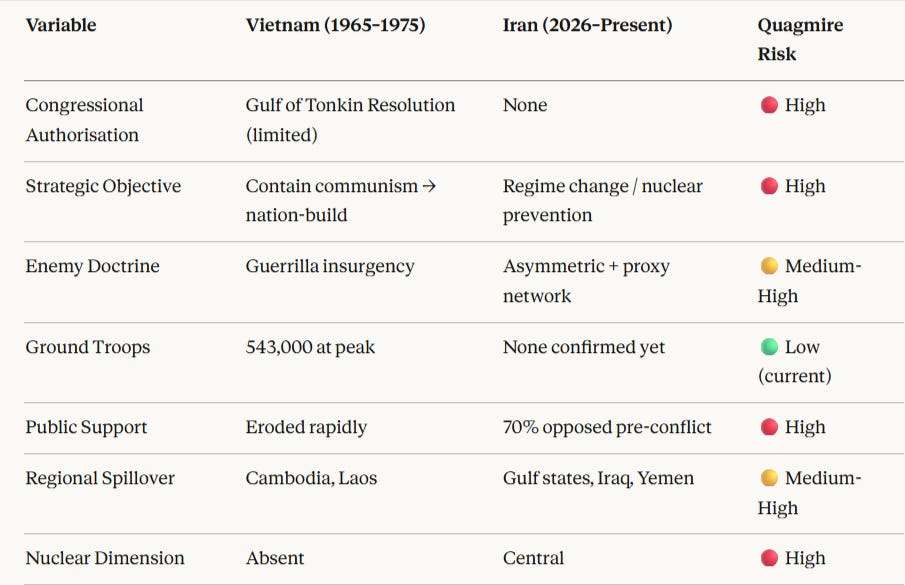
The Vietnam comparison is analytically useful not as a prediction of outcome, but as a diagnostic framework for quagmire risk. The convergences are significant.
Undeclared War, Absent Congressional Mandate
The last time the United States formally declared war was World War II. Conflicts including Vietnam and Iraq were prosecuted without formal declarations, and the Iran campaign follows the same pattern. Unlike Gulf War I — which secured both a UN resolution and Congressional authorisation — or the post-9/11 Authorisations for Use of Military Force that preceded Afghanistan and Iraq, Trump launched strikes without a full Congressional debate or vote, creating both constitutional and political liabilities.
Mission Ambiguity
The administration’s messaging has been incoherent — oscillating between preventing nuclear weapons development, dismantling Iranian proxy networks, and explicit regime change. Trump declared on 28 February that the purpose of the strikes was “effectively regime change,” mirroring the Lyndon Johnson-era strategic drift in South-East Asia where containment morphed into nation-building with no defined endpoint.
Asymmetric Adversary Doctrine
Iran has spent decades building a military designed specifically to survive and impose costs on a technologically superior adversary within its own region. Its doctrine centres on cost imposition rather than conventional battlefield victory. This is the defining characteristic of asymmetric insurgencies — from the Viet Cong’s tunnel networks to the IRGC’s proxy constellation and cyber offensive capabilities.
Domestic Political Fracture
A mid-January 2026 Quinnipiac poll showed that 70 per cent of Americans — including a majority of Republicans — opposed military intervention in Iran. This mirrors the polling trajectory of Vietnam: initial public acquiescence followed by accelerating opposition as casualties mounted and objectives remained undefined.
📊 Iran vs. Vietnam: Comparative Quagmire Risk Matrix
🌐 What Makes Iran Different — and Potentially Worse?
The Proxy Dimension
Iranian missiles and drones have attacked nine countries as of early March 2026, including Gulf bases where US military forces operate, executed through devolved command and control. This distributed retaliation architecture — spanning Iraqi militias, Houthi remnants in Yemen, and Lebanese Hezbollah — means Iran does not need to win conventional battles. It simply needs to raise the cost of sustained engagement beyond what US domestic politics will tolerate.
The Strait of Hormuz Lever
The conflict has effectively halted tanker traffic through the Strait of Hormuz, through which approximately one-fifth of global oil consumption passes daily, causing Brent Crude to surge from around $73 per barrel pre-conflict to above $82 per barrel within days. Vietnam had no comparable economic chokepoint. Iran’s geographic position over critical energy infrastructure gives Tehran a coercive instrument that Ho Chi Minh never possessed — one capable of triggering global recession without firing a single additional missile. As CNBC reported, former White House energy adviser Bob McNally put it plainly: “A prolonged closure of the Strait of Hormuz is a guaranteed global recession.”
Cyber Warfare as Asymmetric Equaliser
The conflict has already triggered a spike in Iranian cyber operations. CISA issued an advisory on 27 February 2026, warning critical infrastructure operators of increased scanning and probing attributed to Iranian state-sponsored actors, particularly targeting energy, water, transportation, and healthcare sectors. Unlike Vietnam, the battlespace extends into the US domestic homeland through cyberspace — a strategic dimension with no Cold War precedent.
📊 Escalation Vectors and Regional Spillover
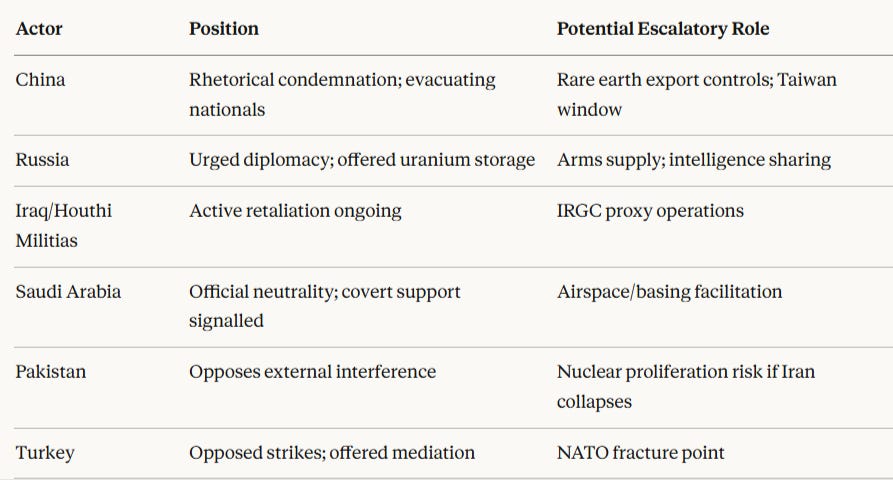
The Iran conflict has diverted US military resources from the Asia-Pacific, unsettling regional allies including Japan, South Korea, and Taiwan. This strategic overextension is precisely the condition Beijing’s long-range planners have anticipated. US expenditure of precision munitions in the opening phases of the campaign is already straining supply chains — creating a vulnerability window China could exploit around Taiwan.
🧠 What Do Intelligence Analysts Assess as the Endgame?
The most authoritative open-source analytical product currently available is the Foreign Affairs assessment by Nate Swanson, former Director for Iran at the National Security Council and a member of Trump’s own Iran negotiating team. His central finding is that sustained diplomatic pressure would have further weakened the Iranian regime without risking open conflict — but that Trump was “rarely satisfied with quiet victories.”
The deeply embedded networks and institutions that have underpinned the Islamic Republic for nearly half a century ensure that, at least in the near term, the regime retains an overwhelming structural advantage over any challengers. Khamenei’s death has not decapitated institutional capacity — it has potentially radicalised it.
The Boston Globe’s editorial synthesis frames the core strategic paradox: Vietnam, Iraq, and Afghanistan each consumed years of military engagement and trillions in expenditure. Trump imagines an exit within weeks. Defence Secretary Pete Hegseth’s dismissal of “nation-building quagmire” as a risk indicator does not eliminate the structural conditions that produce quagmires — it simply removes the early-warning mechanisms for detecting them.
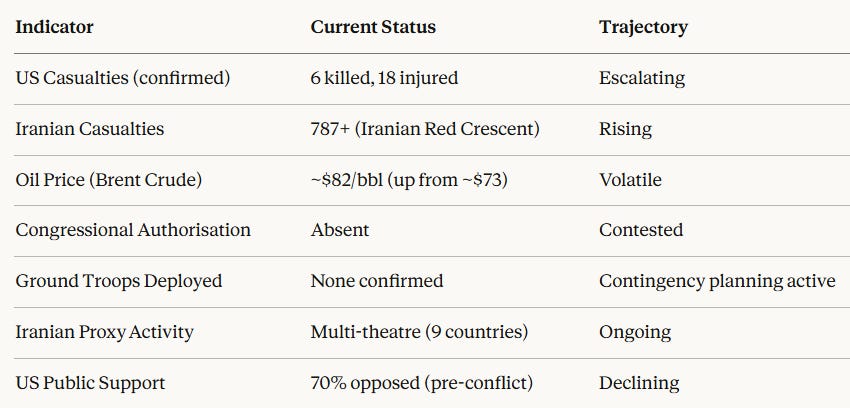
📊 Key Metrics for Quagmire Assessment (March 2026)
🔑 Strategic Assessment: Is It Vietnam?
Iran in 2026 is not Vietnam — yet. The absence of ground troops, the compressed timeframe, and the technological superiority of US-Israeli airpower differentiate the current phase from the grinding infantry warfare of South-East Asia. However, the structural preconditions for a Vietnam-style quagmire — undeclared war, undefined victory conditions, asymmetric adversary resilience, domestic political erosion, and regional spillover — are all present and accelerating, as The War Horse’s conflict timeline documents in granular detail.
The most analytically precise framing comes from the intelligence tradecraft principle of indicator vs. warning: every measurable indicator currently points toward escalation, not resolution. The assassination of Khamenei has not collapsed the regime; Iran’s proxy network remains operationally active across nine countries; the Strait of Hormuz remains a coercive lever; and US domestic opposition stood at 70 per cent before the first American was killed.
The deeper intelligence question is not whether Iran will become another Vietnam, but whether the Trump administration has modelled what “winning” actually looks like — and what happens when no one inside the White House has a coherent answer.
Intelligence assessment current as of 5 March 2026. Analysis draws on open-source reporting from the Brookings Institution, Foreign Affairs, the Atlantic Council Iran Strategy Project, Al Jazeera, NPR, CNBC, Foreign Policy, The War Horse, CISA, and the Centre for International Policy.