🇮🇷 Will Iran Become the Next Iraq, Syria, or Libya? A Live Intelligence Assessment After the Fall of Khamenei
Ujasusi Blog’s Middle East Monitoring Desk | 02 March 2026 | 0130 GMT
🔍 In Brief
Iran’s trajectory following the killing of Ayatollah Ali Khamenei and the destruction of its top military and intelligence command does not neatly replicate the Iraq, Syria, or Libya models of state collapse. Iran’s parallel-state architecture — comprising the IRGC, the clerical Guardian Council, and a resilient technocratic bureaucracy — has activated survival protocols within hours of the strikes. The most analytically precise comparison is a Syria-Iraq hybrid: prolonged institutional contestation, selective fragmentation, and an uncertain transition shaped by one pivotal variable no open-source analysis can yet resolve — whether Reza Pahlavi, the exiled son of the last Shah, has secured prior commitments from mid-level IRGC commanders.
❓ What Exactly Happened on 28 February 2026?
This assessment begins with confirmed ground truth, not analytical inference.
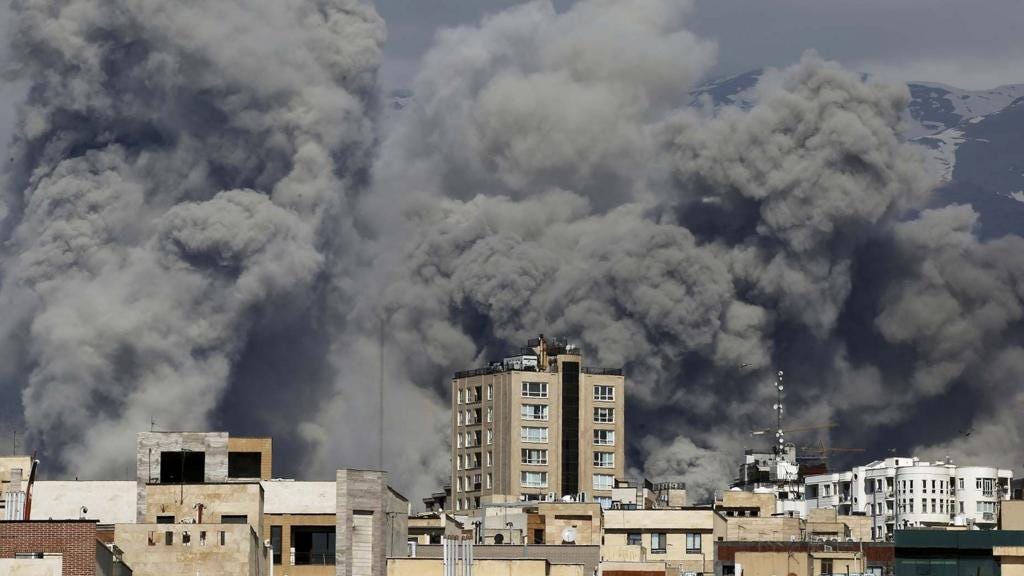
On 28 February 2026, Israel and the United States launched a joint military operation against Iran codenamed Operation Roaring Lion (Israel) and Operation Epic Fury (United States). The operation targeted key officials, military commanders, and facilities across Tehran, Isfahan, Qom, Karaj, and Kermanshah. Supreme Leader Ayatollah Ali Khamenei was killed in the opening hours when Israeli strikes destroyed his compound at the Beit Rahbari. Iranian state media, as reported by NBC News, confirmed that his daughter, grandchild, daughter-in-law, and son-in-law also died in the strikes.
The decapitation went far deeper than the supreme leader. Among those confirmed killed: Iran’s chief of army staff General Abdol Rahim Mousavi, Defence Minister General Aziz Nasirzadeh, IRGC commander General Mohammad Pakpour, Supreme National Security Council secretary Ali Shamkhani, the head of SPND Hossein Jabal Amelian, and multiple senior intelligence officials. Sources cited by CBS News assessed that approximately 40 officials died in the initial strikes. This was not a warning shot — it was a systematic attempt to sever every node of Iran’s command architecture simultaneously.
Critically, 28 February was not the first round. In June 2025, during a 12-day war, Israel struck Iranian nuclear facilities and killed scientists and generals. On 21 June 2025, the United States launched Operation Midnight Hammer, striking three nuclear enrichment sites. However, as IAEA Director-General Rafael Grossi confirmed last week, most of Iran’s nuclear materials remained “still there, in large quantities” despite those earlier strikes. The February 2026 campaign is therefore the second, decisively more ambitious phase — targeting not infrastructure but the political and military command architecture itself.
Iran retaliated immediately. Dozens of drones and ballistic missiles struck Israel, UAE, Qatar, Kuwait, Bahrain, Jordan, and Saudi Arabia. The Islamic Republic’s retaliatory capacity — even after decapitation — demonstrated that the IRGC’s operational command had not been fully severed, a fact with profound implications for every scenario that follows.
❓ Has Iran’s State Activated Survival Protocols?
Yes — and this is the single most analytically significant data point distinguishing Iran from Libya in 2011 and Iraq in 2003.
Within hours of the strikes, Ali Larijani, secretary of Iran’s Supreme National Security Council, announced on state television that an interim leadership council comprising the president, the head of the judiciary, and a jurist from the Guardian Council would assume responsibility until the election of a new supreme leader. Senior Shia cleric Ayatollah Alireza Arafi was appointed interim supreme leader. According to Al Jazeera’s analysis, the rapid formation of this council indicates that the system’s survival protocols have been activated — exactly as designed.
This is structurally decisive. When Muammar Gaddafi’s personalised regime was decapitated in 2011, no institutional continuity mechanism existed because Gaddafi had deliberately prevented one from forming — any rival institutional centre threatened his personal hold on power. Libya had no equivalent of Iran’s Guardian Council, Assembly of Experts, or IRGC bureaucratic hierarchy. The Libyan state was, in effect, Gaddafi. Iran is not Khamenei. It is a parallel-state system constructed over 47 years specifically to survive a decapitation event. The fact that it is performing as designed in the first 48 hours is the most important intelligence indicator of the opening phase.
The most significant political reorientation in the immediate aftermath is Iran’s pivot from religious legitimacy to survivalist nationalism. Surviving officials are no longer framing this conflict as a defence of the clerical order. They are framing it as a defence of Iranian territorial integrity — a calculation designed to broaden the regime’s domestic coalition beyond the devout Shia base to include secular nationalists who might otherwise welcome the regime’s fall.
❓ How Does Iran Compare Structurally to Iraq, Syria, and Libya?
Template-matching is the analytical error most likely to produce wrong conclusions. The four cases diverge sharply on every structural variable that determines whether external military pressure produces rapid collapse or prolonged attrition.
On intervention type: Iraq faced a full ground invasion by US-led coalition forces. Libya faced a NATO air campaign combined with an armed domestic rebel movement. Syria became the theatre of a multi-actor proxy war with limited direct strikes. Iran, by contrast, has faced air and missile strikes only — with no ground forces deployed and no indication that any are planned. This distinction matters enormously: the absence of an occupying force removes the mechanism by which Iraq’s institutional collapse was engineered.
On leadership decapitation: Saddam Hussein survived the opening strikes of 2003 and was not captured until December of that year, allowing regime loyalists months to organise resistance. Gaddafi was killed only after an eight-month campaign in which his regime had largely collapsed. Assad survived the entire Syrian civil war and fled only in December 2024. Khamenei, by contrast, was killed on Day 1 — alongside approximately 40 senior officials. The speed of decapitation is historically unprecedented. But speed alone does not determine outcome.
On institutional continuity: This is where the Iran case diverges most sharply from its predecessors. Paul Bremer’s CPA Order No. 2 in May 2003 deliberately dissolved the Iraqi Army, instantly creating 400,000 armed, unemployed, and aggrieved former soldiers who became the insurgency’s backbone — arguably the single most consequential policy error of the post-invasion period. Gaddafi’s Libya had no institutional architecture beyond his personal patronage network; when he fell, there was nothing to fill the void. Iran activated a formal succession mechanism within hours. No dissolution order has been issued against the IRGC. That contrast is fundamental.
On the opposition claimant: Neither Libya’s National Transitional Council nor Iraq’s Ahmed Chalabi had what Reza Pahlavi possesses in 2026: a documented 180-day governance framework, prior meetings with serving US administration officials, and a diaspora base that is emotionally mobilised and internationally visible. Whether that translates into domestic legitimacy is the central unresolved question — but the structural position is incomparably stronger than any opposition figure in the Libya or Iraq cases.
The Libya comparison — favoured by President Trump’s public “liberation” framing — is analytically weak. As Chatham House assessed, this new stage of conflict is existential and clearly about regime survival — and it is unlikely to end quickly. The Syria model — prolonged internal contestation with a rump regime retaining core territorial control while peripheral authority erodes — remains the most probable structural trajectory.
❓ Is IRGC Cohesion Holding — and Why Is This the Single Most Important Variable?
The IRGC’s operational status in the hours after the strikes is the primary intelligence indicator for every downstream scenario. As Asia Times assessed, so far the coercive and administrative state apparatus appears to be solidly backing the regime — and without serious cracks appearing among IRGC figures, the regime can be expected to survive this crisis. The Iranian military’s immediate retaliatory strikes on multiple Gulf states confirm that operational command was not fully severed by the opening wave.
The arithmetic of IRGC dissolution risk is sobering: an estimated 200,000 regular IRGC forces and 1 million Basij militia members. Without a mass defection cascade, Iraq-style immediate collapse is structurally implausible regardless of how many senior commanders were killed in the opening strikes. Mid-level commanders — the colonels and brigadiers who control territory, prisons, armament depots, and local enforcement — remain the decisive variable.
However, a doctrinal shift of significant intelligence consequence has been confirmed. As Al Jazeera reported, citing a University of Tehran professor, Iran has concluded from the June 2025 war that restraint is interpreted as weakness. Field commanders — freed from the political caution of Khamenei’s doctrine of strategic patience — are likely to operate with greater ferocity. A leaderless IRGC on a de facto scorched-earth logic is a materially more dangerous adversary than the one that existed on 27 February.
“The regime has been built for survival and a long war is now likely. Although Khamenei’s killing is a significant blow, it is not insurmountable — many Iranian leaders have been killed in the past.” — Asia Times, 1 March 2026
❓ Who Is Reza Pahlavi and Why Does the Shah’s Legacy Matter to This Analysis?
Any serious intelligence assessment of post-Khamenei Iran that omits Reza Pahlavi is not a complete assessment. He is, at this moment, the most internationally visible claimant to transitional leadership of Iran, and his positioning in the 48 hours since the strikes illuminates precisely why regime change in Iran is categorically different from Iraq, Syria, or Libya — none of which had an equivalent organised, Western-aligned opposition claimant with an actual governance blueprint and prior Washington access.
Pahlavi was born in Tehran in 1960, the eldest son of Mohammad Reza Shah Pahlavi — the last monarch of Iran, deposed in the 1979 Islamic Revolution that established the Islamic Republic. As NPR reported, Khamenei had ruled for 36 years as the Islamic Republic’s second supreme leader, holding power since 1989. At age 7, Pahlavi was formally named Crown Prince. By 17, he had become Iran’s youngest pilot, departing for the United States for military training and never returning. He has lived in exile for 47 years, primarily in the Washington DC area. Following his father’s death in 1980, he proclaimed himself Shah in exile, though he has publicly and consistently distanced himself from any claim to restore the monarchy, repositioning himself instead as a transitional democratic facilitator — a distinction that is strategically calculated rather than ideologically settled.
His pre-strike positioning was not opportunistic. According to Axios, Pahlavi had previously met with Trump administration officials and explicitly lobbied for strikes targeting the “architecture of repression” — including IRGC command-and-control structures. When the strikes came on 28 February, he described them as precisely the “aid” he had requested — framing a joint military assault as the fulfilment of a promise to Iranian protesters and placing himself at the centre of the narrative rather than the periphery.
In Tehran’s streets, chants of “long live the Shah” were recorded alongside “death to Khamenei.” Diaspora rallies worldwide waved the Lion and Sun flag — the symbol of the pre-revolutionary Iranian monarchy. For a significant portion of Iranians, particularly the secular urban middle class, the Shah’s memory functions not as a nostalgic political preference but as a coded shorthand for the pre-revolutionary Iran they wished had survived. The intelligence significance of this is not sentimental — it is a measure of the emotional reservoir that Pahlavi can potentially convert into political momentum.
❓ What Does Pahlavi’s Transition Plan Actually Contain?
Pahlavi arrived at this moment with a documented governance framework, not merely a symbolic claim. According to Axios and The Forward, on the eve of the joint US-Israeli operation he unveiled an updated version of the Iran Prosperity Project, an initiative affiliated with the US-based National Union for Democracy in Iran (NUFDI). The document outlines Iran’s urgent priorities during the first 180 days following potential regime collapse, including measures for economic stabilisation and institutional reform.
According to Axios, he has publicly stated he would lead the transition through a coalition of forces including people inside Iran and the country’s military, with the process expected to span a matter of years rather than decades. His economic argument to Washington is explicitly transactional: opening Iran’s market to America could produce over a trillion dollars of economic impact — a calculation designed to align his transitional project with the Trump administration’s commercial foreign policy logic and preempt the objection that regime change is strategically costly.
His appeal to the IRGC has been direct. As the Jerusalem Post reported, Pahlavi told Iran’s security forces: “You have sworn an oath to protect Iran and the Iranian people — not the Islamic Republic and its leaders. Join the people and help bring about a stable and secure transition. Otherwise, you will go down with Khamenei’s sinking ship and his regime.” This mirrors the appeal made by Ahmad Chalabi before the 2003 Iraq invasion. Chalabi’s subsequent irrelevance in post-invasion Iraq is the analytical warning sign that Pahlavi’s team appears to understand but cannot publicly acknowledge.
❓ What Are the Structural Weaknesses in the Pahlavi Scenario?
Three intelligence-grade vulnerabilities demand rigorous scrutiny beyond the aspirational framing.
First — Iran is not a monolith. As the Foundation for Defence of Democracies assessed, Iran is a mosaic — including Azeris, Kurds, Arabs, Baluch, and others. Five Kurdish factions recently formed a united front against the regime. Beyond them stand communists, dissident Islamists, and other opposition movements with objectives not inherently aligned with a Pahlavi-led secular democratic transition. Pahlavi speaks to a broadly secular, Persian-identified opposition. He does not have a consolidated relationship with Baloch, Kurdish, or Arab Ahwazi constituencies, each of which has distinct political objectives — including, in some cases, territorial autonomy rather than a reconfigured Tehran-centric state. Any transitional governance framework that does not explicitly address these ethno-political fault lines will face fragmentation from within its own coalition.
Second — the pro-regime street is real. Videos from Tehran show Iranians celebrating the strikes and praising Pahlavi. Those images are genuine. However, opposing protests have condemned the attacks in Iraq, Pakistan, and across the Shia world. Within the symbolic universe of Shia Islam, Khamenei’s killing at his desk — while performing his duties — can be framed as martyrdom. As Al Jazeera noted, death at the hands of perceived enemies of Islam has historically been interpreted not as defeat but as sacralised closure — a martyrological script that can strengthen ideological commitment among the devout. The intelligence error is to analytically erase the pro-regime constituency because it is inconvenient to the regime-change narrative.
Third — the Ahmad Chalabi precedent. Dutch pollster Ammar Maleki’s large-sample surveys found that roughly one in three Iranians expresses confidence in Pahlavi. One in three is not a mandate. It is a plurality in a fractured field — meaningful, but not determinative. Chalabi returned to Baghdad in 2003 to find his decade of exile had made him politically irrelevant to Iraqis who had actually lived under Saddam. The gap between diaspora legitimacy and street legitimacy inside Iran is structural, not a communications problem. It cannot be closed by press conferences in Washington.
❓ What Does Realistic Regime Change Actually Look Like?
Two divergent trajectories are analytically credible. Neither is clean.
The optimistic trajectory — a Pahlavi-led transition — runs as follows: in the first 30 days, IRGC partial defections begin, street protests expand, and the interim council loses internal cohesion. Between one and six months, a transitional council is formally constituted; Pahlavi returns to Iran as a figurehead and seeks international recognition. Between six months and two years, a constitutional convention is convened under international supervision and a secular democratic framework is drafted. Beyond two years, a contested but functioning electoral process begins and US economic integration commences.
The pessimistic trajectory — contested fragmentation — runs as follows: in the first 30 days, the IRGC holds; strikes escalate; an internet blackout deepens and mass civilian casualties mount. Between one and six months, a rump Islamic Republic governs from Qom or Mashhad while ethnic periphery insurgencies activate in Balochistan, Kurdistan, and Khuzestan. Between six months and two years, warlordism takes hold in border provinces and ISIS-Khorasan exploits the vacuum in eastern Iran. Beyond two years, prolonged civil conflict produces a refugee crisis and regional powers including Turkey, Saudi Arabia, and Russia back competing factions.
The analytical precedent most useful here is not Iraq 2003 or Libya 2011 — it is Reagan-era Eastern Europe. As the Foundation for Defense of Democracies argued, America’s role is to cultivate an enlightened leadership capable of governing Iran, as Ronald Reagan did in Eastern Europe during the twilight years of communism. However, that process operated through non-kinetic pressure over a decade and benefited from organised indigenous political infrastructure — trade unions, churches, civil society networks — that Iran’s shattered civil society, after 47 years of systematic repression, does not possess at comparable scale.
📊 Ujasusi Blog Probability Assessment: Through Mid-2026
All probability assessments below represent the independent analytical judgement of Ujasusi Blog, drawing on open-source reporting from Chatham House, Al Jazeera, Asia Times, NPR, CBS News, Axios, and the Foundation for Defence of Democracies. They are not attributed to any external institution.
🔴 Most Probable — 55% confidence: Contested Regime Survival (Syria Parallel)
The interim leadership council stabilises core governance. The IRGC maintains cohesion. Iran conducts sustained asymmetric retaliation via proxies and direct missile strikes on Gulf states and Israel. A new Supreme Leader is elected under wartime conditions — likely a hardliner with no restraining political capital and no appetite for strategic patience. The Islamic Republic survives in degraded, more violent form. Pahlavi remains positioned but not empowered, his transition plan intact on paper but unenacted on the ground.
🟡 Second Most Probable — 28% confidence: Negotiated Ceasefire and Transitional Uncertainty
Escalation costs for all parties — including Gulf Arab states now absorbing Iranian retaliatory strikes — produce a diplomatic off-ramp, potentially brokered by Oman. Iran’s interim council enters negotiations under extreme duress. The outcome is an unstable political arrangement — not collapse, not normalisation. This scenario has been consistently underpriced by conflict analysts given domestic US and Israeli political constraints against it.
🟠 Lower Probability — 12% confidence: Cascading Fragmentation (Libya-Iraq Hybrid)
IRGC fractures along factional lines. Ethnic periphery insurgencies in Balochistan, Kurdistan, and Khuzestan activate simultaneously. Ungoverned spaces are exploited by ISIS-Khorasan. A refugee crisis dwarfing Syria’s 6.8 million displaced persons follows. This scenario carries the highest regional catastrophe risk — and the highest potential for Pahlavi’s transition plan to either succeed spectacularly or expose its limitations catastrophically.
🧭 Intelligence Takeaway
The analytical error most frequently observed in Western commentary — including from officials who should know better — is template-matching Iran to Libya 2011. That comparison flatters the intervention’s architects and obscures the structural reality: Iran’s parallel-state architecture was specifically engineered to survive decapitation events, and it is performing as designed.
The more uncomfortable parallel — one that neither Washington nor Tel Aviv wishes to acknowledge publicly — is Iraq post-2003: not rapid regime collapse, but unintended consequence. A security vacuum. Hardened survivors operating without political restraint. A generation of grievances that metastasise into a regional insurgency without territorial borders.
Reza Pahlavi is a more credible transitional claimant than Ahmad Chalabi was in 2003. His plan is documented. His Washington access is real. His diaspora base is emotionally mobilised. But the critical intelligence question that no open-source analysis can answer is whether he has secured prior, private commitments from IRGC mid-level commanders — the colonels and brigadiers who control territory, prisons, armament depots, and local enforcement capacity. Not the senior leadership, who are largely dead. The men one and two levels down, who are now calculating survival versus loyalty in real time.
That gap — between Pahlavi’s public positioning and the private deals that determine whether it succeeds — is where the actual intelligence story of the next 180 days will be written.
The primary indicator to monitor is not succession politics in Qom. It is IRGC unit-level cohesion at the brigade and divisional level. If that holds, Iran survives in reconfigured form. If it fractures, no governance plan — however well-documented — is sufficient.
All probability assessments represent the independent analytical judgement of Ujasusi Blog and are not attributed to any external institution. This assessment was produced on 2 March 2026 using open-source intelligence (OSINT) from verified published sources including Chatham House, Al Jazeera, Asia Times, NPR, CBS News, Axios, the Foundation for Defence of Democracies, and The Forward. This article does not constitute policy advice.