

Ujasusi Blog’s East Africa Monitoring Team | 14 February 2026 | 2300 GMT
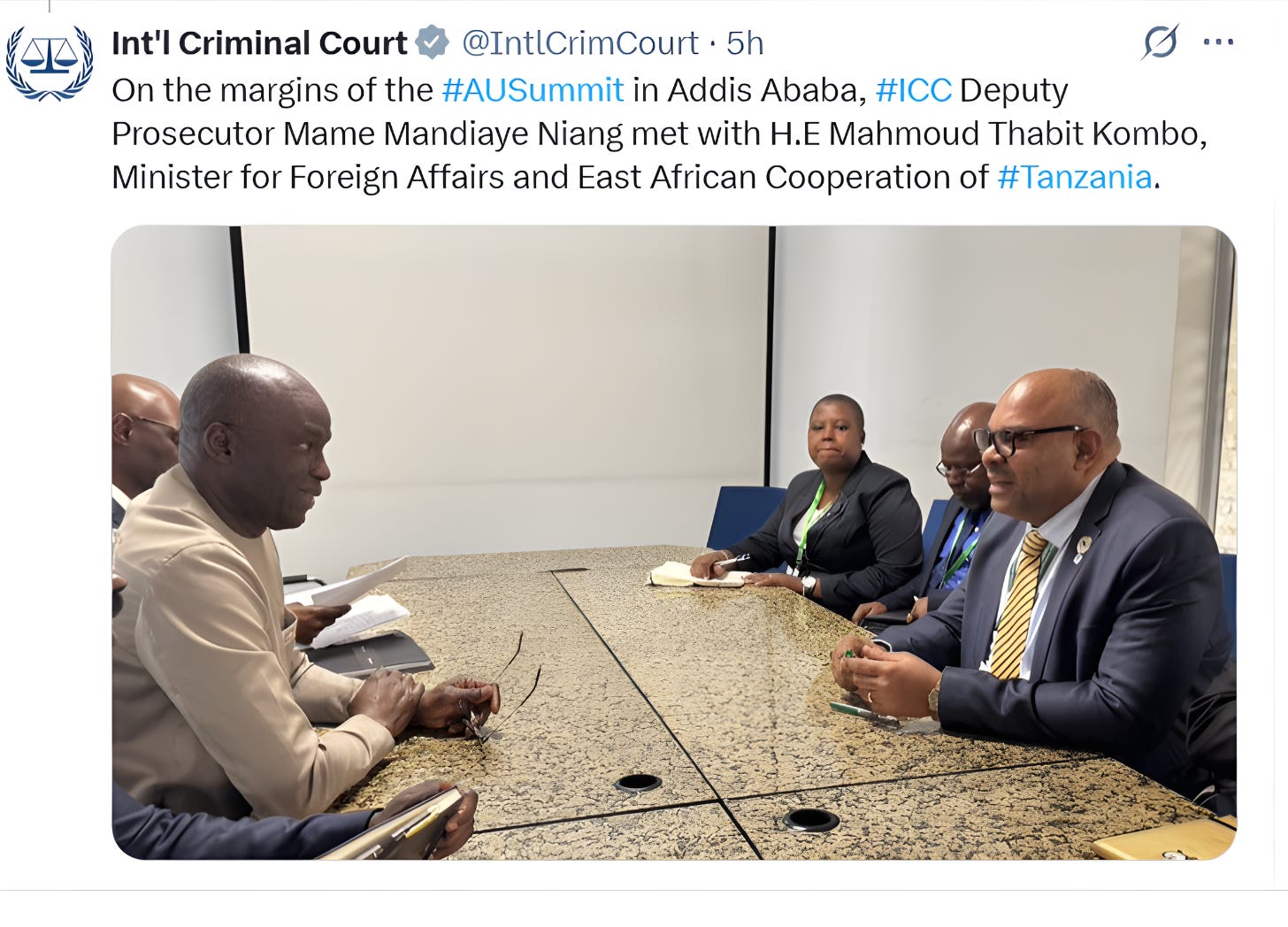
ICC Deputy Prosecutor Mame Mandiaye Niang — currently serving as de facto head of the Office of the Prosecutor — met Tanzania’s Foreign Minister Mahmoud Thabit Kombo on the margins of the 39th African Union Summit in Addis Ababa on 14 February 2026. This was a direct, face-to-face encounter between the man overseeing the 82-page crimes against humanity dossier filed against President Samia Suluhu Hassan’s government and a senior representative of that same government. The meeting, publicly confirmed by the ICC’s verified X account, marks the first known direct engagement between the OTP leadership and Tanzanian officials since the dossier was submitted on 13 November 2025.
📑 Table of Contents
What Exactly Happened at the AU Summit Between ICC and Tanzania?
Why Is Mame Mandiaye Niang the Key Figure in This Case?
What Does the 82-Page Dossier Actually Allege?
Where Does the ICC Process Currently Stand?
What Is the Significance of This Meeting for the Complementarity Assessment?
Could Tanzania Withdraw from the Rome Statute to Avoid Prosecution?
What Happens Next? Scenario Assessment
What Exactly Happened at the AU Summit Between ICC and Tanzania?
The International Criminal Court’s official X account posted at 1:36 PM on 14 February 2026 that Deputy Prosecutor Mame Mandiaye Niang met with “H.E Mahmoud Thabit Kombo, Minister for Foreign Affairs and East African Cooperation of Tanzania” on the sidelines of the AU Summit in Addis Ababa. The accompanying photograph shows both men seated across a conference table with respective delegations present.
This meeting took place during a broader round of diplomatic engagements by Niang at the AU Summit. The ICC confirmed he also met Mauritania’s Foreign Minister Mohamed Salem Ould Merzoug as part of what the Court described as “renewed engagement with African States.” But the Tanzania meeting carries qualitatively different weight. Niang’s name appears on page one of the Article 15(2) Communication filed against the Tanzanian state — he is not a peripheral figure in this matter but the senior OTP official to whom the dossier was formally addressed.
Why Is Mame Mandiaye Niang the Key Figure in This Case?
Niang’s centrality to the Tanzania situation stems from an institutional chain of events that has concentrated decision-making authority in his hands.
ICC Prosecutor Karim Khan took voluntary leave in May 2025 following a UN Office of Internal Oversight Services (OIOS) investigation into allegations of sexual misconduct. On 19 May 2025, Deputies Niang and Nazhat Shameem Khan jointly assumed leadership of the entire Office of the Prosecutor. Separately, in October 2025, the ICC Appeals Chamber disqualified Karim Khan from the Duterte case over conflict of interest, with Niang formally taking charge of that prosecution.
By the time the Tanzania dossier was submitted on 13 November 2025, Niang was operating as the de facto head of the OTP’s prosecutorial operations. The dossier’s cover page lists both Deputies — “Before: Mrs Nazhat Shameem Khan, Mr Mame Mandiaye Niang” — as the receiving officials. Wikipedia notes that Niang has been serving as Acting Chief Prosecutor since 2025.
There is an additional dimension worth noting: Niang is himself a target of US sanctions imposed by the Trump administration in retaliation for the ICC’s investigation into alleged Israeli war crimes in Gaza. His personal financial accounts, including a Wave mobile money account in Senegal, have been frozen. This means the man overseeing the Tanzania dossier is himself operating under considerable external pressure — a factor that could cut both ways in terms of prosecutorial momentum.