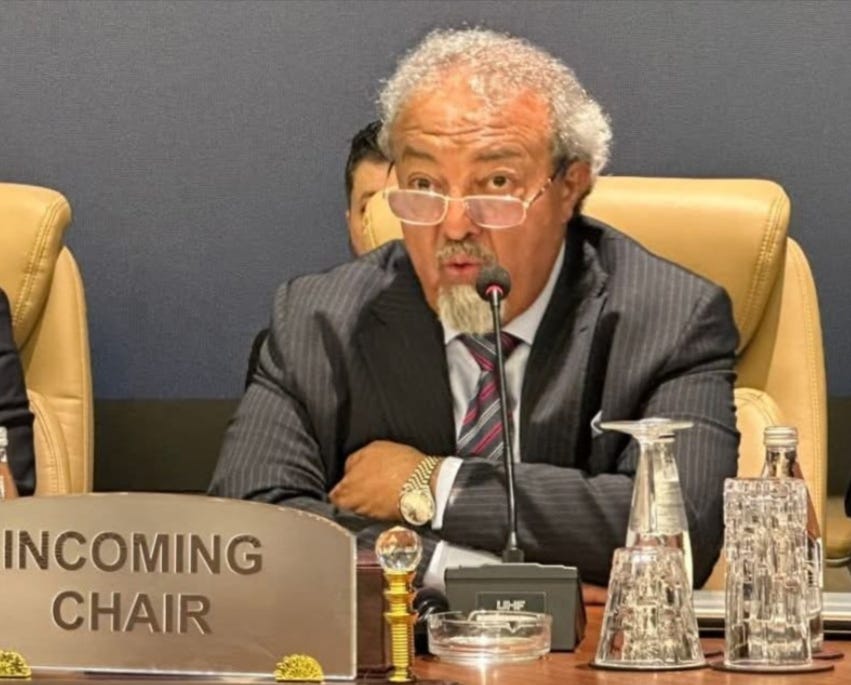
Profile of a Spymaster: Lieutenant General Hussein Muhammad Khalifa al-Ayeb, Head of Libya’s General Intelligence Service (GIS)

Profile of a Spymaster | Ujasusi Blog Originals
📋 In Brief
Hussein Muhammad Khalifa al-Ayeb is the head of Libya’s General Intelligence Service (GIS), appointed by the Presidency Council in May 2021. A career intelligence officer from Al-Jabal Al-Gharbi in western Libya, al-Ayeb holds the rank of Lieutenant General and chairs the Committee of Intelligence and Security Services of Africa (CISSA), a position he has used to host Africa’s largest intelligence summit in Benghazi and to position Libya as a continental security hub despite the country’s unresolved political fragmentation.
🔍 Who Is Hussein al-Ayeb?
Al-Ayeb is a long-serving Libyan intelligence professional whose career spans the turbulent post-Gaddafi era. He originates from Al-Jabal Al-Gharbi (the Western Mountain region), a strategically significant area in western Libya that has historically produced figures with ties to both sides of Libya’s east-west political divide. Before his appointment to lead the GIS, al-Ayeb served as Board Director of the International Company for Development and Investment in Libya — a role that would later attract controversy.
Publicly, al-Ayeb maintains the low profile characteristic of intelligence professionals. He rarely gives media interviews and his public statements are largely confined to official events, diplomatic meetings, and prepared remarks at multilateral conferences. What distinguishes him from many African intelligence chiefs is the sheer volume of bilateral intelligence engagements he has conducted with foreign counterparts — a pattern that suggests a deliberate strategy to build external legitimacy and operational partnerships.
🏛️ How Was al-Ayeb Appointed?
Al-Ayeb’s appointment came through Presidential Council Decision No. 17 of 2021, signed by Presidency Council head Mohamed al-Menfi. He officially assumed duties on 5 May 2021, replacing both Mustafa al-Muqrin (appointed by parliament) and Emad al-Trabelsi (appointed by the previous Government of National Accord under Fayez al-Sarraj). The decision fell within a broader series of appointments made by al-Menfi following the formation of the Government of National Unity (GNU) on 16 March 2021, with Abdul Hamid Dbeibah as prime minister.
The appointment was immediately contentious on multiple fronts. The Libya Observer reported that the head of Libya’s Audit Bureau, Khalid Shakshak, called on the Presidency Council to withdraw the appointment, alleging al-Ayeb had been involved in defrauding the Libyan state during his tenure at the International Company for Development and Investment. The accusation centred on contracts worth over 800 million Libyan dinars allegedly awarded to the Turkish Cengiz construction company for personal benefit.
Separately, commanders of the Volcano of Rage Operation — western Libyan militia forces aligned against Khalifa Haftar — urged that al-Ayeb’s mandate be withdrawn, describing him as a Haftar loyalist. The fact that he survived both the fraud allegations and the militia opposition, and has now held the post for nearly five years, speaks to his political utility as a bridging figure in Libya’s fractured governance structure. He operates from Tripoli under the GNU, yet maintains sufficient credibility with eastern factions to function across the political divide — a rare and valuable quality in Libyan politics.
🏢 What Is Libya’s General Intelligence Service?
The GIS is Libya’s primary civilian intelligence agency, based in Tripoli. It was formally reorganised by Libya’s House of Representatives in April 2023, absorbing the assets and mandates of two dissolved predecessor agencies: the External Security Agency and the National Authority for National Security. Both bodies traced their lineage to elements of the Gaddafi-era intelligence apparatus, which was dismantled following the 2011 revolution and NATO intervention.
The GIS’s statutory mandate covers preserving state security, protecting classified information, monitoring foreign entities and institutions operating in Libya, tracking hostile activity against Libyan interests, and securing the country’s interests abroad. In legislative terms, the 2023 reorganisation was intended to consolidate Libya’s fragmented intelligence landscape under a single civilian umbrella.
In practice, however, the GIS operates within an environment defined by competing armed groups, dual governance structures, and heavy foreign interference. Khalifa Haftar’s Libyan National Army (LNA) maintains its own intelligence apparatus in eastern Libya, and numerous militia-aligned security units in the west operate with varying degrees of autonomy from the GIS. The service’s actual reach is therefore considerably narrower than its statutory mandate implies — a common feature of intelligence agencies in fragmented states.
🌍 How Has al-Ayeb Built Libya’s Intelligence Diplomacy?
Al-Ayeb’s most consequential achievement has been the internationalisation of Libya’s intelligence presence through an aggressive programme of bilateral and multilateral engagement.
Between March and September 2024 alone, the Libyan News Agency (LANA) reported that al-Ayeb met with the intelligence chiefs of Cyprus (Tasos Tsionis), Romania (Gabriel Vlasi), Malta (Joseph Bugia), Turkey (Ibrahim Kalin), and Germany (Bruno Kahl), among others. These engagements focused on counter-terrorism, anti-money laundering, migration management, and intelligence capacity-building — the standard agenda items of Euro-Mediterranean intelligence cooperation, but notable for the frequency and breadth of contact for a Libyan intelligence chief.
This diplomatic trajectory accelerated in January 2025, when CISSA opened its Tripoli office — a direct result of Libya assuming the CISSA presidency, a decision announced in August 2024. At the opening ceremony, attended by CISSA Executive Secretary Jackson Victor Hamata and Presidency Council head Mohamed al-Menfi, al-Ayeb declared that the office enhanced Libya’s leadership in regional intelligence work and called for intensified coordination between African intelligence agencies against terrorism and organised crime.
Al-Ayeb also used the event to address illegal African migration within Libya, stating that a CISSA committee would soon convene to coordinate the return of irregular migrants to their countries of origin according to international standards, with EU involvement. This positioning of the intelligence service as a migration management actor reflects broader European pressure on North African states, but also represents an expansion of the GIS’s institutional role beyond traditional intelligence functions.
🏟️ What Happened at the Benghazi CISSA Summit?
The centrepiece of al-Ayeb’s CISSA chairmanship came in August 2025, when he chaired the 20th CISSA Conference in Benghazi, bringing together delegations from 53 African nations alongside observers from Gulf states, European partners, and the United States. The conference ran from 20 to 27 August under the theme “Preventing Conflicts and Violent Wars in Africa.”
In his opening address, al-Ayeb stated that Benghazi — a city that had confronted terrorism — had regained its security and stability, and that hosting the conference reflected Libya’s return to an active role in Africa. At the conference’s close, he announced a Libyan-led initiative for joint intelligence cooperation that included establishing a unified task force, enhancing information-sharing mechanisms to combat terrorism, and introducing training and capacity-building programmes for African security agencies. Libya also secured hosting rights for CISSA 21, extending its chairmanship.
The choice of Benghazi as venue carried significant political weight. The city is Haftar’s stronghold, yet the conference was chaired by al-Ayeb, who is aligned with the Tripoli-based GNU. The Africa Report noted that the conference organisers deliberately accommodated both rival governments. A large Turkish delegation arrived on a warship, with Turkey’s intelligence chief Ibrahim Kalin holding talks with Haftar — described as a positive shift given Ankara’s historical support for the Tripoli government that Haftar contests. Other prominent figures who reportedly met with Haftar during the conference included French Special Envoy Paul Soler, US Chargé d’Affaires Jeremy Berndt, and UAE Secretary of the Supreme Council for National Security Ali Al-Shamsi.
The Benghazi summit also served as the backdrop for the inauguration of Haftar’s son, Lieutenant General Saddam Haftar, in an official ceremony — underscoring that the CISSA conference functioned as much as a venue for Libyan factional diplomacy as it did for continental intelligence cooperation.
⚖️ What Happened with al-Ayeb’s Son?
The most damaging development for al-Ayeb’s tenure came on 10 April 2025, when the Criminal Department of the Tripoli Court of Appeal sentenced seven individuals for their involvement in the attempted assassination of Abdul Majeed Mleqta, a senior adviser to Prime Minister Dbeibah. The first defendant received an 11-year prison term; the second and third defendants — including Mohamed Hussein al-Ayeb, the intelligence chief’s son — were each sentenced to seven years with hard labour; the fourth defendant received five years; and the fifth, sixth, and seventh defendants received one year each. The sentences appear to have been issued in absentia, with many of the convicted individuals reportedly detained in Tunisia.
Mohamed was convicted of forming a “criminal gang” and causing significant damage to “public property.” The court established that he had served as director of the department within the GIS that oversaw the preparation and execution of the assassination attempt — meaning he used the institutional resources of his father’s own agency to orchestrate the attack.
Mleqta welcomed the verdicts but held the Presidential Council “fully responsible politically and administratively to take the necessary measures towards the head of this agency,” since the GIS falls under PC administration. He cited Article 28 of Law No. 11 of 2012, which holds officials accountable for neglect or actions undermining the integrity of their positions. Mleqta argued that whether Hussein al-Ayeb was aware of his son’s actions or simply lacked oversight, the result demonstrated institutional failure either way. He described the intelligence chief’s continued tenure without investigation as “a serious legal and security loophole.”
Neither scenario reflects well on al-Ayeb’s stewardship of the GIS: either he knew his son was running an assassination operation from within the service and failed to intervene, or he was unaware of what a department under his command was doing. The case remains the single most significant vulnerability in his position.
🔫 What Is the Current Security Context?
Al-Ayeb now operates against a backdrop of intensifying instability. On 3 February 2026, Saif al-Islam Gaddafi — the son of former leader Muammar Gaddafi — was assassinated at his home in Zintan by four masked gunmen. CNN reported that the head of Saif al-Islam’s political team described the killing as a “cowardly and treacherous assassination.” He was 53.
The killing removed a figure who, despite limited political power, had represented a symbolic third-way alternative to the Tripoli-Benghazi divide. Analysts noted that his death eliminates a potential candidate who could have disrupted the status quo in any future elections. From an intelligence perspective, the assassination occurred in western Libya, nominally within the GIS’s area of operations, and raises immediate questions about the service’s capacity to provide security — or, alternatively, about its potential awareness of the operation.
More broadly, security analysts have warned that any political or security crisis in 2025-2026 is most likely to be triggered by instability in the Tripoli government, given that the GNU under Dbeibah appears weakened by public opposition and militia criticism. Haftar has historically seized on such instability to challenge the western government — as he did with his 2019-2020 offensive against Tripoli.
📊 Final Assessment
Al-Ayeb’s trajectory illustrates a pattern common to intelligence chiefs in fragmented states: accumulating international legitimacy to compensate for domestic weakness. His CISSA chairmanship gives Libya a continental intelligence platform it has not possessed since the Gaddafi era, and his bilateral engagements with European, Turkish, Gulf, and African intelligence services are substantive in both frequency and scope.
But the foundations are precarious. The conviction of his son for running an assassination operation from within the GIS against a figure in his own government’s orbit, the unresolved Audit Bureau fraud allegations from his pre-appointment career, and the assassination of Saif al-Islam Gaddafi on his watch collectively constrain his authority and credibility. Al-Ayeb remains in post because he serves the interests of multiple factions simultaneously — a useful quality in Libyan politics, but one that depends entirely on none of those factions concluding it is advantageous to remove him.
For foreign intelligence services engaging with the GIS, the calculation is straightforward: al-Ayeb is a reliable interlocutor for information-sharing and counter-terrorism coordination, but the agency he leads lacks the institutional coherence to deliver on the ambitious cooperative frameworks he announces at multilateral summits. The gap between the GIS’s statutory mandate and its operational reality remains the defining feature of Libyan intelligence under al-Ayeb’s leadership.