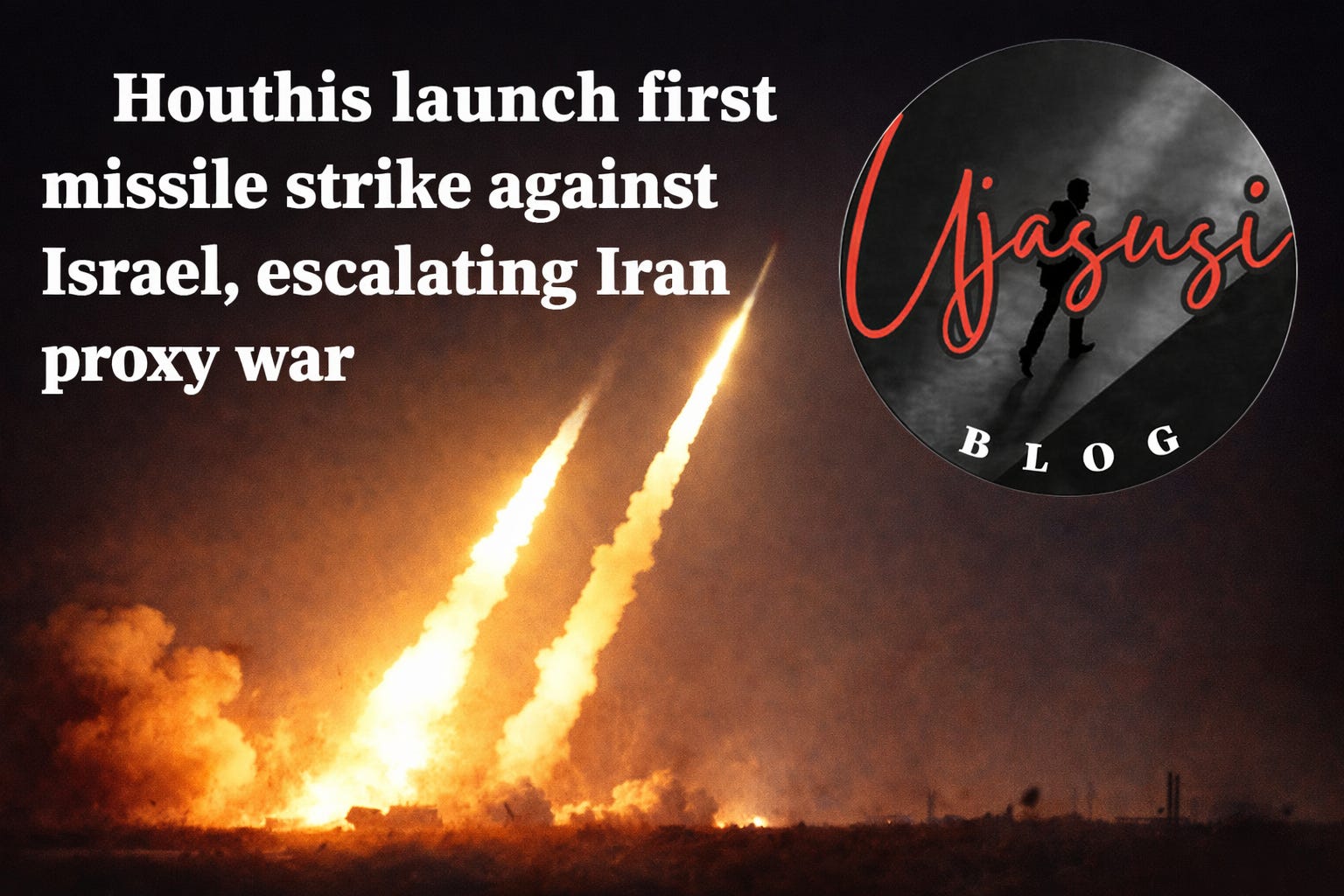
Houthis launch first missile strike against Israel escalating Iran proxy war
Ujasusi Blog’s Middle East Monitoring Desk | 29 March 2026 | 0615 BST
On 28 March 2026, Yemen’s Ansarullah movement—the Houthis—launched its first direct missile strike against Israeli territory, formally entering the Iran-Israel conflict. The operation extends Iran’s multi‑front war strategy to the Red Sea basin, compelling Israeli defence planning to account for a 2,000‑kilometre ballistic missile threat corridor previously considered peripheral.
01. What prompted the Houthis to launch their first missile strike on Israel
The strike was triggered by three conditions the Houthis had publicly articulated hours earlier: the entry of additional alliances alongside the US and Israel against Iran; the use of the Red Sea for hostile operations; and the continuation of escalation against Iran. With US‑Iran negotiations ongoing and Israel concerned a ceasefire might be declared, activating the Houthi front raised the cost of any diplomatic pause that would leave Iran’s position degraded. Yahya Saree, the Houthi military spokesperson, stated the attack was “in implementation of what was stated in the previous statement… regarding direct military intervention in support of the Islamic Republic of Iran”.
02. How do Houthi missiles threaten Israeli security infrastructure
Houthi ballistic missiles add a fourth threat ring from the southeast, with launch sites 1,600–2,000 kilometres from Israeli population centres. This distance complicates early‑warning timelines and demands that the Arrow system operate across a broader azimuth. Houthi arsenals include Iranian‑designed Qadr and Soumar variants, with ranges exceeding 2,000 kilometres and warheads up to 750 kilograms. Components are transferred via Iran's weapons transfer to Yemen routes, with technical support from the Islamic Revolutionary Guard Corps. The threat extends beyond interception: sustaining air‑defence coverage over Eilat and the southern Negev imposes operational costs and diverts assets from northern fronts.
03. Why are Houthis entering the Iran-Israel proxy war now
Iran held the Houthis in reserve to avoid overextending its deterrent posture prematurely and to create a front that cannot be neutralised through the same military or diplomatic means applicable to Lebanon or Syria. The Houthis control the Bab el‑Mandeb Strait, enabling pressure on maritime chokepoints—a capability referenced in their pre‑strike statement. For Ansarullah leadership, direct engagement with Israel elevates the group’s status within the Iranian‑led coalition, unlocking advanced weaponry and political backing.
04. Is Iran directing Houthi missile strikes against Israel
Iran's proxy network coordination occurs at the strategic level. The Quds Force provides training, technical support and targeting guidance, but Houthi commanders retain tactical initiative. Iran supplies the weapons and authorises the decision to escalate; the Houthis execute within those boundaries. Operational patterns mirror Hezbollah’s relationship with Tehran, where broad strategic parameters are set by Iran while local commanders determine tactical execution.
05. What capabilities do Houthi ballistic missiles possess against Israel
Houthi ballistic missile capabilities include liquid‑fuelled Scud‑derived Burkan‑2H and Burkan‑3 (range 1,200–1,800 km) and more advanced Iranian‑designed Qadr (1,800–2,000 km) and Soumar (2,000–2,500 km) systems, the latter also liquid‑fuelled. Launch survivability is enhanced by mobile launchers concealed in mountainous terrain and tunnel complexes. Iranian weapons transfer to Yemen delivers missile components and technical assistance, enabling the Houthis to maintain a credible long‑range strike capability.
Sources: CSIS Missile Threat Project; UN Panel of Experts reports.
06. How does Houthi involvement escalate regional Iran-Israel conflict
The Houthis transform regional conflict expansion from a contiguous multi‑front challenge to a dispersed theatre spanning the Arabian Peninsula and the Red Sea. For the Israeli Defense Forces, this means managing a threat axis with no land border, precluding ground operations and forcing reliance on long‑range air strikes and naval interdiction. The Red Sea corridor now carries direct implications for global energy security and Maritime Security Operations. Iran achieves two objectives: stretching US and Israeli military resources across a wider geography, and introducing an actor difficult to deter through traditional bilateral channels.
Original analytical judgement: The Houthi entry represents a structural shift in escalation control. Iran has delegated credible offensive capability to a proxy that lacks a territorial border with Israel, is not subject to direct Israeli ground retaliation, and can sustain attacks through a logistics pipeline that has weathered years of sanctions. This “escalation hedge” allows Tehran to inflict direct military costs while insulating itself from immediate conventional retaliation, fundamentally altering the calculus of conflict management in the region.
The operationalisation of the Houthi front consolidates Iran’s vision of a distributed deterrent across the Red Sea and the Levant. For Israeli defence planners, the battlefield now stretches from the Mediterranean to the Arabian Peninsula. Whether the Houthis sustain their engagement or use it as a bargaining chip will depend on Iranian calculations about ceasefire talks and the evolution of the Abraham Accords security architecture. The threshold for direct Iranian‑sponsored strikes on Israeli territory has been crossed, and the precedent set on 28 March 2026 will define the parameters of the next phase of the conflict.