
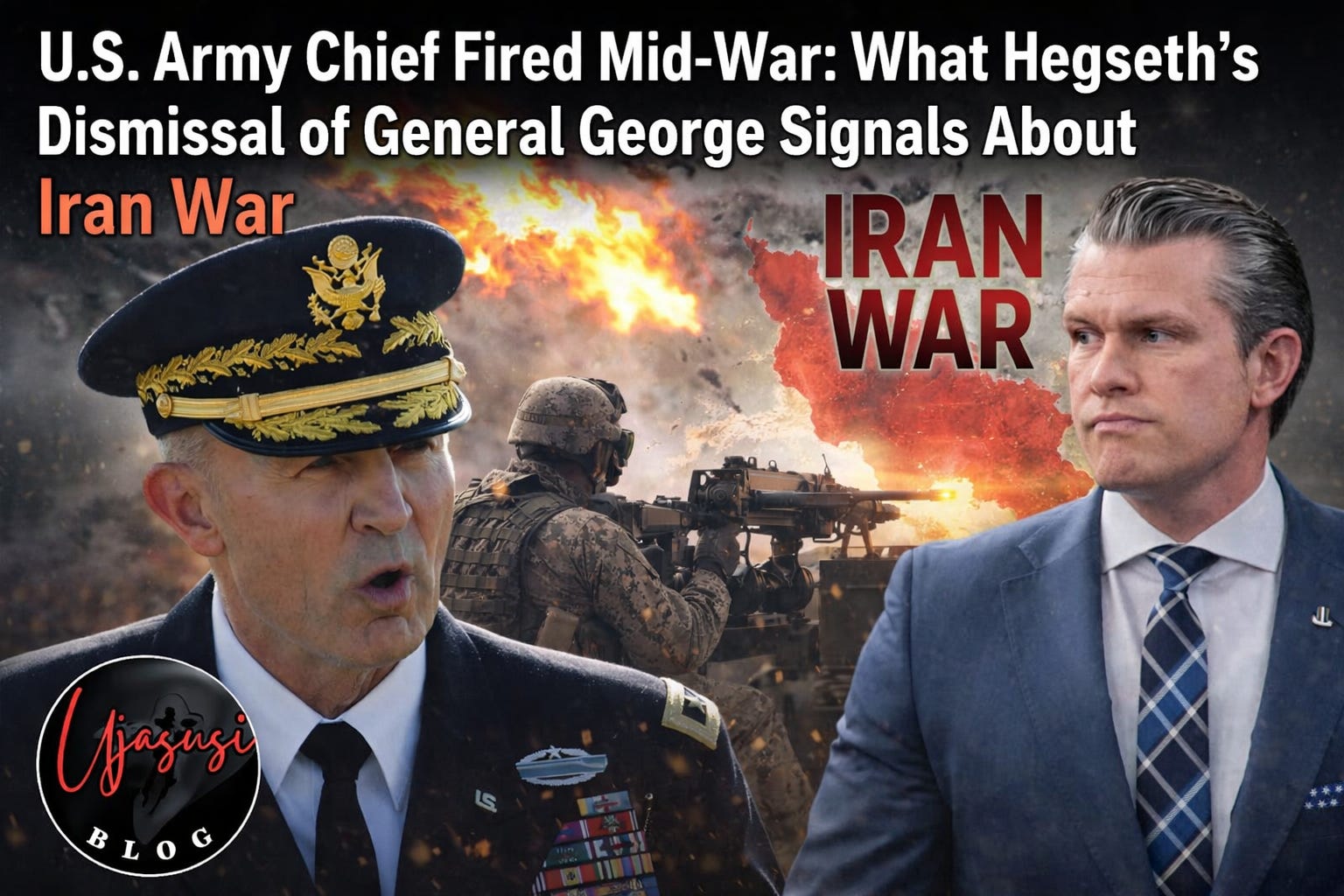
U.S. Army Chief Fired Mid-War: What Hegseth's Dismissal of General George Signals About Iran War

Ujasusi Blog’s U.S. Monitoring Desk | 03 April 2026 | 0100 BST
The forced retirement of General Randy A. George as the 41st Chief of Staff of the United States Army on 2 April 2026 — ordered by Secretary of War Pete Hegseth during the fifth week of Operation Epic Fury — is the most operationally consequential personnel decision taken by the Department of War since the campaign commenced on 28 February 2026. George’s removal, effective immediately and without publicly stated cause, extends a systematic purge of senior military leadership that has now claimed more than a dozen four-star officers since Hegseth assumed office in January 2025.
The Record Behind the Dismissed General
Commissioned from West Point in 1988, George deployed across Desert Storm, Operation Iraqi Freedom, and Operation Enduring Freedom before ascending to the Army’s most senior uniformed post in August 2023 — a position that typically runs four years. His removal cuts that tenure short by more than eighteen months. Pentagon spokesman Sean Parnell confirmed the departure with a single line: “General Randy A. George will be retiring from his position as the 41st Chief of Staff of the Army effective immediately.” No operational rationale accompanied the statement.
The Loyalty Architecture Driving the Purge
The George dismissal follows an established pattern. Hegseth’s removals have included Chairman of the Joint Chiefs General Charles “CQ” Brown Jr., Chief of Naval Operations Admiral Lisa Franchetti, Air Force Vice Chief General James Slife, and Defence Intelligence Agency Director Lieutenant General Jeffrey Kruse, among others. The selection criteria, though never formally stated, are legible from the record: association with former Defence Secretary Lloyd Austin, proximity to former Chairman General Mark Milley, and perceived resistance to the administration’s restructuring agenda.
George’s tenure as Austin’s senior military assistant from 2021 to 2022 — a role traditionally awarded to the most capable officers in the service and considered apolitical — was reframed within Hegseth’s circle as a political disqualifier. His replacement confirms the logic. General Christopher LaNeve, who previously served as Hegseth’s personal military aide, will assume the acting Chief of Staff role. Hegseth described LaNeve as a leader who will “ensure the Army revives the warrior ethos, rebuilds for the modern battlefield and deters our enemies around the world” — language that frames the appointment as ideological correction, not operational improvement.
The Battlefield Picture the Dismissal Obscures
The removal occurred against a campaign producing measurable kinetic results. U.S. Central Command reported that American forces had struck more than 11,000 targets, conducted more than 11,000 combat flights, and damaged or destroyed over 150 Iranian vessels since Operation Epic Fury commenced. As of 31 March, 348 U.S. personnel wounded, with 13 killed; approximately 91 percent of the wounded had returned to duty.
George’s contribution to those figures was institutional rather than operational. The Army’s primary role in Epic Fury has been ground-based air defence, precision strike support, and force generation. The Army Precision Strike Missile made its combat debut in the campaign, deployed against undisclosed Iranian targets. There is no credible reporting connecting George to any failure within that domain. The removal is a product of political architecture, not battlefield accountability.
Political Signalling Dressed as Personnel Management
This is the core analytical judgement: Hegseth’s timing was not operationally driven. The dismissal came one day after Trump’s nationally televised address on the Iran war, in which the President described the conflict as nearing completion while simultaneously pledging intensified strikes over the following weeks — a public contradiction that signals political pressure on the campaign’s management, not confidence in its trajectory.
Removing the Army’s most senior uniformed officer at that moment serves a specific inward-facing function: it communicates to the officer corps that no prior institutional standing, no combat record, and no survival of an earlier purge wave insulates a general from removal if the administration judges their loyalty insufficient. That message carries a coercive function the operational situation does not require.
The succession compounds the risk. LaNeve commanded the 82nd Airborne Division for less than the standard two-year tenure before accelerating through Hegseth’s personal staff to the Army’s second-highest uniformed post. His advancement tracks proximity to Hegseth rather than conventional command progression — and the 82nd Airborne has elements preparing to deploy to the Central Command area of responsibility as the Pentagon weighs sending up to 10,000 additional troops to the Middle East. The acting Army Chief of Staff will manage that force generation without strategic-level theatre experience, installed through a loyalty pathway at the precise moment institutional continuity carries the highest operational premium.
If Operation Epic Fury produces a settlement the Trump administration can frame as a victory, the structural damage to Army institutional coherence will be absorbed as an acceptable cost. If the campaign extends or requires a ground component beyond its current advisory and strike support role, the consequences of replacing experienced strategic leadership with politically aligned officers will become operationally visible — in ways no amount of public messaging will contain.
Independent intelligence analysis takes time and resources — if this work matters to you, please consider supporting it by donating HERE