


Ujasusi Blog’s East Africa Monitoring Team | 16 December 2025 | 0030 GMT
🔍 KEY INTELLIGENCE FINDINGS
This intelligence profile reveals:
Haji Omar Kheir (born January 10, 1960) served six consecutive terms representing Tumbatu constituency in Zanzibar’s House of Representatives (1995-2025) and held multiple ministerial portfolios including Minister in the President’s Office overseeing “Special Forces” under Zanzibar President Dr. Ali Mohamed Shein.
President Samia Suluhu Hassan appointed Kheir as Presidential Adviser on Political and Social Relations on June 13, 2023—a potential turning point in Tanzania’s democratic collapse.
Multiple credible sources spanning a decade have named Kheir as responsible for security operations: The Citizen newspaper (July 5, 2015), opposition leader Maalim Seif Sharif Hamad (October 13, 2015 and September 23, 2020), and torture survivors Atuhaire and Mwangi (June 2, 2025).
Tanzania’s October 29, 2025 election violence killed hundreds to thousands of civilians—with diplomatic sources indicating 1,000 deaths, and operational methods mirroring Zanzibar security force tactics Kheir allegedly oversaw.
Kheir faces no investigation, dismissal, or charges despite identification by international torture victims, public accusations from deceased opposition leaders, and documented ministerial oversight of paramilitary forces implicated in extrajudicial killings.
📊 ESSENTIAL BACKGROUND

⏱️ CRITICAL TIMELINE: 30 YEARS OF ALLEGATIONS
Early Career & Political Ascent
January 10, 1960: Born in Zanzibar
1980-1985: Municipal bureaucrat (Public Relations Officer, Zanzibar Municipal Council)
1995: First elected to Zanzibar House of Representatives (Tumbatu constituency)
2000-2010: Served as CCM Chief Whip during Zanzibar’s deadliest election violence era
Ministerial Authority & Security Portfolio
2010-2013: Minister of State (Public Service and Good Governance)
2013-2020: Minister of Regional Administration, Local Government & Special Departments
Dates uncertain: Minister in the President’s Office (Special Forces)
Documented Allegations & Violence
June-July 2015: Hooded vigilantes attacked Coconut FM radio station during voter registration violence
October 13, 2015: Maalim Seif Sharif Hamad named Kheir at Johannesburg press conference
September 23, 2020: Maalim Seif identified Kheir on Weyani TV as responsible for Pemba killings
October 26-30, 2020: At least 14 killed in Zanzibar election violence
June 13, 2023: Kheir appointed Presidential Adviser
May 19-23, 2025: Atuhaire and Mwangi abducted and tortured
July 18, 2025: Victims identified Kheir through photographs during lawsuit filing
October 29, 2025: Hundreds to thousands killed in mainland election violence
📋 WHO IS HAJI OMAR KHEIR? BIOGRAPHICAL BACKGROUND

Haji Omar Kheir was born on January 10, 1960 in the Zanzibar Islands. Official Zanzibar House of Representatives records and Wikidata entries confirm his birthdate, though his birthplace is listed variously as “Zanzibar Islands” or “Sultanate of Zanzibar” in official documentation. His strong association with Tumbatu constituency—where he attended Tumbatu Secondary School from 1974 to 1977 and later represented politically—suggests probable origins on Tumbatu Island, part of the Zanzibar archipelago.
Kheir completed Form 3 education in 1977. Within Zanzibar’s educational context during that era, Form 3 was equivalent to completing primary education on the mainland—a detail that provides important framing for understanding educational qualifications within Zanzibar’s political elite. President Samia Suluhu Hassan herself completed only Form 4, whilst Kheir stopped at Form 3, yet both rose to the highest levels of power through CCM loyalty networks.
His documented early employment history shows advancement through Zanzibar’s municipal bureaucracy during the single-party CCM (Chama Cha Mapinduzi) era. Official records confirm he served as Assistant Public Relations Officer (1980-1982) and Public Relations Officer (1982-1985) for Zanzibar Municipal Council, positioning him within the administrative structure of the Revolutionary Government.
His official CV lists board memberships suggesting continued political connections: Chairman of Higher Education Board in the Ministry of State President Office for Planning and Investment (1996-2000), Board Member of Mahonda Sugar Industry Zanzibar (1997-2000), and Board Member of Zanzibar Port Cooperation in two separate terms (1997-2000 and 2007-2011).
⚖️ POLITICAL ASCENT: SIX TERMS IN ZANZIBAR’S HOUSE OF REPRESENTATIVES
Kheir entered electoral politics during Tanzania’s democratic transition. In 1995, when Zanzibar held its first multiparty elections, he joined the ruling CCM party and successfully contested the Tumbatu constituency seat in the Zanzibar House of Representatives. This inaugural victory occurred in an election the Commonwealth Observer Team later characterized as deeply flawed—CCM candidate Salmin Amour was declared winner with just 50.24% against opposition leader Maalim Seif Sharif Hamad’s 49.76%, amidst widespread fraud allegations that led to aid suspension.
Academic research and analyses from the International Crisis Group and the Center for Strategic and International Studies consistently document the Zanzibar Electoral Commission’s partisan role in systematically favoring CCM candidates through late delivery of voting materials to opposition areas, registration irregularities, and result manipulation throughout Zanzibar’s multiparty era.
Official records confirm Kheir won re-election in Tumbatu constituency in 2000, 2005, 2010, 2015, and 2020, serving six consecutive terms spanning 30 years until CCM declined to renominate him for the 2025 elections. The Citizen reported in July 2025 that the party replaced him with candidates Mohamoud Omar Hamad and Mtumweni Ali Saleh for the Tumbatu seat.
Within CCM’s internal structure, he advanced to significant positions. His official CV documents service as Member of Executive Committee of CCM at Branch, Ward, and District levels (1995-2020), Member of Executive Committee of CCM Region (1995-2020), and crucially, Chief Whip of the Ruling Party from 2000 to 2010—a position placing him at the nexus of parliamentary discipline and government policy implementation during a decade that included Zanzibar’s most violent post-election massacres.
📊 CONTINUE READING: PREMIUM INTELLIGENCE ANALYSIS
⚡ SUPPORT INDEPENDENT AFRICAN INTELLIGENCE JOURNALISM.
Other media cover Tanzania’s October 2025 election in headlines. Ujasusi Blog provides the intelligence assessment.
Behind this paywall:
✓ The Atuhaire-Mwangi torture case: What happened in those 4 days
✓ Why June 13, 2023 matters: US-based Tanzanian professor’s turning point analysis
✓ Zanzibar’s 30-year violence pattern: 2001 massacres to 2025
✓ Where are the bodies? 400+ missing from hospitals
✓ Will there be accountability? ICC, EACJ, or impunity? No parachute journalism. No superficial coverage. Deep intelligence analysis.
Your subscription funds this work.
🛡️ MINISTER OF SPECIAL FORCES: SECURITY PORTFOLIO & PARAMILITARY OVERSIGHT
Under Zanzibar President Dr. Ali Mohamed Shein (2010-2020), Kheir held multiple cabinet positions that progressively expanded his authority over security and administrative apparatus:
Minister of State in the President’s Office (Public Service and Good Governance) (2010-2013)
Minister in the President’s Office - Regional Administration, Local Government and Special Departments (2013-2020)
Minister of State and Chairman of the Revolutionary Council of Zanzibar (dates uncertain)
Minister in the President’s Office (Special Forces) (dates uncertain, during Shein presidency)
The “Special Departments” and “Special Forces” under Zanzibar’s Revolutionary Government operate as a complex security ecosystem distinct from Tanzania’s union police force. Human Rights Watch investigations and academic research document that Zanzibar maintains its own paramilitary structures including:
Kikosi Maalum cha Kuzuia Magendo (KMKM): Anti-smuggling naval unit armed and deployed during electoral periods despite normally policing coastal waters
Jeshi la Kujenga Uchumi (JKU): National Youth Service providing military training, compulsory for government employment, with members deployed during political violence
Kikosi cha Valantia Zanzibar (KVZ): Special volunteer forces
Field Force Unit (FFU): Riot police
Mazombi/Janjaweed: Government-aligned militia described as armed, hooded men in black civilian clothes—the name deliberately echoing Sudan’s notorious Janjaweed militia
The 2002 “The Bullets Were Raining” report and subsequent 2021 documentation established that these forces operated with deadly effect during Zanzibar elections, particularly targeting opposition strongholds in Pemba Island. The ministerial position overseeing “Special Forces” thus controlled operational deployment of paramilitaries operating outside normal police command structures.
🏛️ PRESIDENTIAL ADVISER APPOINTMENT: THE JUNE 13, 2023 TURNING POINT
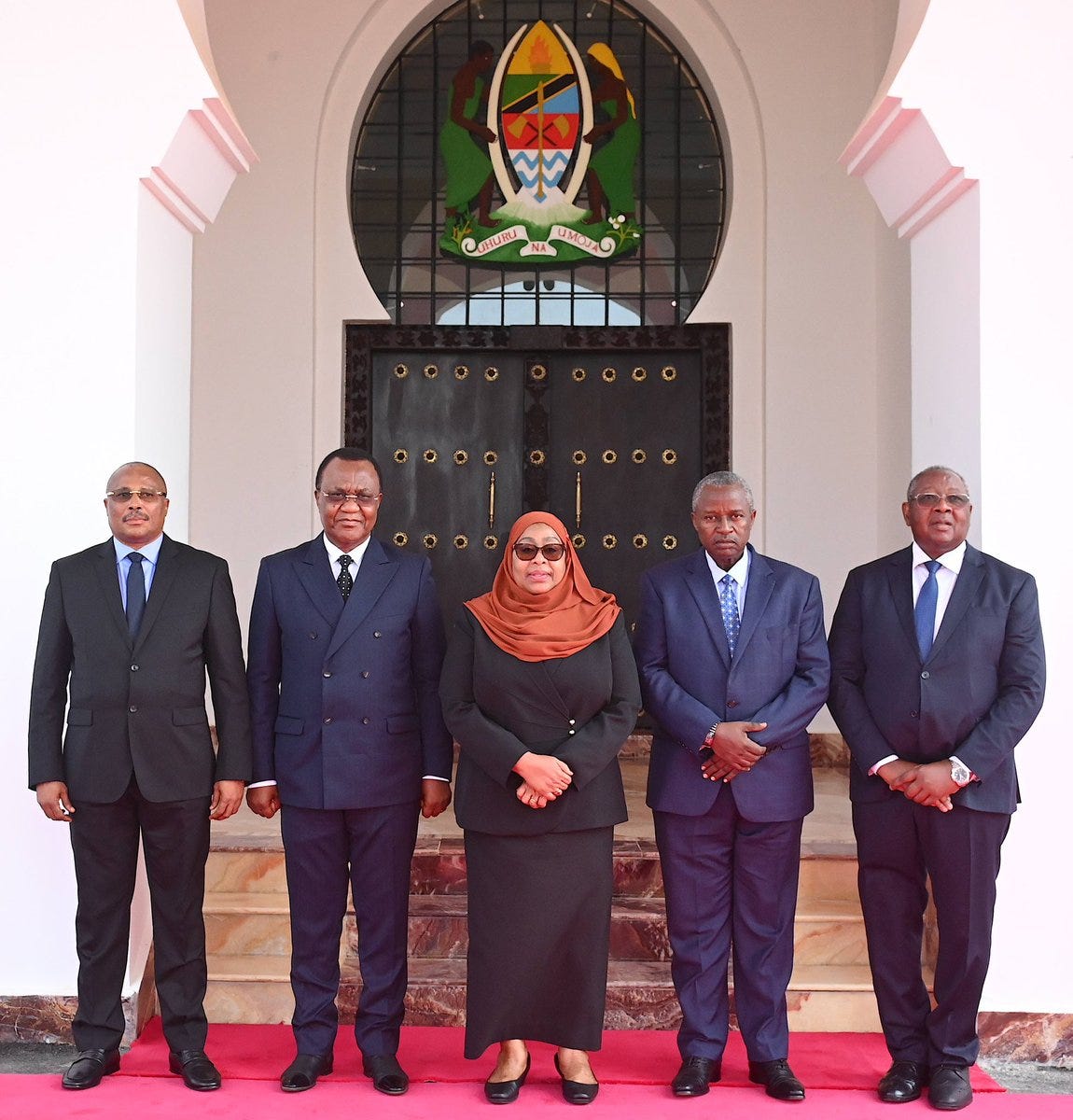
On June 13, 2023, President Samia Suluhu Hassan appointed Haji Omar Kheir as Presidential Adviser on Political and Social Relations. The announcement came via State House’s official social media accounts, alongside three other adviser appointments: Abdallah Bulembo, Rajab Omar Luhwavi, and William Lukuvi.
The appointment’s significance extends beyond the formal advisory role. Most mainland Tanzanians did not pay much attention, but Zanzibaris raised their voices on social media, associating Kheir with major atrocities against dissidents in Zanzibar.
This observation highlights a critical information asymmetry: whilst mainland Tanzanians largely remained unaware of Kheir’s controversial history, Zanzibaris immediately recognized the implications based on lived experience with his alleged security operations. The appointment effectively brought a figure with documented allegations of directing paramilitary violence into the innermost circle of presidential governance—with apparent jurisdiction over “political and social relations” that could encompass security responses to political opposition.
The timing proves significant when analyzed against Tanzania’s democratic trajectory. President Samia had initially (March-June 2021) implemented reforms that generated international optimism: reversing her predecessor John Magufuli’s COVID denial, lifting newspaper bans, and engaging in economic diplomacy. However, the period from mid-2023 onwards saw accelerating repression—cabinet reshuffles returning Magufuli hardliners, attacks on opposition figures, media restrictions, and ultimately the catastrophic October 2025 election violence.
⚠️ 2015 VOTER REGISTRATION VIOLENCE: FIRST MAJOR ALLEGATIONS
The first major public allegations against Kheir emerged during Zanzibar’s June-July 2015 voter registration period. The Citizen newspaper published “Straight Talk: Zanzibar now at the mercy of hooligans” on July 5, 2015, documenting a campaign of systematic violence.
Hooded vigilantes invaded Coconut FM radio station in Zanzibar Town in daylight, suspected to be from “Zanzibar government’s own brigades – KMKM, Fire Department, JKU, Volunteers and Mafunzo.” The vigilantes were angry at public condemnation of minister Haji Omar Kheir for letting them loose to beat and threaten people during voter registration.
When questioned by Coconut FM, Kheir denied having knowledge of the vigilantes and claimed “those were hooligans and they have nothing to do with the government’s own brigades, whilst everyone saw them around in government vehicles.” This denial-despite-evidence pattern would recur in subsequent allegations.
The vigilantes carried sub-machine guns, pangas, clubs and at least one chainsaw when invading and parading at the radio station. Police denied knowledge of vigilantes despite public reports of beatings, attacks, abductions, and torture. Several people were arrested by police “and their only folly being to resist the vigilantes.”
Corroboration from Opposition Sources: Late opposition leader Maalim Seif Sharif Hamad provided detailed testimony at a press conference in Johannesburg, South Africa on October 13, 2015. His statement, archived by ZanziNews, directly named Kheir:
“The Revolutionary Government’s Special Forces, under the order of the Minister of State in the President’s Office, Haji Omar Kheri, used live ammunition and arrested over 100 people without legal grounds, other than that they supported the CUF [Civic United Front opposition party].”
Maalim Seif documented that during June-July 2015, police and paramilitary units unleashed a systematic campaign of violence and intimidation against CUF supporters. The violence included “beatings, kidnappings and rape” targeting CUF supporters presenting themselves for voter registration and CUF agents questioning illegal voters. Over 100 people were arrested without legal grounds, and “the majority of those who were illegally arrested have since been released, but only following intense intimidation and torture.”
Source Assessment: The Citizen is a major IPP Media publication and Tanzania’s leading English-language newspaper. Whilst Tanzania’s media environment involves government pressure, The Citizen has maintained investigative capacity. Maalim Seif’s testimony, whilst from an opposition perspective, was made under his name at a formal press conference and provides specific operational details (force types, arrest numbers, methods). The convergence of independent reporting and direct opposition testimony strengthens credibility, particularly given Kheir’s documented ministerial authority over the security forces named.
🔴 2020 PEMBA ALLEGATIONS: DIRECT ACCUSATION OF KILLINGS
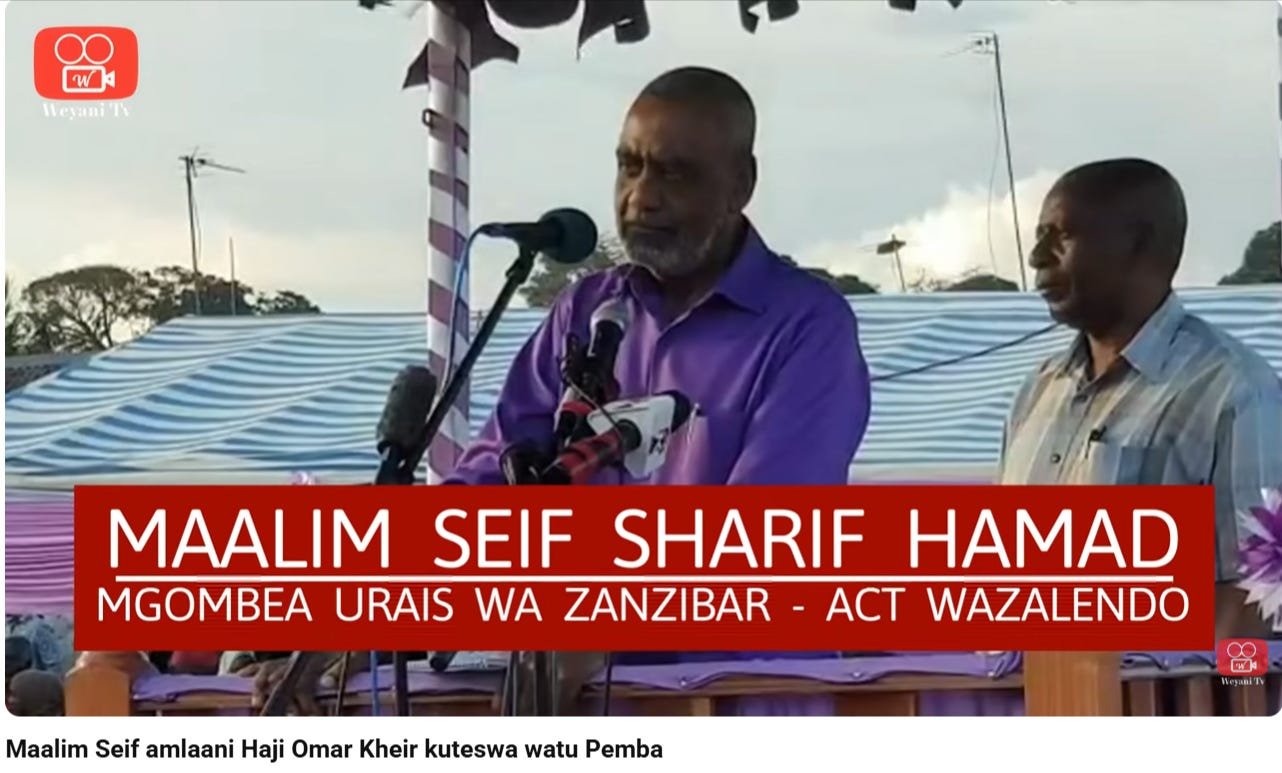
In the lead-up to Zanzibar’s October 2020 elections, Maalim Seif made his most explicit public accusation. On September 23, 2020, in a speech posted to Weyani TV YouTube channel, he “categorically” stated the person who was responsible for sending (’his own’) troops to kill some people in Pemba is ‘one person and is well-known’ to the Zanzibari. Without mincing words, he named Haji Omar Kheir directly.
The late opposition leader emphasised these were NOT regular police forces but “Haji Omar Kheir’s own forces,” expressing disappointment that “no legal action was taken.” He singled out those in higher echelons of power in Zanzibar in 2020 as “not being any different” from those responsible for historical violence.
Context of 2020 Election Violence: Human Rights Watch documented that during October 26-30, 2020, at least 14 people were killed and 55 injured in Zanzibar during and after voting. The victims included:
Massoud Salim Fadhal, 16 (student) - shot in the back by security forces at Mtemani Primary School, Wete district, Pemba, just after midnight on October 27
Abdalla Said Abdalla, 24 - killed at midnight October 26 at Chwaka Primary School, Tumbe, Pemba, when security forces fired teargas and live bullets
Asha Haji Hassan (pregnant woman) - shot by armed uniformed men (police/Vikosi) in Kangagani village, Pemba, around 9pm October 26
Police, soldiers, and armed men in civilian clothes used tear gas and shot at crowds. Multiple witnesses described Mazombi (hooded men in black civilian clothes) chasing and beating people at polling places, setting up makeshift camps for detaining and beating opposition supporters, and operating with complete impunity alongside uniformed forces.
Torture and Enforced Disappearance: Seventy-two-year-old political commentator Ameir Ameir Soud was abducted from his home in Bwejuju, Unguja on October 26, 2020. Fellow detainees reported he was taken to a torture room and never returned. He was dumped at Madema police station 24 days later in “very bad condition”—legs not functioning, eye problems. He told family he was tortured. He died November 24, 2020 in hospital.
Zanzibar Inspector General of Police Simon Sirro acknowledged only 2 deaths from “sporadic violence.” No investigations were conducted. No accountability measures were taken. This pattern of impunity mirrors responses to the 2001 massacres when President Benjamin Mkapa publicly congratulated security forces for an “excellent job” after they killed at least 35 people.
Source Assessment: Maalim Seif Sharif Hamad was not a fringe figure but Zanzibar’s First Vice President (2010-2015, 2020-2021) under power-sharing arrangements, with a 29-year career as opposition leader and former Chief Minister under CCM (1984-1988) before his 1988 expulsion and 1989-1991 imprisonment as prisoner of conscience designated by Amnesty International. His accusations, made publicly and under his own name with political and legal risks, carry substantial weight. He died February 17, 2021 from COVID-19 complications—months after the 2020 violence. Human Rights Watch’s independent investigation corroborates the pattern of security force and militia violence in Pemba that Maalim Seif attributed to Kheir’s command.
🚨 THE ATUHAIRE AND MWANGI TORTURE CASE: INTERNATIONAL VICTIMS IDENTIFY KHEIR
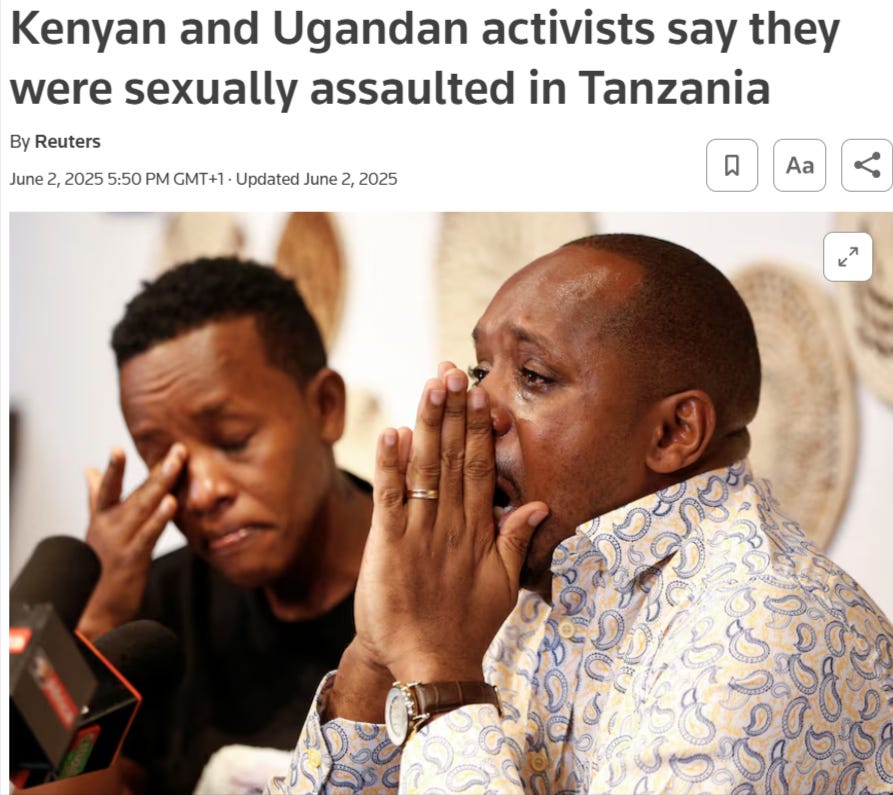
On May 19, 2025, Ugandan journalist and activist Agather Atuhaire and Kenyan activist Boniface Mwangi were abducted from the Serena Hotel in Dar es Salaam. They had travelled to Tanzania to observe the treason trial of opposition leader Tundu Lissu, who faced charges carrying potential death penalty for advocating electoral reforms.
Documented Torture: At a press conference on June 2, 2025, both activists provided detailed accounts of their four-day ordeal. They were:
Taken first to Immigration Department offices and Central Police Station in Dar es Salaam
Then forcibly removed by unidentified persons to unknown locations
Stripped naked, blindfolded, and handcuffed
Subjected to severe torture including sexual violence
Mwangi was tied upside down to a metal pole and beaten on the soles of his feet with wooden planks
Both were sexually assaulted with objects whilst captors played gospel music to drown screams
Forced to chant “Asante Mama Samia” (Thank you President Samia)
Threatened with video recordings of the assault
Mwangi was dumped at Horohoro border (Tanzania-Kenya) on May 22, 2025. Atuhaire was dumped at Mutukula border (Tanzania-Uganda) on May 23, 2025. Both suffered multiple fractures, broken toes, and severe psychological trauma requiring ongoing treatment.
Identification of Haji Omar Kheir: When Atuhaire and Mwangi filed their lawsuit at the East African Court of Justice on July 18, 2025: “With the assistance of the photographs, videos, and social media posts that were shown to them,” the duo was “able to identify… their captors and torturers…” One person identified was “Mr Haji Omar Kheir – Presidential Adviser.”
The primary perpetrator identified was Tanzanian Assistant Commissioner of Police Faustine Jackson Mafwele (age 47), whom both victims described as the lead coordinator who personally assaulted them, threatened sexual violence, and coordinated their transfer to torture sites. However, Kheir’s identification by the victims places a sitting Presidential Adviser at the scene of an internationally condemned torture incident.
No one resigned. And no one fired him.
International Condemnation: The case generated significant international response:
US Bureau of African Affairs (May 23, 2025): “The United States is deeply concerned by reports of the mistreatment in Tanzania” of the activists, noting Atuhaire’s 2024 International Women of Courage Award
Amnesty International Regional Director Tigere Chagutah: “For four days, these two human rights defenders were subjected to unimaginable cruelty... there must be accountability and justice”
UN experts issued joint press release June 13, 2025 condemning the violations
International Bar Association’s Human Rights Institute and multiple legal organisations demanded investigations
The activists filed suit seeking $1 million compensation each, public apologies from Tanzania, Uganda, and Kenya, and institutional reforms. They also plan International Criminal Court filings.
Source Assessment: Both victims are internationally recognised figures—Atuhaire received the US State Department’s 2024 International Women of Courage Award; Mwangi is Kenya’s most prominent photojournalist and human rights activist. Their detailed, consistent testimony provided under oath in legal proceedings, corroborated by documented injuries requiring medical treatment, and supported by international human rights organisations including Amnesty International and the UN, establishes high credibility. Tanzania’s government response—denials without providing alternative explanations, refusal of consular access during detention, and failure to investigate despite international pressure—follows the pattern of official protection seen in previous allegations against Kheir.
💀 OCTOBER 29, 2025 ELECTION VIOLENCE: OPERATIONAL PARALLELS AND PRE-DEPLOYMENT INTELLIGENCE
Tanzania’s October 29, 2025 general election produced catastrophic violence and disputed casualty figures that, if confirmed at upper estimates, would represent one of Africa’s deadliest electoral crackdowns in recent decades.
Pre-Election Suppression: The electoral environment was fundamentally compromised before voting began:
April 2025: Main opposition party CHADEMA disqualified from participation after refusing to sign electoral code of conduct
Opposition leader Tundu Lissu: Arrested on treason charges in April 2025, remained detained through election day, faces potential death penalty
ACT-Wazalendo candidate Luhaga Mpina: Disqualified by electoral commission
Only 16 minor opposition candidates allowed to contest
UN Human Rights experts documented over 200 enforced disappearances since 2019. Human Rights Watch reported at least 10 politically-motivated assaults, harassment, abductions, and torture in September 2025 alone. Amnesty International documented 83 disappearances of opposition party members during the campaign period, warning elections “risk becoming a procedural affair devoid of legitimacy.”
The October 25 Warning: A JamiiForums thread posted by user “Brittanica” on October 25, 2025—four days before the election—claimed an ununiformed force of 320 had been deployed countrywide with orders to “arrest all those who oppose the government” and that the order was “shoot to kill.” The forces would use Land Cruisers rather than special vehicles, and would be swapping plates as needed to avoid identification. Most people dismissed this as “far-fetched and/or a mere conspiracy theory.”
Election Results: President Samia Suluhu Hassan was declared winner with 97.66% of the vote (31,913,866 out of 32,678,844 votes cast), with reported turnout at 87%—unprecedented in Tanzania’s multiparty history. Regional observer missions condemned the process: SADC declared the elections did not meet standards for credible, free, fair process; the African Union observation mission stated the process “did not comply with AU principles and international democratic standards.”
Violence and Death Toll: Protests erupted on election day morning in Dar es Salaam and spread to Arusha, Mwanza, Mbeya, Tunduma, and Dodoma. The government imposed a nationwide curfew, ordered residents into 24-hour lockdown (October 29-November 3), implemented complete internet shutdown (October 29-November 3), and deployed military forces alongside police throughout the country.
Disputed Casualty Figures:
Opposition CHADEMA claims: Initially ~700 deaths (350 in Dar es Salaam, 200+ in Mwanza), later updated to 2,000 deaths. Additional claims that police disposed of 400+ bodies at undisclosed locations
UN OHCHR: Initially confirmed at least 10 deaths (October 31), then stated “hundreds” killed based on multiple sources (November 11), noting inability to independently verify due to internet blackout and access restrictions
Amnesty International: At least 100 deaths documented
BBC diplomatic source: Credible evidence of at least 500 deaths
Security source to AFP: Reports of 500-800 deaths
Jumuiya ni Yetu coalition (civil society): Estimates between 5,000-10,000 based on compiled names and hospital/police station searches
Tanzania government position: “No excessive force used,” “no official figures,” “no number of any protesters killed,” claimed only “pockets of violence” and vandalism
Verified Incidents: BBC Verify authenticated multiple videos showing police shooting at fleeing protesters on Nelson Mandela Road in Dar es Salaam, a woman in a purple jacket shot and falling to the ground in Arusha, 10 bodies piled at Sekou Toure Hospital in Mwanza, and casualties with various injuries across Dar es Salaam. Human Rights Watch documented a neighbour of their source being shot and killed outside his home on October 30 at 3:30pm in Temeke district by a man in civilian clothes—the victim was not participating in protests.
Operational Methods: Security forces used live ammunition against protesters and bystanders, tear gas, and systematic removal of bodies from streets and hospitals to undisclosed locations. Families were prevented from claiming bodies. More than 150 people were arrested post-election, with 240 charged with treason and criminal conspiracy by November 5, including children. Reports suggested mass graves dug at Mabwepande, though independent verification remained impossible due to access restrictions.
Unconfirmed but Credible Allegations: Multiple sources reported deployment of Ugandan security forces to assist Tanzanian authorities, with protesters claiming to have confronted individuals who could not speak Swahili. President Samia’s son, Abdul Halim Hafidh Ameir, was widely accused of overseeing the crackdown, allegedly leading an “informal task force” of police and intelligence services and controlling the Tanzania Intelligence and Security Service (TISS) as de facto leader.
Operational Parallels: The operational similarities between Zanzibar’s historical security force deployments and the October 2025 mainland violence include:
Use of forces in civilian clothes alongside uniformed personnel
Live ammunition against unarmed civilians
Systematic body removal to prevent casualty documentation
Torture in unofficial detention sites
Impunity for perpetrators
Official denial despite overwhelming evidence
Targeting of opposition strongholds
“Why is this Modus Operandi (MO) so similar to what we witnessed on the tragic October 29 and its immediate aftermath? How come this MO is akin to what our fellow Zanzibaris were complaining about back then? Could it have something to do with June 13, when someone special entered the State House?”
Source Assessment: The casualty figures remain highly disputed due to the government’s complete information blackout—internet shutdown prevented real-time documentation, foreign journalists were denied accreditation, and bodies were systematically removed from public view. However, the convergence of estimates from UN human rights officials (hundreds), diplomatic sources (500+), and human rights organisations (100+) establishes that deaths occurred on a massive scale, far beyond the “sporadic violence” claimed by authorities. The government’s refusal to provide any official death toll, combined with evidence of deliberate body concealment, suggests figures in the high hundreds to low thousands are plausible. UN High Commissioner for Human Rights Volker Türk’s November 11 statement calling the reports “harrowing” and the African Commission on Human and Peoples’ Rights noting violations “would constitute very grave violations of the African Charter” if confirmed, provide authoritative international assessment of the crisis’s severity.
💰 WEALTH ACCUMULATION AND FAMILY PATRONAGE
Multiple sources reference allegations that Kheir acquired substantial assets including apartment buildings, vehicles, land, and farms. Additionally, two of his daughters reportedly hold special seats amongst CCM’s 113 women Members of Parliament—a concentration of family representation suggesting patronage networks operating within the party’s allocation system.
These wealth and patronage claims, whilst consistent with patterns documented across Zanzibar’s political elite, could not be fully verified through accessible government asset declarations or independent financial investigation. Tanzania lacks robust public asset declaration systems for government officials, and investigative journalism faces significant constraints. The absence of verification does not constitute evidence of absence, particularly in a governance environment where asset declaration requirements remain weak and political patronage structures operate with limited transparency.
🎯 STRUCTURAL ANALYSIS: THE SIGNIFICANCE OF JUNE 13, 2023
Assistant Professor Chambi Chachage (Howard University, PhD from Harvard University) published “Tragic October 29: Tanzania’s Turning Point?” in The Chanzo on November 8, 2025. His analysis provides the most comprehensive academic assessment of Haji Omar Kheir’s appointment and its implications.
The Central Hypothesis: Chachage identifies President Samia’s June 13, 2023 appointment of Kheir as a critical turning point in Tanzania’s democratic trajectory. He poses the fundamental question: “Who or what exactly halted the brief repose that characterised the then-celebrated first 100 days in office of President Samia Suluhu Hassan in 2021?”
Presidential Trajectory Analysis: Samia assumed the presidency on March 19, 2021 following John Magufuli’s death. Her first months generated international optimism—she reversed COVID denial policies, lifted newspaper bans, released political prisoners initially, and engaged in economic diplomacy. US Vice President Kamala Harris visited in March 2023, pledging support for Tanzania’s economic growth.
However, progressive deterioration followed:
July 21, 2021: Opposition leader Freeman Mbowe arrested on terrorism charges, held 7 months
2022-2023: Forced evictions of Maasai communities with violence documented by UN experts
June 13, 2023: Kheir appointed Presidential Adviser
Late 2023-2024: Progressive return of Magufuli hardliners to cabinet, four cabinet reshuffles in 2024 alone, reinstatement of Paul Makonda (a figure designated by US State Department for human rights abuses)
2024: Murder of CHADEMA official Ally Kibao, attack on CHADEMA official Aisha Machano, hundreds of CHADEMA members detained
April 2025: Opposition leader Tundu Lissu arrested on treason charges, CHADEMA barred from elections
October 2025: Election violence with hundreds to thousands killed
Mainland vs. Zanzibar Information Asymmetry: Chachage emphasises that Kheir’s appointment generated immediate alarm amongst Zanzibaris on social media, who “all associated him with some major atrocities against dissidents in Zanzibar,” whilst mainland Tanzanians “did not pay much attention.” This information gap prevented early recognition of the implications on the mainland, where Zanzibar’s security force methodologies remained relatively unknown.
Operational Transfer Hypothesis: Chachage’s analysis suggests Kheir’s appointment facilitated the operational transfer of Zanzibar security force tactics to mainland Tanzania. The operational continuity—use of paramilitary structures outside normal police command, deployment of forces in civilian clothes, live ammunition against unarmed civilians, systematic concealment of bodies, torture in unofficial sites, complete impunity—suggests adaptation of Zanzibar methodologies to mainland scale.
The Institutional Question: “Why would a President of the United Republic of Tanzania appoint a former Minister in the President’s Office of the Revolutionary Government of Zanzibar, responsible for Special Forces, to be her political adviser?” The appointment becomes explicable if Samia sought to replicate Zanzibar’s proven capacity for electoral control through security force deployment—maintaining political dominance through violence and intimidation whilst preserving plausible deniability through paramilitary structures.
Assessment of Chachage’s Analysis: His credentials as an academic at a major US university with expertise in Tanzania politics and business history, combined with his evidence-based approach connecting documented historical patterns to contemporary events, provide strong analytical foundation. His identification of June 13, 2023 as a turning point is supported by temporal correlation—the appointment preceded the acceleration of repressive tactics and the October 2025 violence. However, Chachage himself acknowledges this as hypothesis requiring further investigation, noting the appointment “could” have significance rather than asserting definitive causation.
The alternative explanation—that deterioration was already underway (Freeman Mbowe’s July 2021 arrest) and Kheir’s appointment was symptom rather than cause—merits consideration. However, the scale and operational sophistication of October 2025 violence, combined with the specific identification of Kheir by torture victims in May 2025, suggests his State House role involved more than symbolic advisory function.
📅 HISTORICAL CONTEXT: ZANZIBAR’S THREE DECADES OF ELECTORAL VIOLENCE
Understanding Kheir’s alleged role requires examining Zanzibar’s documented pattern of election-related violence since multiparty democracy began in 1995.
2000-2001: The Worst Massacres: Following the October 2000 election—where CCM candidate Amani Abeid Karume was declared winner despite fraud allegations—opposition party CUF called for peaceful demonstrations on January 27, 2001. Human Rights Watch’s comprehensive investigation “The Bullets Were Raining” documented at least 35 killed, over 600 injured, and 2,000 fled to Kenya as refugees.
At four massacre locations across Zanzibar Town and Pemba Island (Wete, Micheweni, Chake Chake), Tanzania Police Force, Tanzania People’s Defence Forces (army), KMKM coastguard, JKU National Youth Service members, and CCM militia opened fire on peaceful demonstrators. One witness in Wete, Pemba described: “About seventy security officers. I counted forty of them with guns. All of them were shooting. One of them was shouting, ‘Shoot! Kill! Kill!’” Four people died in that single incident.
Security forces blocked hospital access, denying medical care to the wounded. A police helicopter attacked boats attempting to transport injured to Kenya for medical care, sinking at least one boat with unknown deaths. In the days following, security forces conducted house-to-house rampages, indiscriminately arresting, beating, and sexually abusing residents. Police dragged people from homes and hospital wards into overcrowded cells where torture and rape were documented.
Government Response: President Benjamin Mkapa publicly congratulated security forces for their “excellent job in restoring order.” Several officers received promotions. Eight police officers who refused to participate were arrested and fired. A 2002 Commission of Inquiry acknowledged major human rights abuses including killings, torture, and rape but recommended NO prosecutions. No security force member was ever held accountable.
2005-2015: Continued Violence and Manipulation: The 2005 election saw “pitched battles” between CCM and CUF supporters. The 2010 election proved relatively peaceful due to a Government of National Unity arrangement where runner-up Maalim Seif became First Vice President. But 2015 marked a new crisis when Zanzibar Electoral Commission Chairman Jecha Salim Jecha unilaterally annulled results after 31 of 54 constituencies were declared—opposition claimed victory before annulment. International observers from the EU and African Union had found the election “generally peaceful and organised,” making the annulment clearly political.
Pattern of Impunity: Across all election cycles, no security force member or government official has been prosecuted for election violence. Academic research from the International Crisis Group and Centre for Strategic and International Studies documents that this impunity is structural—Zanzibar’s electoral commission operates as CCM instrument, security forces receive advance authorisation for violence, and judicial independence remains constrained.
The late Maalim Seif Sharif Hamad—who contested every election from 1995 to 2020—repeatedly documented this pattern. His February 17, 2021 death from COVID complications occurred before he could see accountability for the 2020 violence in which at least 14 were killed. His public naming of Haji Omar Kheir in 2015 and 2020 as responsible for security operations represents his attempt to establish individual accountability within this system of collective impunity.
📚 SOURCE RELIABILITY AND INFORMATION QUALITY ASSESSMENT
This intelligence profile synthesises evidence from multiple source categories with varying reliability levels:
Tier 1 - Highest Reliability (Official/Primary Documents):
Zanzibar House of Representatives official CV for Haji Omar Kheir
State House official social media announcements
Human Rights Watch investigative reports (multi-year documentation with field research)
Sworn legal filings (East African Court of Justice lawsuit by Atuhaire/Mwangi)
Tier 2 - High Reliability (Established Media and Academic):
The Citizen newspaper (major Tanzanian publication, IPP Media)
The EastAfrican (regional newspaper of record)
The Chanzo (independent investigative journalism platform, Chambi Chachage analysis)
Academic research from International Crisis Group, CSIS, ISS Africa, Chatham House
BBC, Al Jazeera, Reuters, AFP (international news with editorial standards)
Tier 3 - Moderate Reliability (Opposition/Activist Sources with Corroboration):
Maalim Seif Sharif Hamad’s statements (opposition leader but documented under own name with political/legal risk, corroborated by independent investigations)
CHADEMA casualty claims (partisan but specific, partially corroborated by international sources)
Torture survivor testimony from Atuhaire/Mwangi (corroborated by medical evidence and international organisations)
Tier 4 - Limited Reliability (Unverified Claims):
JamiiForums posts (anonymous forum content, though October 25 post was prescient)
Specific wealth accumulation details (no documentation accessible)
Family biographical details (brothers’ names - no verification, though daughters in parliament has community confirmation)
Highest casualty estimates (5,000-10,000 from civil society groups - no verification possible)
Information Gaps and Limitations:
Body Count Verification: The October 2025 death toll remains fundamentally unknowable due to deliberate government actions—internet blackout prevented real-time documentation, bodies were systematically removed, families prevented from claiming deceased, and independent investigation blocked. The range from 500 to 2,000 deaths represents reasonable extrapolation from partial data, but definitive figures may never be established.
Kheir’s Direct Operational Role: Whilst multiple credible sources name Kheir as responsible for security operations, the specific command-and-control mechanisms remain unclear. Did he issue direct orders? Did he provide strategic oversight whilst subordinates executed operations? Did forces operate with his approval but independent initiative? The ministerial position and adviser role establish authority and access, but the precise operational chain requires additional investigation.
Financial Documentation: Tanzania’s weak asset declaration requirements and constrained investigative journalism environment prevent verification of wealth accumulation claims. This represents a systemic limitation rather than specific exoneration.
Government Perspective: Tanzania’s government has provided no substantive response to allegations against Kheir—no investigations announced, no alternative explanations offered, no documentation released. This silence, combined with the pattern of protection (no dismissal after torture victims identified him), suggests official acquiescence but leaves the government’s specific position undocumented.
🎯 INTELLIGENCE ASSESSMENT AND CONCLUSION
Verified Core Facts:
Haji Omar Kheir (born January 10, 1960) served six terms representing Tumbatu constituency in Zanzibar House of Representatives (1995-2025)
He held ministerial positions including Minister in President’s Office (Special Forces) under Zanzibar President Dr. Ali Mohamed Shein
President Samia Suluhu Hassan appointed him Presidential Adviser on Political and Social Relations on June 13, 2023
The Citizen published allegations in July 2015 linking him to vigilante violence during voter registration
Opposition leader Maalim Seif Sharif Hamad named him publicly in 2015 and 2020 as responsible for security operations and killings in Pemba
Torture survivors Agather Atuhaire and Boniface Mwangi identified him amongst their captors/torturers in May 2025
He has not been dismissed, investigated, or charged despite these allegations
Tanzania’s October 29, 2025 election killed hundreds to potentially thousands of people
Security force operations in 2025 displayed operational similarities to documented Zanzibar security force methods from 2015 and 2020
Credible but Unverified Allegations:
Direct command responsibility for specific killings in Pemba and elsewhere
Personal presence during May 2025 torture of Atuhaire and Mwangi (they identified him but primary torturer was Assistant Police Commissioner Mafwele)
Coordination role in October 2025 election violence
Substantial wealth accumulation through official position
Two daughters serving as special seat MPs
Analytical Conclusions:
Pattern Recognition: Thirty years of consistent allegations from independent sources (established newspapers, opposition leaders, international victims, human rights organisations, academic analysts) establish a pattern that exceeds coincidence or political vendetta.
Operational Signature: Use of government brigades operating outside normal police structures, forces in civilian clothes alongside uniformed personnel, live ammunition against unarmed civilians, torture in unofficial sites, systematic body concealment, complete impunity—appears consistently in allegations from 2015 (voter registration violence), 2020 (election killings in Pemba), May 2025 (torture of international activists), and October 2025 (mainland election violence).
Structural Role: Kheir represents a category of security operator common in authoritarian contexts—individuals who occupy formal government positions whilst allegedly directing paramilitary violence that maintains regime control whilst preserving plausible deniability.
June 13, 2023 Significance: Temporal correlation between Kheir’s State House appointment and acceleration of repressive tactics supports hypothesis that his role involved operationalising Zanzibar security methodologies at mainland scale.
However, the question of individual criminal responsibility versus systemic institutional function requires careful distinction. Kheir operated within governance structures that have systematically protected security force violence—no prosecutions after the 2001 massacres, no investigations after 2020 violence, no accountability after 2025 torture and killings. He may be less individual aberration than effective operator within a system designed for political violence with impunity.
The international human rights community’s response—UN High Commissioner calling reports “harrowing,” African Commission on Human and Peoples’ Rights noting potential “very grave violations of the African Charter,” US, UK, Canada, and Norway issuing joint condemnation—establishes that Tanzania’s October 2025 violence constitutes a major human rights crisis regardless of which specific individuals commanded operations.
Outstanding Intelligence Questions:
What specific operational role did Kheir play in October 2025 security deployments?
What is the precise relationship between his advisory position and security force command structures?
Were operational plans for October 2025 developed in Zanzibar or adapted from Zanzibar methodologies?
What role did President Samia’s son Abdul Halim Hafidh Ameir play, and what is his relationship to Kheir?
Were Ugandan security forces deployed, and if so, who coordinated cross-border operations?
Where are the bodies of October 2025 victims who disappeared from hospitals and streets?
Will international mechanisms (ICC, East African Court of Justice) establish individual criminal responsibility?
Strategic Implications:
If Kheir’s appointment did facilitate the operational transfer of Zanzibar security methodologies to mainland Tanzania, it represents a significant evolution in East African authoritarianism—the systematic application of island-scale repression techniques to a nation of 65 million people. The October 2025 violence, if confirmed at upper casualty estimates, would represent one of Africa’s deadliest electoral crackdowns since the 2007-2008 Kenya crisis (1,000+ deaths).
The complete impunity enjoyed despite international condemnation suggests Tanzania’s government calculates that economic relationships and geopolitical considerations will prevent meaningful consequences. The appointment of family members to ministerial positions immediately after the violence signals confidence that the crisis has been successfully managed rather than requiring accountability.
For regional stability, the precedent is ominous—a government conducting mass killings, maintaining power through 97.66% electoral “victory,” and facing no practical consequences beyond rhetorical condemnation. If Tanzania’s democratic collapse proceeds without accountability, it establishes a template for authoritarian consolidation in East Africa.
Haji Omar Kheir emerges from this analysis not as isolated perpetrator but as skilled operator within a system that demands political violence whilst requiring deniability. Whether he will ultimately face accountability—through domestic processes, regional courts, or international mechanisms—remains the outstanding question determining whether Tanzania’s October 2025 turning point leads towards justice or entrenched impunity.
🔍 FREQUENTLY ASKED QUESTIONS
Q: Who appointed Haji Omar Kheir as Presidential Adviser?
A: President Samia Suluhu Hassan appointed Kheir on June 13, 2023.
Q: What was Kheir’s role in Zanzibar’s government?
A: Kheir served as Minister in the President’s Office overseeing “Special Forces” and held multiple ministerial portfolios (2010-2020) under Zanzibar President Dr. Ali Mohamed Shein.
Q: What evidence links Kheir to torture?
A: Torture survivors Agather Atuhaire and Boniface Mwangi identified Kheir through photographs and videos after their May 19-23, 2025 abduction and torture in Dar es Salaam.
Q: Who was Maalim Seif Sharif Hamad?
A: Zanzibar’s First Vice President (2010-2015, 2020-2021), 29-year opposition leader, former Chief Minister under CCM before his 1988 expulsion and 1989-1991 imprisonment as Amnesty International prisoner of conscience. He died February 17, 2021 from COVID complications.
Q: How many people died in Tanzania’s October 2025 election violence?
A: Estimates range from hundreds to thousands, with UN High Commissioner for Human Rights confirming “hundreds” killed, diplomatic sources indicating around 1,000, and civil society groups estimating 5,000-10,000.
Q: Has Kheir been investigated or charged?
A: No. Despite allegations spanning 2015-2025 from multiple credible sources including torture victims, Kheir faces no investigation, dismissal, or criminal charges.
Q: What are Zanzibar’s “Special Forces”?
A: Paramilitary structures distinct from Tanzania’s union police force, including KMKM (anti-smuggling unit), JKU (National Youth Service), KVZ (volunteer forces), FFU (riot police), and Mazombi militia.
📎 PRIMARY SOURCES CONSULTED
Official Zanzibar House of Representatives records
State House Tanzania official announcements
UN High Commissioner for Human Rights official statements (2025)
Human Rights Watch: “The Bullets Were Raining” (2002), election violence documentation (2020, 2025)
US State Department statements and Country Reports on Human Rights Practices
East African Court of Justice lawsuit filings (Atuhaire/Mwangi v. Tanzania, Uganda, Kenya)
The Citizen, The EastAfrican, BBC, Reuters, AFP
Chambi Chachage, “Tragic October 29: Tanzania’s Turning Point?” The Chanzo (November 8, 2025)
International Crisis Group, CSIS, ISS Africa, Chatham House academic research
Maalim Seif Sharif Hamad archived statements (ZanziNews, Weyani TV)
🔑 Upgrade your Ujasusi Blog subscription and get more for less. Switch to Annual and save 17%, or become a Founding Member to make a lasting impact while enjoying full access to exclusive intelligence insights.
You can also donate.