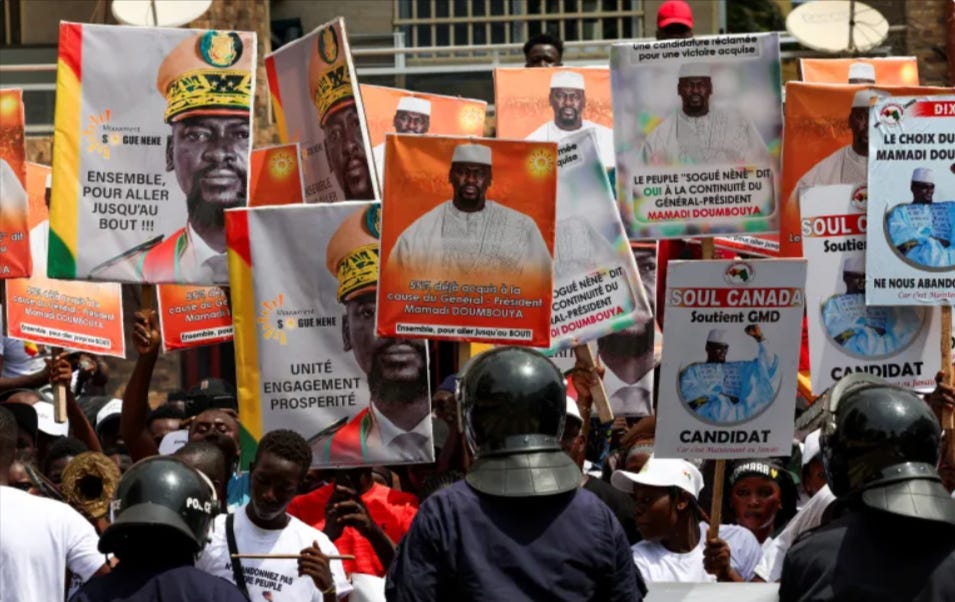
Guinea Elections 2025: Intelligence Brief 🗳️🇬🇳

Ujasusi Blog’s West Africa Monitoring Team | 29 Dec 2025 | 0425 GMT
🔓FREE ACCESS
Please consider becoming a paid subscriber
You can also donate.
Guinea’s 28 December 2025 presidential election was the country’s first national poll since the September 2021 coup that removed Alpha Condé, as documented in contemporaneous Reuters reporting on the military takeover and its aftermath. Conducted under a new constitution approved by referendum in September 2025, the election involved about 6.7 million registered voters and nine approved candidates, with transitional leader Mamady Doumbouya positioned to consolidate power through a seven-year mandate.
What is the strategic significance of the 2025 Guinea elections?
The election represents a managed transition from military rule, rather than a democratic reset. It functioned primarily as a legitimacy-seeking exercise by the post-coup regime, shaped by constitutional engineering, selective candidate exclusion, and extensive state control of political space, patterns highlighted in Al Jazeera’s pre-election analysis and echoed in ECOWAS communiqués on Guinea’s transition.
Strategic implications include:
Normalisation of junta-led governance under civilian constitutional cover, following the September constitutional referendum endorsed by state authorities
Conditional re-engagement with ECOWAS after repeated transition delays noted in regional bloc statements
Low probability of short-term regime change through electoral means, given the exclusion of major opposition figures
Investor confidence anchored more in mining stability than political pluralism, as reflected in international coverage of the Simandou iron ore project
How did Guinea arrive at this election?
Guinea’s political trajectory since 2021 has been defined by elite military capture of the transition process following the 5 September 2021 coup led by Mamady Doumbouya, which ended Alpha Condé’s third-term presidency after months of unrest documented by international media and human-rights organisations.
Key milestones:
September 2021: Military seizure of power and suspension of the constitution, widely reported by Reuters and AFP
2022–2024: Protest bans, party suspensions, arrests of activists, and media restrictions documented in Amnesty International briefings and UN human-rights reporting
September 2025: Constitutional referendum passed with more than 90% approval, according to official results cited by Al Jazeera, allowing transitional leaders to contest elections and extending presidential terms
December 2025: Presidential election held under the revised constitutional framework
The constitutional process was overseen by the transitional authorities rather than an independent constituent body, a concern repeatedly raised in ECOWAS monitoring updates and African Union assessments.
How was the election organised and administered?
The election was administered by the Ministry of Territorial Administration through the Directorate General of Elections, rather than by an independent electoral commission, centralising operational control within the executive branch, as explained in Al Jazeera reporting on Guinea’s voting process.
Operational parameters:
Registered voters: approximately 6.7 million, based on official voter-roll figures cited in international media
Polling stations: 23,662 nationwide, as reported by Al Jazeera and CGTN Africa.
Electoral system: two-round absolute majority
Presidential term: seven years, as stipulated in the new constitution
Turnout expectations were shaped by the September 2025 referendum, which official figures placed above 85%, figures referenced in Reuters and Al Jazeera coverage.
Who were the candidates and who was excluded?
Nine candidates were cleared to run, while the most credible opposition figures were excluded on residency, documentation, or legal grounds following administrative reviews by the authorities, a process scrutinised by international observers and rights groups.
Notable exclusions included longtime opposition leader Cellou Dalein Diallo and former president Alpha Condé, both barred under provisions of the new constitutional and electoral framework, a decision widely reported by Reuters and Al Jazeera.
Approved candidates included:
Mamady Doumbouya (Generation for Modernity and Development)
Aboulaye Yero Baldé (Front for Democracy in Guinea)
Makalé Camara (Front for National Alliance)
Faya Millimono (Liberal Bloc)
Ibrahima Abe Sylla (New Generation for the Republic)
Analysts cited by Al Jazeera noted that none of the approved opposition candidates possessed nationwide mobilisation capacity or organisational depth comparable to the incumbent.
What role did security forces play?
Security forces played a central role in shaping the electoral environment.
Observed patterns included:
Nationwide deployment of military, gendarmerie, and police units before and during voting, reported by Reuters correspondents in Conakry
Enforcement of protest bans throughout the campaign period
Temporary restrictions on social-media platforms, including Facebook, in the week preceding the vote, reported by digital-rights monitors and international media
Preventive arrests and surveillance of activists and organisers reported by local civil-society groups and cited in human-rights reporting
The security posture prioritised order and predictability over electoral competitiveness, consistent with post-coup governance patterns observed since 2021.
How did international actors respond?
International and regional observation missions were present but cautious in their public assessments, framing the election primarily as a stabilisation milestone rather than a democratic breakthrough.
Observer missions included:
ECOWAS, which emphasised calm conduct while reiterating the need for institutional reforms
African Union, which sent an observation mission without endorsing the political process
United Nations, which focused on stability and violence prevention
European Union, which deployed observers while avoiding a formal validation of results
Organisation internationale de la Francophonie, which monitored procedural aspects
What economic factors shaped the vote?
Economic expectations, particularly around extractive industries, were central to regime messaging and public justification for stability-first governance.
Key indicators drawn from international financial institutions:
GDP growth of 5.7% in 2024, driven by mining and non-mining sectors, as detailed in the World Bank’s 2025 Guinea Economic Update
Poverty rate of roughly 52% of the population living below the international $3.65-a-day line, according to World Bank poverty data
Tax revenues averaging about 12.8% of GDP, constraining public spending and social investment
The launch of iron-ore exports from the Simandou project featured prominently in official narratives, reinforcing a development-first legitimacy model tied to large-scale resource exploitation, as analysed in international mining and geopolitical reporting.
How does Guinea compare regionally?
CountryTransition modelElectoral outcomeECOWAS postureGuineaManaged civilianisationJunta leader electedCautious engagementMaliMilitary consolidationElections delayedSanctions and ruptureNigerMilitary consolidationElections suspendedHostileBurkina FasoMilitary consolidationElections postponedHostile
This comparison reflects ECOWAS policy statements and regional security analyses published throughout 2024–2025.
Intelligence Outlook
Short term (0–12 months)
Consolidation of executive authority under Doumbouya
Limited opposition mobilisation capacity
Gradual easing of overt ECOWAS pressure, contingent on post-election stability
Medium term (1–3 years)
Institutionalisation of executive dominance
Increased fiscal dependence on mining revenues, particularly Simandou
Managed civic space punctuated by periodic crackdowns
Long term (3–7 years)
Risk of elite fragmentation if economic expectations from mining revenues fail to materialise
Potential succession and cohesion challenges within the security services
Persistent legitimacy deficits among urban youth populations
Bottom line
Guinea’s 2025 election formalised a new political order rather than restoring democratic competition. Electoral procedures now coexist with structurally insulated power, prioritising stability and resource governance over pluralism, with long-term implications for governance resilience and social cohesion.