

Ujasusi Blog Originals | Intelligence Explainers
Please consider becoming a paid subscriber
You can also donate.
📋 Executive Summary
On 26 November 2025, Guinea-Bissau experienced its latest military coup d’état when army officers deposed President Umaro Sissoco Embaló, suspended the electoral process just three days after general elections, and declared “total control” of the state. This marks another chapter in Guinea-Bissau’s chronic instability—a pattern unmatched in most of sub-Saharan Africa—and raises fundamental questions about civil-military relations, state fragility, and the durability of democratic institutions in West Africa’s narco-state.
This intelligence explainer provides:
Incident chronology and immediate tactical developments
Structural analysis of Guinea-Bissau’s coup-proneness
Actor mapping (military factions, political elites, transnational criminal networks)
Regional security implications for ECOWAS and the Sahel corridor
Comparative case study: Why Tanzania, despite significant democratic erosion and military complicity in post-election massacres under President Samia Suluhu Hassan, has never experienced a military coup
Key Intelligence Assessment: Guinea-Bissau’s coup is best understood not as an aberration but as the logical outcome of a failed post-colonial state-building project characterised by narcotised political economy, factionalised security forces, and the absence of unified political control. By contrast, Tanzania avoids coups not through military professionalism or democratic civilian oversight—both absent—but through successful party-military fusion where the Tanzania People’s Defence Force (TPDF) is structurally subordinated to the ruling Chama Cha Mapinduzi (CCM) party. When the military and ruling party form a unified authoritarian apparatus, coups become structurally unnecessary.
🔫 Incident Chronology: What Happened on 26 November 2025
Initial Tactical Phase (Morning, 26 November)
Heavy gunfire erupted near two critical nodes in Bissau: the presidential palace and the National Electoral Commission headquarters. Witnesses reported sustained automatic weapons fire, suggesting coordinated military action rather than spontaneous violence or localised factional clashes.
Military Declaration (Midday)
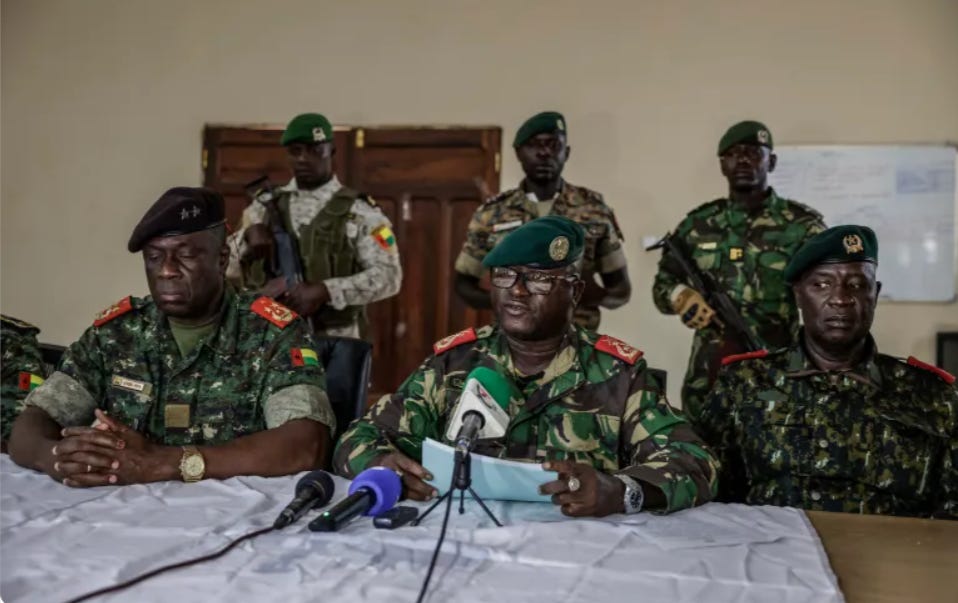
Military officers appeared on state television and radio to announce:
The removal of President Umaro Sissoco Embaló from power
Assumption of “total control” by a self-described military “high command” representing all branches of the armed forces
Closure of all land, air, and sea borders
Imposition of a nationwide curfew
Suspension of the electoral process and annulment of the 23 November 2025 general elections
The public face of the coup was General N’ha, though the statement emphasised collective military leadership rather than a single strongman.
Presidential Response
President Embaló himself confirmed his arrest in media statements, explicitly characterising events as a coup d’état led by the army chief of staff. This represents a rare instance of a deposed leader publicly acknowledging a coup in real-time, suggesting either:
A genuine loss of control over communications infrastructure, or
A strategic decision to frame the narrative internationally before the junta could consolidate
Justification Narrative
The coup leaders claimed their intervention was triggered by the “discovery” of an electoral manipulation plot involving:
National political figures (unspecified)
A “well-known drug trafficker” (likely referencing Guinea-Bissau’s narco-trafficking networks)
“Foreign actors” (potentially Portugal, France, or narco-trafficking cartels from Latin America)
Intelligence Assessment: This justification follows a familiar pattern in African military coups—wrapping a power grab in the language of defending democratic integrity. However, Guinea-Bissau’s narco-trafficking context means the claim of criminal interference in elections is entirely plausible, even if weaponised for political purposes.
⚖️ Electoral Context: A Disputed Vote as Coup Trigger
23 November 2025 General Elections
Guinea-Bissau held combined presidential and legislative elections on 23 November 2025 in an atmosphere of acute political polarisation. The dual-ballot design—intended to streamline political transition—instead created a high-stakes, winner-take-all contest that heightened pre-existing tensions.
Contested Results and Dual Claims of Victory
Before official results were announced, both President Embaló and main challenger Fernando Dias da Costa claimed victory. This echoes the 2019-2020 electoral crisis and demonstrates the absence of institutional trust in Guinea-Bissau’s electoral commission—itself a symptom of deeper state weakness.
Intelligence Note: Dual claims of victory are a classic indicator of potential political violence. In Guinea-Bissau’s context, where electoral disputes have historically been resolved through military intervention rather than judicial process, this pattern created permissive conditions for coup plotting.
Opposition Dynamics
Long-time political rival Domingos Simões Pereira (leader of the PAIGC party) and his camp have previously accused Embaló of “constitutional coup” tactics, referencing:
Extension of presidential powers
Marginalisation of opposition through administrative and security apparatus
This fragmentation among civilian political actors—combined with their mutual accusations of illegitimacy—weakens collective resistance to military intervention.
🌍 Structural Drivers: Why Guinea-Bissau is Coup-Prone
Guinea-Bissau has experienced multiple successful and failed coups, mutinies, and attempted putsches since independence from Portugal in 1974, making it one of West Africa’s most chronically unstable states. Understanding this pattern requires analysing structural rather than contingent factors.
1. Politicised and Factionalised Military
Guinea-Bissau’s armed forces have historically operated as kingmakers rather than subordinate institutions. Key characteristics include:
Ethnic and regional factionalism: The military is divided along ethnic lines (Balanta, Mandinka, Papel, Fula) with competing patronage networks
Generational divides: Veterans of the liberation war (1963-1974) versus post-independence cohorts, creating competing claims to legitimacy
Absence of professional cohesion: Limited training, poor equipment, irregular pay—conditions that incentivise coup participation as economic advancement
Direct political involvement: Senior officers routinely hold political positions, blurring civilian-military boundaries
Intelligence Assessment: Guinea-Bissau’s military comprises competing factions that act as independent political actors. Unlike party-controlled militaries (Tanzania, Rwanda, Zimbabwe), no single civilian authority has successfully subordinated all military factions to unified command.
2. Narcotised Political Economy
Guinea-Bissau serves as a critical transshipment hub for cocaine trafficking from Latin America (primarily Colombia and Venezuela) to European markets. This has profound governance implications:
State capture by trafficking networks: Elements of the military, intelligence services, and political elite derive income from facilitating drug flows
Undermining of meritocracy: Promotion and patronage based on trafficking connections rather than professional competence
Sovereignty erosion: Foreign criminal networks (Mexican cartels, Colombian syndicates, West African facilitators) exercise veto power over political decisions
Financing of coups: Drug money provides liquid capital for coup plotting, weapons acquisition, and mercenary recruitment
Comparative Note: Tanzania faces corruption challenges, but its political economy has not been criminalised to this extent. The absence of large-scale narco-trafficking means Tanzania’s security forces are not structurally enmeshed with transnational criminal organisations that operate independently of state authority.
3. Weak and Fragmented Political Institutions
Guinea-Bissau exhibits classic symptoms of neo-patrimonial politics:
Personalist leadership: Politics organised around individual leaders rather than programmatic parties
Executive-legislative deadlock: Chronic constitutional crises over power-sharing and parliamentary dissolution
Judicial weakness: Courts unable to adjudicate electoral disputes or constrain executive overreach
Civil society fragmentation: Limited capacity for civic mobilisation to defend democratic norms
Intelligence Assessment: When formal institutions are hollow, disputes default to violence. Military intervention becomes rational for actors who cannot achieve goals through constitutional process.
4. Failed Post-Colonial State-Building
Portugal’s colonial administration in Guinea-Bissau was particularly extractive and underdeveloped. Post-independence:
PAIGC’s liberation credentials created a revolutionary-nationalist ideology that justified military-party fusion attempts, but factional competition within PAIGC prevented consolidation
Limited economic development meant few opportunities for non-military career advancement
External dependency (foreign aid representing 70%+ of government budget) created perverse incentives where political control—rather than development—became the primary goal
🗺️ Regional Security Implications
ECOWAS Credibility Crisis
The Guinea-Bissau coup represents another test for the Economic Community of West African States (ECOWAS), which has faced criticism for inconsistent responses to military takeovers in:
Mali (2020, 2021)
Burkina Faso (2022, 2023)
Niger (2023)
Guinea (2021)
ECOWAS faces a dilemma:
Suspend Guinea-Bissau and risk pushing the junta towards the Russia-aligned Alliance of Sahel States (AES)
Engage pragmatically and undermine anti-coup norms, emboldening future putschists
Intelligence Assessment: ECOWAS lacks enforcement mechanisms. Without Nigerian military intervention (unlikely given Nigeria’s own security crises), ECOWAS statements will remain symbolic.
Lusophone Africa Dynamics
As a member of the Community of Portuguese Language Countries (CPLP), Guinea-Bissau’s instability has specific implications:
Portugal maintains historical ties and commercial interests but limited capacity for military intervention
Angola has previously deployed peacekeeping forces but is increasingly inward-focused under President João Lourenço
Brazil traditionally played a mediating role but has reduced African engagement
Narco-Trafficking Corridor
The coup creates opportunities for reconfiguration of drug trafficking routes:
New military leaders may renegotiate protection arrangements with cartels
Temporary border closures will disrupt cocaine flows, potentially diverting traffic through neighbouring Senegal, Gambia, or Guinea
European counter-narcotics agencies (Europol, French DNRED, Portuguese PJ) may lose intelligence sources within Guinea-Bissau’s security apparatus
🇹🇿 Comparative Case Study: Why Tanzania Has Never Experienced a Military Coup Despite Party-Military Fusion
This question is central to understanding civil-military relations in Africa. Tanzania, despite significant democratic erosion, extrajudicial killings, enforced disappearances, and military complicity in post-October 2025 election massacres, has never experienced a successful military coup since independence in 1961. This contrasts starkly with Guinea-Bissau’s chronic instability.
❌ Correcting a Common Misconception: Tanzania’s Military is NOT Professional or Democratically Controlled
The myth: Tanzania avoids coups because its military is professional with robust civilian oversight.
The reality: Tanzania’s Tanzania People’s Defence Force (TPDF) is deeply politicised, structurally subordinated to the ruling CCM party, and complicit in systematic human rights violations. Evidence includes:
TPDF complicity in post-October 2025 election violence: Military and security forces have been implicated in:
Extrajudicial killings of opposition supporters
Enforced disappearances of activists and protesters
Failure to prevent (or active participation in) systematic violence against civilians
Providing security cover for CCM-orchestrated repression
Deep politicisation: TPDF is thoroughly integrated into CCM party structures through:
Political commissars within units
Promotion based on party loyalty
Officers holding CCM positions
Military intelligence serving party rather than constitutional objectives
Absence of genuine civilian oversight: What exists is party control, not civilian oversight in any democratic sense. TPDF answers to CCM leadership, not independent civilian institutions, parliament, or judiciary.
The military’s inaction during October 2025 massacres proves party-military fusion: TPDF followed CCM directives to suppress opposition rather than constitutional obligations to protect civilians. This is not professional neutrality—it is partisan enforcement.
✅ The Real Explanation: Party-Military Fusion vs. Factionalised Military
The actual difference between Guinea-Bissau and Tanzania is NOT professionalism vs. politicisation—both militaries are deeply politicised. The key distinction is organisational structure:
Guinea-Bissau: Factionalised Military as Independent Political Actor
Military comprises competing ethnic/regional factions with separate patronage networks
Officers stage coups to gain control of state resources for their faction
Military acts independently of civilian political parties
No single party has successfully subordinated all military factions
Coups are rational because they’re the mechanism through which military factions access state resources
Tanzania: Unified Party-Military Fusion
Military is subordinated to CCM party apparatus, not to democratic civilian oversight
Officers benefit from existing CCM patronage system—no need to coup
Military serves as CCM’s enforcement arm rather than independent political force
TPDF represses civilians on behalf of the ruling party, not against it
Coups are structurally unnecessary because military officers already control state resources through CCM membership
The crucial point: Tanzania hasn’t avoided coups because its military is “professional” or “democratically controlled”—it hasn’t experienced coups because the military and ruling party are fused into a single authoritarian structure. When officers already control state resources through CCM membership, staging a coup would mean overthrowing themselves.
Historical Foundation: Nyerere’s Party-Military Architecture (1961-1985)
Tanzania’s coup-resistant structure was deliberately constructed by President Julius Nyerere following the 1964 Tanganyika Rifles mutiny:
Nyerere’s Response to 1964 Mutiny:
Disbanded the existing force with British military assistance
Rebuilt TPDF with explicit emphasis on political subordination to TANU (later CCM)
Integrated political commissars within military units to ensure ideological alignment
Established National Service (JKT) as mechanism for political indoctrination
Created redundant intelligence structures (military intelligence, party intelligence, civilian intelligence) to monitor each other
Liberation War Participation: TPDF’s role supporting liberation movements (FRELIMO in Mozambique, ZANLA in Zimbabwe, ANC in South Africa) built corporate identity around pan-Africanism subordinated to party ideology rather than independent military professionalism.
Intelligence Assessment: Nyerere successfully established party supremacy over military by making officer career advancement dependent on CCM loyalty. This is authoritarian control, not democratic professionalism.
CCM Penetration and Control Mechanisms
The ruling Chama Cha Mapinduzi (CCM) party exercises multiple layers of control over the military:
Appointment power: All senior military positions require CCM approval; promotions based on party loyalty alongside (not instead of) professional competence
Tanzania Intelligence and Security Service (TISS) oversight: TISS monitors military officers for coup plotting, creating internal deterrence through surveillance and pre-emptive detention
Military Intelligence Directorate: A separate military intelligence arm reports directly to the president, creating redundant surveillance
Patronage distribution: CCM ensures military officers benefit economically from the status quo (land allocations, business contracts, post-retirement positions in parastatals)
Ideological training: Continuous political education emphasises CCM’s historical legitimacy and frames opposition as “enemies of the state”
Key Insight: In Guinea-Bissau, the military acts as a factional political actor. In Tanzania, the military is structurally embedded within the ruling party apparatus—coups would require overthrowing CCM itself, a far more complex task involving purging fellow officers who benefit from the existing system.
Non-Criminalised Political Economy
Tanzania’s political economy, whilst corrupt, has not been captured by transnational criminal networks:
No narco-trafficking hub status: Tanzania faces drug transit issues (heroin from South Asia, methamphetamine production) but not the wholesale state capture seen in Guinea-Bissau
Diversified economy: Agriculture, mining, tourism provide legitimate economic opportunities; military officers have more to lose from instability
CCM patronage networks: Officers access wealth through legal (if corrupt) channels via CCM connections—land deals, construction contracts, mining permits
Developmental ideology: Despite CCM’s authoritarianism, it maintains a nationalist developmental narrative that legitimises civilian party rule in ways Guinea-Bissau’s leaders cannot
Comparative Note: When military officers can achieve wealth through existing political arrangements, coup incentives diminish. Tanzania’s officer corps benefits from CCM patronage; Guinea-Bissau’s officers see coups as economic advancement mechanisms because no unified party structure distributes resources predictably.
Intelligence Services as Coup Prevention
Tanzania’s Tanzania Intelligence and Security Service (TISS) plays a critical role in preventing military coups:
Pre-emptive surveillance: TISS monitors military officers and has detained individuals suspected of coup plotting (though often on flimsy pretexts or fabricated charges)
Penetration of military units: TISS operatives embedded within TPDF create paranoia that deters conspiracy formation
Loyalty testing: Routine surveillance, interrogations, and loyalty checks maintain fear among officers
Redundant intelligence: Military intelligence, TISS, and CCM party intelligence create overlapping surveillance that makes coup plotting exceptionally difficult
Comparative Note: Guinea-Bissau’s intelligence services are weak, factionalised, and often complicit in coups rather than preventing them. Tanzania’s intelligence architecture, whilst repressive and frequently violating human rights, effectively prevents military challenges to CCM.
Why Democratic Erosion and Massacres Don’t Trigger Coups in Tanzania
This is perhaps the most paradoxical—and disturbing—finding: Tanzania’s authoritarianism has intensified dramatically under Samia Suluhu Hassan (2021-present), including:
Systematic extrajudicial killings of opposition supporters post-October 2025 elections
Enforced disappearances of activists and journalists
Torture of detained opposition members
Military and police participation in election-related violence
Yet the military remains subordinate to CCM. Why?
CCM co-opts rather than excludes military: Officers benefit from authoritarian system through patronage; they are perpetrators, not victims
No inter-elite split: Unlike Guinea-Bissau (where Embaló faced opposition from PAIGC creating factional opportunities), CCM maintains internal cohesion at elite level
Intelligence repression works: TISS prevents conspiracy formation at early stages through surveillance and pre-emptive detention
Officers participate in repression: TPDF and police are complicit actors in post-election massacres, not neutral observers—they have criminal liability and thus vested interest in CCM remaining in power to shield them
No external encouragement: Regional powers (Kenya, South Africa) and global actors (China, Western donors) prefer stable authoritarianism to coup instability
Intelligence Assessment: Tanzania demonstrates that authoritarian stability is possible when ruling parties successfully fuse with security forces to create unified repressive apparatus. The military doesn’t stage coups because:
Officers already exercise power through CCM
They benefit materially from status quo
They face criminal liability for human rights violations if CCM falls
Surveillance architecture makes coup plotting exceptionally difficult
Democratisation advocates may find this uncomfortable, but it explains why some authoritarian systems (Tanzania, Rwanda, Zimbabwe under ZANU-PF) avoid coups whilst others (Guinea-Bissau, Mali, Burkina Faso) experience chronic military intervention.
Regional Security Environment
Tanzania’s geopolitical context differs markedly from Guinea-Bissau:
No immediate existential military threats: Unlike Guinea-Bissau (surrounded by instability), Tanzania faces manageable security challenges (Mozambique insurgency spillover, Great Lakes instability)
SADC membership: Tanzania operates within the Southern African Development Community, which has stronger anti-coup norms than ECOWAS
Economic integration: Tanzania’s role in East African Community (EAC) trade creates external constraints on military adventurism that would disrupt commerce
Chinese investment: Major infrastructure projects (SGR railway, port development) create external stakeholders with interest in stability
Summary: Party-Military Fusion as Coup Prevention
The corrected thesis:
Guinea-Bissau experiences coups because its military is factionally fragmented with no unified party control—military factions compete for state resources through coups.
Tanzania avoids coups because its military is unified under CCM party control through deliberate party-military fusion—officers already access state resources through party membership, making coups structurally unnecessary.
Both systems involve deeply politicised militaries. The difference is organisational structure, not democratic virtue or professional neutrality.
Tanzania’s military is not professional, not democratically controlled, and actively complicit in human rights violations. It doesn’t stage coups because it doesn’t need to—CCM already provides officers with power, wealth, and impunity.
📊 Scenario Mapping: Guinea-Bissau’s Short-Term Trajectories
Scenario 1: Consolidated Military Rule (40% probability)
Junta establishes transitional military government with civilian technocrats in subordinate roles
Elections postponed 12-24 months under pretext of “national dialogue” or “constitutional reform”
ECOWAS imposes sanctions but lacks enforcement capacity
Narco-trafficking continues or intensifies under new military-cartel arrangements
Risk: Factional fighting within junta leads to secondary coup if resource distribution disputes emerge
Indicators to monitor:
Unity of military command in public statements
Appointments to key ministries (finance, interior, defence)
Resumption of drug trafficking patterns through maritime surveillance data
Scenario 2: Rapid Counter-Coup (25% probability)
Loyalist military factions or presidential guard attempt to restore Embaló
Urban warfare in Bissau between competing military units
Regional intervention (ECOWAS, Senegalese military) to prevent state collapse
Risk: Humanitarian crisis, refugee flows to Senegal and Guinea
Indicators to monitor:
Reports of intra-military clashes
Movement of loyalist units
Regional troop deployments at borders
Scenario 3: Negotiated Transition (20% probability)
International pressure (ECOWAS, AU, Portugal) forces compromise
Junta agrees to shortened transition with inclusive government
Elections rescheduled within 6-9 months under international observation
Risk: Cosmetic transition that maintains military veto over civilian politics
Indicators to monitor:
Regional diplomatic activity
Junta statements on transition timeline
Opposition party positioning
Scenario 4: Prolonged Instability (15% probability)
Multiple coup attempts as factions compete
State institutions collapse
Guinea-Bissau becomes a fully criminalised narco-state
Risk: Regional spillover, increased cocaine flows through West Africa
Indicators to monitor:
Drug seizure data in neighbouring countries
Reports of mercenary activity
Humanitarian indicators (food security, displacement)
🔍 Intelligence Collection Priorities
For ongoing monitoring, priority intelligence requirements include:
Military faction mapping: Identify competing groups within junta, ethnic compositions, command relationships
Drug trafficking networks: Track cartel negotiations with new military leadership
Opposition positioning: Monitor PAIGC, Fernando Dias da Costa, and Domingos Simões Pereira for resistance or accommodation strategies
Regional response: ECOWAS extraordinary summit decisions, Nigerian and Senegalese military posturing
International engagement: Portuguese, French, and US diplomatic activity; potential sanctions packages
📚 Conclusion: Structural Determinism in Civil-Military Relations
Guinea-Bissau’s November 2025 coup reinforces a fundamental truth about African civil-military relations: institutional structure determines coup propensity more than democratic rhetoric or constitutional design.
Guinea-Bissau’s factionalised military acts as an independent political force because no civilian authority has successfully constructed unified control mechanisms. Coups are the rational outcome of military competition for state resources.
Tanzania’s fused party-military structure prevents coups not through democratic professionalism but through authoritarian integration—CCM has successfully subordinated TPDF through patronage, surveillance, and ideological control. Officers don’t stage coups because they already exercise power through party channels.
For intelligence analysts and policymakers, this comparison highlights that:
Coup prevention requires unified political control over security forces—whether democratic or authoritarian
Military professionalism alone is insufficient without robust political institutions or party control
Democratic erosion does not automatically trigger coups if ruling parties maintain effective security force co-optation
Party-military fusion can produce stable authoritarianism that is immune to coup risk but poses severe threats to human rights and democratic governance
The uncomfortable reality: some of Africa’s most coup-resistant states (Tanzania, Rwanda, Zimbabwe) achieve stability through authoritarian party-military fusion, not democratic civilian control. Guinea-Bissau’s chronic instability stems from failed authoritarianism—no faction is strong enough to unify the military under single-party control.