
🌍 Global Terrorism Index 2026: What the Data Reveals About Africa’s Security Crisis

Ujasusi Blog’s Terrorism Monitoring Desk | 25 March 2026 | 0140 GMT
The Global Terrorism Index 2026, published by the Institute for Economics and Peace in March 2026, records 5,582 terrorism deaths across 2,944 incidents in 2025 — a 28 per cent fall from the prior year. Sub-Saharan Africa remains the undisputed global epicentre, accounting for over half of all terrorism fatalities, with six of the ten most-impacted countries located on the continent. The Sahel alone drove this concentration.
🔎 What are the key findings of the Global Terrorism Index 2026?
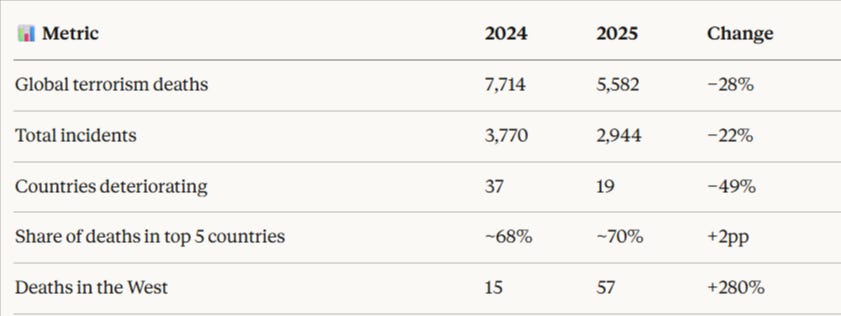
The 13th edition of the GTI documents a broad but uneven improvement. Deaths fell 28 per cent year-on-year, from 7,714 in 2024 to 5,582 in 2025, while incident counts dropped nearly 22 per cent to 2,944. Eighty-one countries recorded improved scores — the highest annual improvement count since 2021. Only 19 countries deteriorated.
Yet the headline figures obscure a critical structural reality: terrorism is not retreating globally so much as it is concentrating. Where it has diminished, it has done so sharply — deaths in Iraq and Afghanistan have fallen 99 and 95 per cent respectively from their peaks. Where it persists, it is intensifying in lethality. The 2025 data confirms a pattern established over the previous decade: the epicentre has migrated decisively from the Middle East and North Africa into sub-Saharan Africa, and particularly into the Sahel tri-border region.
For the first time in the Index’s history, Pakistan displaced Burkina Faso as the most-impacted country, recording 1,139 deaths and 1,045 incidents. Pakistan’s GTI score of 8.574 reflects six consecutive years of increasing terrorism deaths, driven overwhelmingly by the Tehrik-e-Taliban Pakistan (TTP), which was responsible for 56 per cent of the country’s terrorism fatalities in 2025. The Taliban’s return to power in Afghanistan in 2021 created the operational sanctuary that enabled TTP’s resurgence; deaths from terrorism in Pakistan are now at their highest level since 2013.
The four deadliest groups globally — Islamic State, Jamaat Nusrat Al-Islam wal Muslimeen (JNIM), TTP, and al-Shabaab — collectively accounted for 3,869 deaths, or 70 per cent of all terrorism fatalities in 2025. Three of the four recorded decreases; TTP was the sole exception.
🌍 How has terrorism evolved in Africa since 2025?
Sub-Saharan Africa’s trajectory diverges sharply from the global trend. While the regional death count fell 23.5 per cent in 2025, the structural conditions that have driven a tenfold increase in Sahel deaths since 2009 remain intact. Six of the ten most-impacted countries globally are African: Burkina Faso (rank 2), Niger (3), Nigeria (4), Mali (5), Somalia (7), and the Democratic Republic of the Congo (8).
The Sahel accounted for more than half of all terrorism-related deaths worldwide in 2025 — a share that stood at under one per cent in 2007. This inversion of the global geography of terrorism is the defining trend of the past decade.
Burkina Faso’s death toll fell 45 per cent to 846, its first sub-thousand total in three years. But the decline is analytically misleading. Lethality per incident actually increased — from 10.5 deaths per police and military incident in 2024 to 18.9 in 2025 — as JNIM shifted toward fewer but more concentrated strikes. Civilian casualties collapsed 84 per cent, not because civilians are safer, but because JNIM has deliberately reduced indiscriminate civilian attacks in favour of economic blockade and supply-chain interdiction as instruments of state erosion. The group’s October assault between Djibo and Namsiguia killed over 120 soldiers and remains the deadliest single terrorist attack globally in 2025.
Nigeria recorded the largest absolute increase in terrorism deaths — 237 additional fatalities, a 46 per cent rise to 750. Islamic State West Africa Province (ISWAP) drove the surge, with attacks jumping from 20 in 2024 to 92 in 2025, resulting in 384 deaths. ISWAP and Boko Haram together accounted for 80 per cent of Nigeria’s terrorism fatalities. US tomahawk strikes on ISWAP camps in north-western Nigeria in December 2025 signal growing external concern, but the underlying territorial and governance conditions remain unaddressed.
The deeper analytical picture — including what the decline in Sahel attack frequency actually signals about jihadist strategic doctrine, and what it means for East Africa — is examined below.
🏆 Why do certain African countries rank highest globally?
The GTI’s composite methodology — weighting deaths (×3), incidents (×1), injuries (×0.5), and hostages (×0.5) over a five-year average — captures both the scale and the persistence of terrorism’s impact. Countries that rank highest share a specific configuration of structural vulnerabilities.
State fragility and coups. Burkina Faso, Mali, and Niger have each experienced military coups since 2021. Political instability creates institutional vacuums that jihadist organisations exploit methodically. In Burkina Faso, external assessments suggest the government controls 30 per cent or less of national territory, with JNIM operating with near-impunity across northern and eastern provinces.
Border porosity and tri-border dynamics. Over 41 per cent of all terrorist attacks globally occur within 50 kilometres of an international border, and 64 per cent within 100 kilometres. In the Sahel, the Mali-Burkina-Niger tri-border area known as Liptako-Gourma has become the world’s most lethal terrorism hotspot. National boundaries constrain security forces but not armed groups. JNIM and IS Sahel Province exploit this asymmetry systematically, retreating across borders when under pressure and re-entering to conduct operations.
Withdrawal of international counterterrorism capacity. The expulsion of French forces and the UN stabilisation mission removed a structural buffer that, however imperfect, constrained jihadist territorial expansion. Russia’s Africa Corps replacement has proven operationally inferior and produced documented mass civilian casualties — 2,430 civilian deaths in the Sahel in 2024 were attributed to state security forces and their Russian partners, according to ACLED. This pattern directly fuels recruitment.
Youth radicalisation drivers specific to sub-Saharan Africa. A 2023 UNDP study of over 1,000 former violent extremists across eight African countries found that religious ideology drove only 17 per cent of voluntary recruitment — a 57 per cent decline from 2017. The tipping point for 71 per cent of recruits was direct experience of human rights abuse by state security forces. A quarter cited a total lack of employment opportunities. In Niger, 51 per cent cited climate-induced livelihood disruption.
💀 Who are the most active terrorist groups in Africa?
Four groups dominate Africa’s terrorism statistics, each operating across distinct but overlapping geographies.
JNIM (Jamaat Nusrat Al-Islam wal Muslimeen) is the second-deadliest group globally, responsible for 147 incidents and 1,274 deaths in 2025 — the second consecutive year above a thousand fatalities. Founded in 2017 as an al-Qaeda-affiliated coalition of Ansar Dine, the Macina Liberation Front, Al-Mourabitoun, and AQIM’s Saharan branch, JNIM operates primarily across Mali, Burkina Faso, Niger, and Benin. Its average lethality in Burkina Faso reached 16 deaths per attack in 2025. The group has begun expanding toward coastal West Africa, conducting its first recorded attack in Nigeria (Kwara State, October 2025) and dramatically increasing operations in Benin, with 70 per cent more deaths recorded in that country year-on-year.
Islamic State (IS) and its affiliates remain the world’s deadliest overall, despite a 15 per cent reduction in attributed incidents. IS attacks in sub-Saharan Africa nearly doubled, rising from 111 to 221 incidents. IS-affiliated groups in the DRC — primarily the Allied Democratic Forces (ADF), which operates under IS-Central Africa Province — drove 467 deaths across 35 incidents, giving the theatre a lethality rate of over 13 deaths per attack. IS Sahel Province recorded a dramatic escalation in Niger, with 33 attacks and 416 deaths compared to 12 attacks and 108 deaths in 2024.
Al-Shabaab remains the fourth-deadliest group globally, with 93 attacks and 286 deaths in 2025 — a 24 per cent decline in attributed fatalities for the third consecutive year. The quantitative decline is structurally deceptive. Al-Shabaab’s Shabelle Offensive, launched in late February 2025, overran government positions across central Somalia, recaptured strategic towns including Moqokori and Tardo, and by mid-year had advanced to within 50 kilometres of Mogadishu. The group exploited the transition from ATMIS to the new AUSSOM peacekeeping mission, an arms pipeline from Yemen’s Houthis, and attempted to assassinate President Hassan Sheikh Mohamud in March, before raiding Somalia’s national intelligence headquarters in October. Fewer deaths and near-total encirclement of the capital are not indicators of a weakening organisation.
Islamic State West Africa Province (ISWAP) recorded 92 attacks and 384 deaths in Nigeria in 2025 — a 360 per cent increase in attacks from the prior year. Together with Boko Haram’s JAS faction (43 attacks, 213 deaths), ISWAP accounts for the dominant share of Nigeria’s terrorism burden.
⏰ When did current terrorism trends begin emerging?
The current configuration of African terrorism emerged from several distinct turning points.
The 2012 collapse of northern Mali following the Libyan civil war’s weapons proliferation and a Tuareg separatist uprising created the original operational space for what would become JNIM. French intervention through Operation Serval contained the immediate crisis but displaced armed groups into neighbouring states. The pattern of state fragility exploited by jihadism spread to Burkina Faso after 2015, Niger after 2016, and coastal West Africa after 2022.
In the Lake Chad Basin, Boko Haram’s 2009 armed uprising marked the beginning of a sustained insurgency that has claimed over 15,000 lives across Nigeria, Chad, Cameroon, and Niger. ISWAP’s emergence as the dominant faction following Shekau’s 2021 death introduced a more strategically coherent actor with direct ties to IS central.
The Taliban’s 2021 return to power in Afghanistan triggered TTP’s resurgence in Pakistan and represents the most significant terrorism-enabling geopolitical event of the current cycle. Pakistan’s death count is now at its highest level since 2013, and open conflict between Pakistan and Afghanistan erupted in February 2026.
In East Africa, al-Shabaab’s 2025 Shabelle Offensive represents the most serious territorial challenge to Somali state authority since 2012.
The analysis that follows examines counterterrorism effectiveness, the economic costs of this violence, the Sahel’s structural logic, and what the 2026 data signals for East Africa’s medium-term threat environment — including an original analytical inference not derivable from the IEP data alone.
🛡️ What counterterrorism strategies prove most effective?
The GTI 2026 data allows a comparative assessment of counterterrorism approaches, with the evidence pointing toward a set of recurring patterns.
Military-only approaches fail consistently. The Sahel provides the clearest contemporary evidence. France’s sustained counterterrorism presence under Operations Serval and Barkhane failed to prevent jihadist expansion from Mali into Burkina Faso, Niger, and coastal West Africa. Russia’s Africa Corps replacement has generated higher civilian casualties and comparable or worse territorial outcomes. Burkina Faso’s Volunteers for the Defense of the Homeland (VDP) programme, which recruits poorly trained civilian auxiliaries while explicitly excluding the Peuhl community, has produced documented massacres and accelerated JNIM recruitment within communities targeted by state violence.
Multinational joint task forces produce conditional results. The MNJTF in the Lake Chad Basin achieved meaningful gains in 2015 by dislodging Boko Haram from major Nigerian towns. However, political disruption — Chad’s reduced engagement following Idriss Déby’s 2021 death, Niger’s coup-driven suspension of security cooperation with Nigeria in late 2023 — has repeatedly degraded operational coherence. The model functions when political alignment among member states is sustained; it fractures when domestic pressures take precedence.
Somalia’s AUSSOM framework marks a structural upgrade from the predecessor ATMIS mission, but the transition period itself became a primary vulnerability that al-Shabaab exploited with the Shabelle Offensive. Mission transitions create security vacuums regardless of the quality of the incoming framework.
Development and governance integration produces the most durable results, but operates on timescales that outpace military urgency. Ghana and Côte d’Ivoire have largely contained jihadist incursion through decentralised governance investment and northern development programmes that reduce recruitment incentives. Both stand as instructive contrasts to the Sahelian military juntas that expelled French forces while failing to deliver basic services.
💰 How does terrorism impact African economic development?
Direct costs include destruction of infrastructure, displacement of populations, diversion of government expenditure toward security, and loss of productive labour through death, injury, and displacement. In Burkina Faso, jihadist control or influence over the majority of national territory has severed supply chains, blocked fuel and food imports, and collapsed government service delivery across large swathes of the country.
JNIM’s 2025 Bamako blockade strategy operationalises economic warfare explicitly. By targeting fuel tankers supplying the Malian capital from September 2025, the group sought to collapse the Mali junta’s economic base without direct urban combat. Mining, which accounts for approximately 80 per cent of Mali’s foreign export earnings, has been systematically targeted through JNIM’s expansion into the gold-rich Kayes region along the borders with Guinea, Senegal, and Mauritania.
The DRC’s deterioration carries global implications. Every single terrorist attack in the DRC in 2025 was attributed to IS-affiliated groups, with the ADF deliberately targeting the agricultural sector, Christian communities, and civilian infrastructure in North Kivu — territory central to global cobalt and coltan supply chains. Over 13 people were killed per incident on average — the highest lethality rate in the country in more than a decade.
🔥 Why has the Sahel become a terrorism hotspot?
The Sahel’s transformation into the global epicentre of terrorism results from the convergence of five mutually reinforcing structural conditions, none of which is being addressed at scale.
Governance vacuum and coup proliferation. Mali (2020, 2021), Burkina Faso (2022), and Niger (2023) have all experienced military takeovers since 2020. Each coup weakened institutional coherence, disrupted security cooperation frameworks, and produced new grievances that jihadist groups have exploited for recruitment. Jihadist-controlled territory has expanded in all three countries since 2021.
Borderland geography. The Liptako-Gourma tri-border area is characterised by sparse state presence, interrelated Tuareg and Fulani communities whose identities and livelihoods span national boundaries, and difficult terrain that enables rapid cross-border movement. National security forces cannot pursue groups across borders without joint operations that political tensions have made increasingly rare.
The Russian counterterrorism deficit. Africa Corps has demonstrated repeatedly that high-intensity indiscriminate operations against communities perceived as sympathetic to jihadists accelerate recruitment rather than reducing it. The 2,430 civilian deaths attributed to state forces and Russian partners in 2024, documented by ACLED, represent a structural recruitment driver that JNIM has consistently and effectively exploited.
Demographic pressure and economic marginalisation. Niger and Mali have median ages of approximately 15 — among the world’s youngest populations. Climate-induced disruption to pastoral and agricultural livelihoods has eliminated traditional economic coping mechanisms. The UNDP’s 2023 findings confirm that economic motivation now drives more voluntary recruitment than religious ideology.
Coastal expansion as strategic logic. JNIM’s movement toward coastal West Africa is not opportunistic but doctrinal. The group seeks port access, additional tax revenues from mining and trade, and strategic depth beyond the Sahelian states where it is already deeply embedded. Benin, Togo, and intermittently Côte d’Ivoire have experienced JNIM incursions, and the group conducted its first attack in Nigeria in October 2025.
🔬 Analytical Inference: The Decline Paradox and East Africa’s Coming Stress Test
The GTI 2026 presents what analysts risk misreading as a Sahel success story: deaths down 45 per cent in Burkina Faso, 42 per cent in Mali, 26 per cent in Niger. This reading is incorrect, and the error carries significant intelligence consequences.
JNIM’s reduction in attack frequency reflects a deliberate strategic transition, not degraded operational capacity. The group has shifted from high-frequency attacks that generate civilian casualties toward economic warfare through blockades, supply-chain interdiction, and territorial consolidation. The organisation now controls or exerts influence over a majority of Burkina Faso’s territory while conducting fewer but more lethal strikes against military targets. Lethality per military incident in Burkina Faso rose from 10.5 to 18.9 deaths between 2024 and 2025.
This is not a retreating force. It is a maturing insurgency shifting from the terrorism phase to the proto-state phase of its strategic cycle — a transition that historically precedes more severe governance and territorial challenges for affected states, not less.
The East African implication is direct. Al-Shabaab’s Shabelle Offensive demonstrates that the same proto-state logic is operative in Somalia. The group’s 2025 territorial gains — achieved while its terrorism fatality count fell for the third consecutive year — indicate that deaths-as-metric systematically underestimates the group’s threat trajectory. For Tanzania, Kenya, Uganda, and Ethiopia, the intelligence-relevant question is not whether al-Shabaab is weakening but whether the AUSSOM framework can hold the line around Mogadishu long enough for Somali state capacity to recover. The GTI data provides no grounds for confidence that it will.
The convergence of JNIM’s westward expansion, ISWAP’s northward corridor development toward Niger’s Dosso region, and IS-CAP’s exploitation of the DRC’s M23-driven security vacuum suggests that sub-Saharan Africa’s terrorism burden in 2026 and 2027 will not follow the 2025 trajectory of modest improvement. The preconditions for sustained deterioration are in place across the western, central, and eastern African theatres simultaneously.
The Global Terrorism Index 2026 confirms that the world’s terrorism problem has a specific African address — and that addressing it requires engagement with governance, economic inclusion, and regional political alignment at a scale that current counterterrorism frameworks have not delivered.
Independent intelligence analysis takes time and resources — if this work matters to you, please consider supporting it by donating HERE