

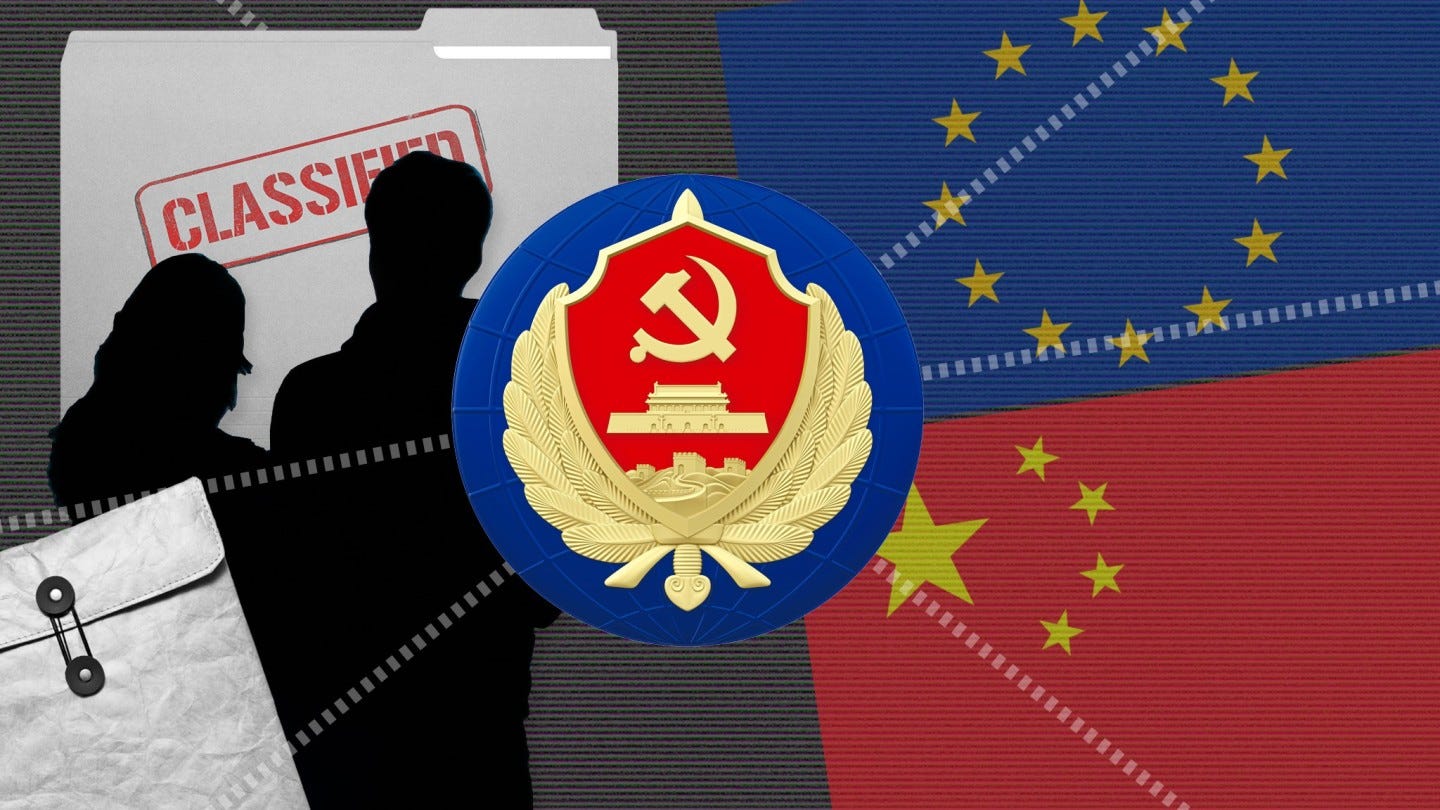

Chinese President Xi Jinping’s trip to Europe, starting this Sunday, comes at a rather awkward time. European police and intelligence agencies have been uncovering and arresting an astonishing number of alleged Chinese spies in a tidal wave of counterespionage activity in recent weeks, underscoring the well-known fact that Beijing targets the West with prodigious intelligence operations.
Complaining to Xi about the problem, however, is unlikely to make any difference. Back in 2014, when then-U.S. President Barack Obama visited Beijing, he addressed already growing concerns about Chinese spying. A year later, when Xi went to Washington, the two leaders formally agreed to stop cyber-espionage for the purposes of stealing intellectual property, another issue of great concern to the West and one of the Chinese economy’s signature paths to superpower status.
That agreement went on to have a positive impact, at least in the short term, when it came to industrial espionage.
But in other domains, Chinese spying activities have gone into overdrive. Most countries spy, but experts say Beijing’s behavior and the scale of its intelligence operations are on a different level.
Western leaders and intelligence agencies have apparently concluded that diplomatic exchanges and personal entreaties are the wrong approach. Now they are set on dismantling Chinese spying and political influence operations. It will not be easy, and it will take a toll.
The sheer number of cases and the pace of arrests suggest that the issue is going to become a major irritant to Europe-China ties.
China’s intelligence operations—much of them cyber spying, hacking and social media influence campaigns—have a number of objectives. For decades, the country was known for its industrial espionage in an effort, often successful, to leapfrog the time, cost and talent it takes to develop commercial products. The tactic has now expanded to advancing military technology. There’s also the effort to influence global public opinion, cast doubts on democracy and destabilize the West. Finally, Beijing has an aggressive intelligence campaign to undercut and bring back expatriate Chinese citizens, many of them opponents of the regime.
On all of these fronts, the ingredients for a crisis with the West are falling into place.
Consider the recent avalanche of cases—and the seriousness of the accusations.
Amid a wave of arrests last week, German prosecutors detained a man they referred to as Jian G, but who they identified as an aide to the legislator heading the far-right AfD party’s list of candidates for next month’s European Parliament elections. They called Jian G an “employee of a Chinese secret service” and accused him of passing along information about parliamentary activities to Beijing and spying on Chinese opposition groups in Germany.
The same day, authorities arrested three Germans on suspicion of working with Beijing to obtain technology for the Chinese navy. China denies all the accusations.
Separately, but also on April 22, the U.K. charged two men of spying for China. One was reportedly an aide to a prominent member of the British Parliament.
The counterintelligence cases are piling up at a growing pace. That’s because China’s spying operations are so vast, but also because Europe is becoming more aggressive about countering them. Still, the challenge is enormous.
A month earlier, Britain accused Chinese hackers of trying to infiltrate the email accounts of British MPs who were critical of China. British authorities also announced that a computer breach of Britain’s Electoral Commission, reported last year, was conducted by hackers affiliated with the Chinese government.
The Chinese Embassy in London called the accusation “malicious slander.”
In the Netherlands, the Dutch military intelligence agency, MIVD, issued its annual report on April 18. The agency said Beijing is investing heavily in spying operations targeting Dutch industries—particularly the semiconductor, aerospace and maritime sectors—in order to build up its military.
In February, the Dutch Ministry of Defense said Chinese cyber spies had hacked into a Dutch military network.
In Belgium, authorities accused China of recruiting a member of the far-right Vlaams Belang party as an intelligence asset. The party expelled the member.
The cases are piling up at a growing pace. That’s because China’s spying operations are so vast, but also because Europe is becoming more aggressive about countering them.
But the challenge is enormous. Intelligence operations in the 21st century are very different from the days when computers were not ubiquitous and social media didn’t exist.
Consider the controversy over TikTok, the social media platform for short-form video that hundreds of millions of people use regularly. The platform is owned by a Chinese company, ByteDance, raising fears that it could be susceptible to pressure by the Chinese government to hand over sensitive user data. Though the Chinese government has banned TikTok—as well as Facebook and WhatsApp—in China, it hypocritically decries the recently passed U.S. law to force ByteDance to sell TikTok to a U.S. purchaser over these data security concerns.
ByteDance insists that all its U.S. users’ data is stored securely in servers in the U.S., beyond the reach of the Chinese government. It also denies that the platform would spy on its users. But despite those protestations, it has already been known to do so: A 2022 internal investigation by ByteDance itself found that its employees had been spying on U.S. journalists.
The concerns over TikTok are not only about its ability to amass huge quantities of information about its users. There are also fears that it might try to influence U.S. public opinion and inflame divisions, as Russia was found to have done during the 2016 U.S. elections.
The difference is that Russia was forced to use heavy-handed methods on existing platforms, like Facebook and Twitter, now known as X. TikTok could use its own powerful proprietary algorithm that serves up content individually tailored to a user’s tastes. Some have already accused it of deliberately trying to stoke divisions in the U.S. over the war in Gaza through the videos it amplifies in users’ feeds.
With or without TikTok, though, China already has an elaborate intelligence operation aimed at influencing opinions in the West. A recent report by Citizen Lab lists a series of “news” websites with names that misleadingly suggest local origins: Milano Moda Weekly in Italy, Friendly Paris in France, Iguazu in Ecuador and Ginza Daily in Japan, among others. The sites post stories that echo Chinese propaganda. And although they have minimal traffic, the project, dubbed Paper Wall, seeds the internet with pro-China content that is picked up by aggregators and search engines.
Then there’s the notorious Dragonbridge or Spamouflage campaign, a huge network of accounts numbering in the hundreds of thousands that flood the internet with Chinese disinformation.
Another major operation is Fox Hunt, nominally focused on corrupt officials who have fled China, but reportedly used to capture or lure back thousands of exiles, including human rights activists and political dissidents. A report by Safeguard Defenders says that in the past decade, Beijing has conducted 12,292 “successful apprehensions” in 120 countries using kidnappings, harassment and intimidation.
Last year, a former New York police officer was convicted of serving as “an illegal agent” for China, after he stalked and threatened exiled Chinese nationals for the Chinese government.
The vastness of China’s intelligence operations is overwhelming counterintelligence agencies in the West. After last week’s arrests, Germany said it had only found the tip of the iceberg. Referring to China’s spying, the chairman of the German parliament’s intelligence committee, Konstantin von Notz, said authoritarian states are finding new ways to “influence and destabilize our democracy on an almost daily basis.”
That’s hardly a propitious backdrop for Xi’s upcoming European tour.