[FREE] Intelligence Brief: Ethiopia–Eritrea on Brink of War After IGAD Withdrawal
Ujasusi Blog’s Horn of Africa Monitoring Team | 15 December 2025 | 0345 GMT
🔓FREE ACCESS
Please consider becoming a paid subscriber
You can also donate.
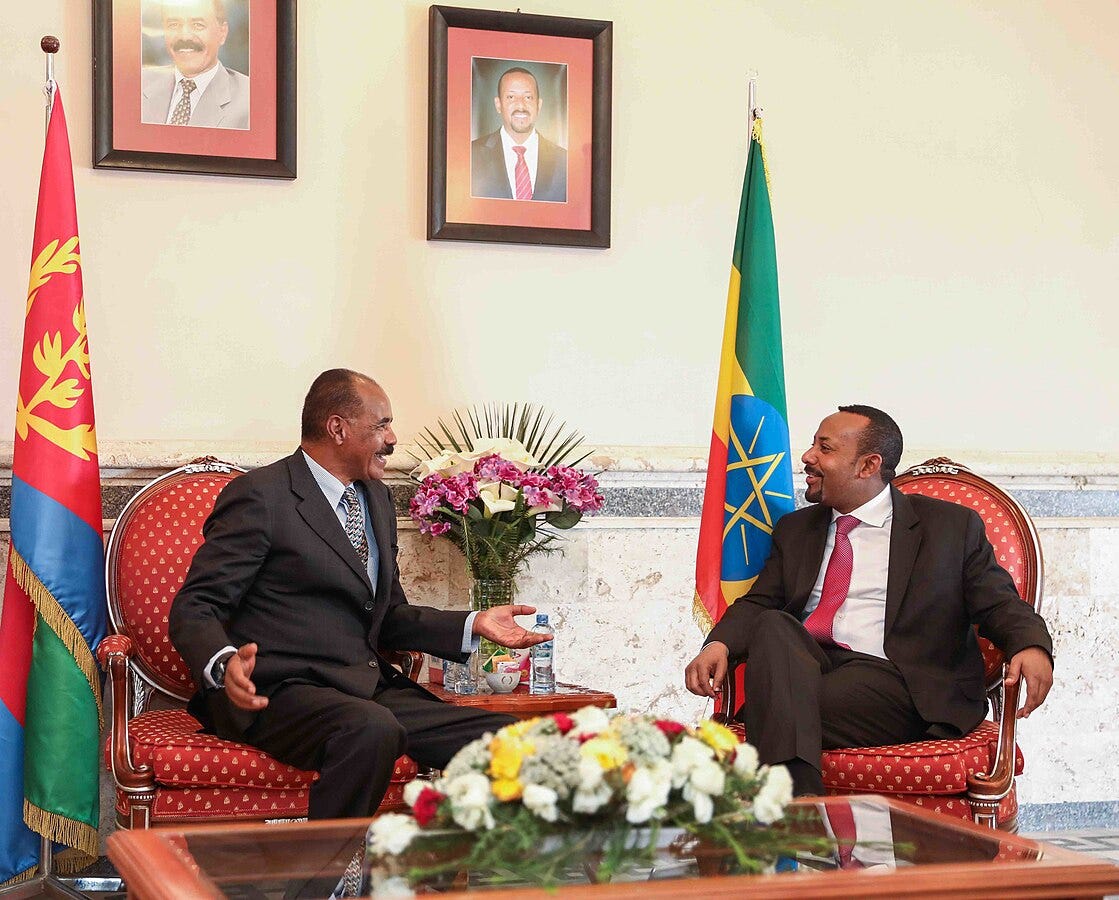
Ethiopia and Eritrea are entering one of their most volatile phases since the 1998–2000 border war. On 11 December 2025, Prime Minister Abiy Ahmed accused Eritrea, under President Isaias Afwerki, of fuelling insecurity through proxy interference and economic sabotage, warning that Ethiopia would not tolerate threats to sovereignty. Within twenty‑four hours, Afwerki’s government formally notified the Intergovernmental Authority on Development (IGAD) of Eritrea’s withdrawal, deepening regional instability and raising the prospect of renewed interstate conflict.
What triggered the confrontation?
Abiy’s parliamentary speech (11 Dec 2025): Directly criticised Eritrea under President Isaias Afwerki for backing insurgents and undermining stability.
Eritrea’s response (12 Dec 2025): Afwerki’s government issued a note verbale withdrawing from IGAD.
Underlying dispute: Ethiopia’s push for Red Sea access versus Afwerki’s sovereignty concerns.
Context: Regional instability in Sudan, Somalia, and Red Sea maritime competition.
What are Ethiopia’s allegations against Eritrea?
Proxy interference:
Weapons, training, logistics for Oromo Liberation Army (OLA) in Oromia.
Support to FANO militias in Amhara.
Arms smuggling through Afar and Tigray.
Human trafficking: Networks linked to Eritrea exacerbating refugee pressures (>900,000 refugees hosted in Ethiopia).
Economic sabotage:
Counterfeit U.S. dollar notes traced to Eritrean ports under Afwerki’s administration.
Black‑market currency exchanges undermining local economies.
How did Eritrea justify quitting IGAD?
Formal notification: Delivered by Afwerki’s government to IGAD Secretariat in Djibouti.
Background: Eritrea rejoined IGAD in June 2023 after two decades of suspension but remained inactive.
Claimed rationale: Opposition to Ethiopia’s Red Sea access push, framed as sovereignty defence.
IGAD’s response: Expressed regret, urged reconsideration, noted Eritrea had not submitted reform proposals.
What are the strategic stakes?
Ethiopia:
Landlocked, population >120 million.
Sea access framed as strategic necessity.
Eritrea (Isaias Afwerki):
Sovereignty concerns over Assab and Massawa ports.
Fear of coercive approaches violating international law.
Regional:
IGAD weakened by Eritrea’s exit.
Red Sea corridor contested by Ethiopia, Eritrea, Djibouti, Sudan, and Gulf states.
Comparative Positions
Strategic Outlook
Short‑Term (0–90 days)
Indicators: Eritrea’s IGAD withdrawal, Abiy–Afwerki rhetoric, proxy activity in Oromia/Amhara.
Scenario A – Diplomatic containment (40%): AU/IGAD outreach tempers escalation; rhetoric remains sharp but no direct clashes.
Scenario B – Proxy intensification (35%): Afwerki’s networks harden support to insurgents; Abiy deploys forces along northern corridors.
Scenario C – Border skirmishes (25%): Localised confrontations test Abiy–Afwerki command restraint.
Mid‑Term (90–180 days)
Indicators: Ethiopia’s pursuit of Red Sea access, Eritrean port sovereignty claims, refugee flows.
Scenario A – Negotiated maritime access (30%): Abiy secures third‑party sea access, reducing direct pressure on Afwerki.
Scenario B – Escalated confrontation (45%): Abiy intensifies pursuit of Red Sea access; Afwerki leverages isolation and hard power.
Scenario C – Regional spillover (25%): Sudan/Somalia conflicts intersect, constraining both leaders’ options.
Long‑Term (180+ days)
Indicators: Maritime trade corridors, external actor involvement (Gulf states, U.S., China).
Scenario A – Managed competition (35%): Abiy and Afwerki sustain tense equilibrium via external guarantees.
Scenario B – Interstate war (30%): Failure of mediation; Abiy–Afwerki decisions drive mobilisation and conflict.
Scenario C – Institutional fragmentation (35%): IGAD weakened; Afwerki’s exit accelerates bloc realignment.
Key Risks
Sovereignty clash: Ethiopia’s non‑negotiable stance vs Afwerki’s port control.
Proxy warfare: OLA, FANO, and cross‑border arms flows.
Humanitarian strain: >900,000 refugees in Ethiopia, rising IDPs.
Economic sabotage: Currency instability, illicit trade networks.