

Espionage Chronicles | Ujasusi Originals
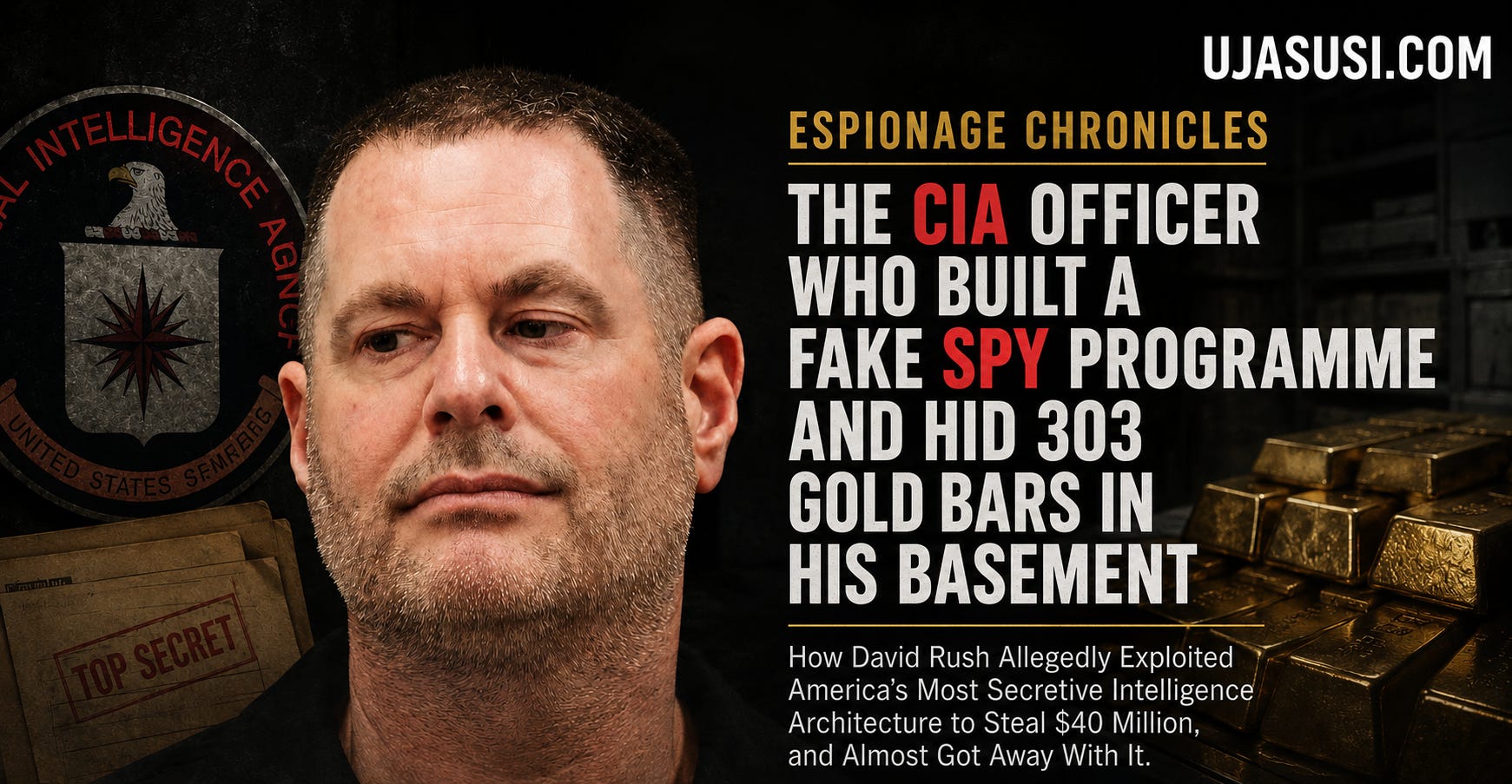
In May 2026, FBI agents searching a house in the Virginia suburbs found 303 gold bars, $2 million in cash, and 35 luxury watches hidden inside. The man who lived there was a senior CIA officer with seventeen years of service and access to some of the most sensitive programmes in American intelligence. He had not sold secrets to a foreign power. He had done something the agency’s elaborate security architecture was never designed to stop: he had invented an entire classified programme from scratch, used its secrecy to shield himself from scrutiny, and allegedly walked out with $40 million of his own government’s money.
On 18 May 2026, FBI agents knocked on the door of a house in Ashburn, Virginia. What they found inside was not the usual evidence of financial crime: an offshore account, a falsified invoice, a trail of shell companies. What they found was 303 gold bars. Each bar weighed approximately one kilogram. Together, they were worth more than $40 million. Alongside them sat roughly $2 million in cash and 35 luxury watches, many of them Rolexes.
The man who lived there was David J. Rush, a senior officer at the Central Intelligence Agency who had spent seventeen years inside one of the most powerful intelligence organisations on earth. He was arrested the following day, charged with theft of public funds. He has not yet entered a plea. His lawyer describes the case as being, at its core, about $65,000 worth of time card fraud. Federal prosecutors describe something considerably more alarming.
🎭 The Invisible Programme
To understand what Rush allegedly did, one must first understand what a Special Access Programme is.
Within American intelligence, ordinary top-secret clearance is not sufficient to access the most sensitive operations. Above that level exists a category of classified programmes so restricted that even officials with the highest clearances cannot see inside them without explicit, individual authorisation. These are called Special Access Programmes, or SAPs. They are, in the language of intelligence professionals, black boxes. Compartmentalised by design. Impenetrable by default. Verified only by those already inside.
Rush is accused of building one from nothing. According to people familiar with the criminal investigation cited by the Washington Post, he constructed a sham SAP and used its secrecy architecture as a weapon against the very institution designed to protect it. The fictional programme was reportedly pitched as a continuity-of-government operation, a contingency plan for keeping the American government functional in the event of nuclear war or catastrophic emergency. The cover story was deliberately chosen for its gravitas. Few subjects are treated with more institutional seriousness inside American intelligence than nuclear war planning.
READ ALSO
Introducing “A Spy’s Guide to Deception” — The First in the Spy Guide Series

Intelligence work is built on deception. Every service that has ever run an agent, mounted a cover operation, or manufactured a false narrative has done so through principles that remain largely invisible to the public. Not because they are secret, but because no one has taken the time to explain them plainly.
Having constructed this fiction, Rush allegedly briefed two CIA colleagues into it (formally “reading them in,” in intelligence parlance) and invoked the SAP’s strict need-to-know rules to prevent them from discussing it with anyone outside the programme. One of those colleagues was subsequently persuaded to approve the transfer of millions of dollars to the sham project. A government defence contractor, acting on a fraudulent contract allegedly established by Rush, purchased large quantities of gold. That gold was supposed to fund classified operations. Instead, according to court documents, it ended up stacked in a Virginia suburb.
📋 A Career Built on Lies
The scandal has a second dimension that is, in its own way, equally troubling. Rush allegedly did not simply exploit the CIA’s secrecy infrastructure. He may have entered the organisation under false pretences in the first place.
Court documents filed by prosecutors allege that Rush fabricated significant portions of his professional biography. In government job applications, he claimed to have graduated from Clemson University in 2000 and to hold a graduate degree from Rensselaer Polytechnic Institute. He also claimed to have served as a Navy pilot. None of that was true, according to prosecutors. He did serve in the United States Navy, joining in 1997 as an information systems technician and later receiving a commission as a Navy Reserve officer, but he held no pilot’s licence and was honorably discharged in 2015 with the rank of lieutenant. He joined the CIA around 2009 and rose, over seventeen years, into some of the agency’s most sensitive assignments, including a role in the Directorate of Science and Technology and a liaison position to the Pentagon for a classified nuclear submarine programme.
The question of how a person can sustain fabricated credentials inside an intelligence organisation for nearly two decades, inside an organisation whose primary business is the verification of identity and the detection of deception, is one that members of the United States Congress are now asking loudly. “This is just staggering,” said Representative Jim Himes of Connecticut, the senior Democrat on the House Intelligence Committee. “How the hell did this happen?”
🏛️ The Pentagon Connection
The case has drawn in a figure far more senior than Rush. The New York Times reported on 11 June 2026 that Rush had worked closely with Stephen A. Feinberg, the current Deputy Secretary of Defense and the second-highest official in the United States Department of Defense, on a covert programme focused on China.
Feinberg, a billionaire private equity executive who founded Cerberus Capital Management and served as chairman of President Trump’s Intelligence Advisory Board during his first term, reportedly recommended that Rush be given a broader role in the classified China-focused intelligence effort. According to NBC News, it was at Feinberg’s request that Rush was assigned his Pentagon liaison position. Feinberg reportedly contacted the CIA earlier in 2026 asking that Rush play a more significant role, unaware, officials say, that Rush was already under criminal investigation.
The Pentagon has categorically denied that any significant relationship existed. Chief Pentagon spokesman Sean Parnell stated that suggestions of a close professional connection between the two men are “completely false and embellished” and that Feinberg “never supported Mr. Rush’s career at any point in his life.” Feinberg has not been accused of wrongdoing. Once the Pentagon was made aware of the investigation, Rush was removed from interagency meetings. Several senior CIA officials have been placed on administrative leave over their handling of Rush’s requests for assets and the internal warning signs that went unheeded.
🌍 Lessons for African Intelligence Services
The Rush case is not simply an American story. It is a case study in the vulnerabilities that attend any intelligence organisation, including those on the African continent.
The mechanism Rush allegedly exploited, namely the use of extreme secrecy as a shield against accountability, is not unique to the United States. Every intelligence service that maintains compartmentalised programmes faces the same structural tension: the more secret a programme, the fewer people can scrutinise it, and the greater the opportunity for abuse. African intelligence services, many of which operate under limited legislative oversight and with inadequate internal audit mechanisms, are, if anything, more exposed to this category of risk than the CIA.
The credential falsification dimension of the case is equally instructive. The failure to verify Rush’s academic and professional claims over seventeen years points to a fundamental vulnerability in vetting, one compounded in services where background investigation capacity is limited, where political patronage influences hiring, and where officers are promoted on the basis of internal relationships rather than verified competence.
The Rush case also illustrates the institutional damage that follows when the oversight of covert expenditure is treated as incompatible with the requirements of secrecy. The CIA, according to court documents, could not locate the assets Rush had requested, a failure of financial control that any intelligence service should treat as a categorical warning. Operational secrecy and financial accountability are not mutually exclusive. The Rush case demonstrates what happens when an institution behaves as though they are.
⚖️ The Case Ahead
As of June 2026, Rush has been ordered to remain in jail pending trial, with a United States District Court judge ruling that his seventeen years of CIA service, including the skills and contacts that entails, make him a credible flight risk. The formal charge currently before the court is a single count of theft of public money, centred on the allegation that he filed false time sheets claiming to be an active Navy Reserve member. The investigation is ongoing. Additional charges have not been ruled out.
The gold bars remain in federal custody. Their origin, and the precise mechanics of how they moved from CIA procurement channels to a basement in Virginia, are among the central questions the investigation has not yet fully answered publicly.
What is already clear is that the David Rush case has exposed a failure not of one person’s ethics but of multiple institutional systems simultaneously: credential verification, financial oversight, programme accountability, and the internal culture of an organisation in which secrecy, over time, can become a habit of mind rather than a tool of tradecraft.
In espionage, the most dangerous deceptions are rarely the ones directed outward at an adversary. They are the ones that exploit the trust of the institution itself.
📚 Sources
FBI Affidavit in Support of Criminal Complaint — United States v. David J. Rush
Washington Post: CIA Officer Accused of Creating Fake Black Box Spy Programme
NBC News: CIA Officer Arrested with Gold Bars Accused of Making Up Top Secret Programme
NBC News: CIA Officer Accused of Stealing Gold Bars Was No Low-Level Agent
IndexBox: Ex-CIA Officer David J. Rush Charged in $40M Gold Bar Fraud Scheme
No advertisers. No corporate backers. Just you. Ujasusi is 100% reader-supported. Keep our journalism independent. [Support Ujasusi Here]