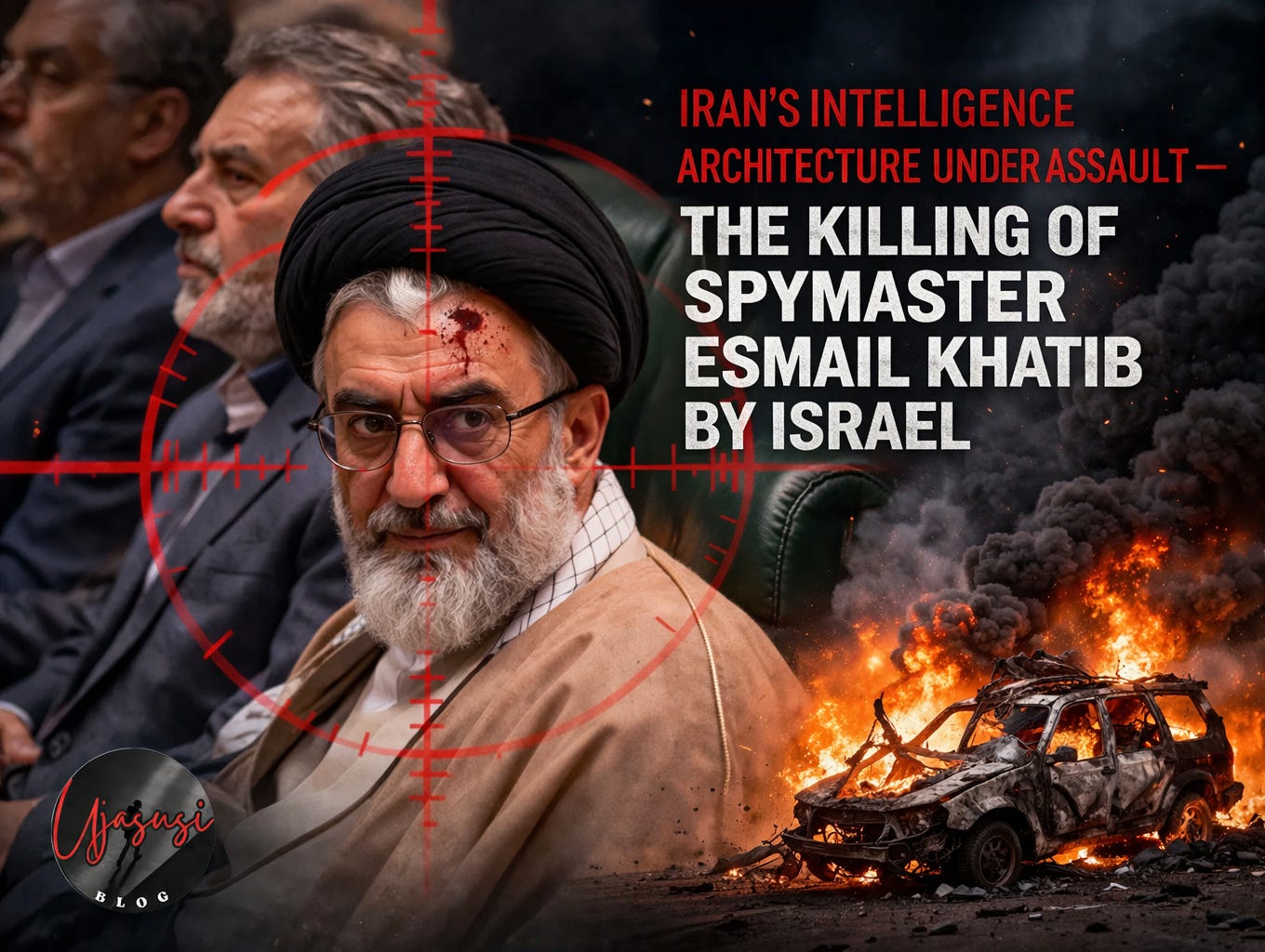
Iran's Intelligence Architecture Under Assault — The Killing of Spymaster Esmail Khatib by Israel
Ujasusi Blog - Middle East Monitoring Team | 19 March 2026 | 0110 GMT
Esmail Khatib, Iran’s Minister of Intelligence and head of the Ministry of Intelligence and Security (MOIS), was killed in an Israeli Air Force airstrike on Tehran in the early hours of 18 March 2026. His death marks the third assassination of a senior Iranian security official within 48 hours, following the killing of National Security Council chief Ali Larijani and Basij commander Gholamreza Soleimani on 17 March 2026.
🔍 Who Was Esmail Khatib and Why Did His Death Matter?
Born in Qaen, South Khorasan, in 1961, Khatib entered seminary studies in Qom around 1975–76, studying under clerics who formed the ideological backbone of the revolutionary state — among them Ali Khamenei himself, before Khamenei’s ascent to supreme leadership. He held the clerical rank of Hujjat al-Islam, a rank below Ayatollah but carrying substantial religious authority within the Islamic Republic’s clerical-security hierarchy.
Khatib was not a conventional minister. Appointed in August 2021 by then-President Ebrahim Raisi, he was a Shia cleric with deep roots in the security world and a history inside the Islamic Revolutionary Guards Corps. He ran both the crushing of dissent at home and the expansion of Iran’s shadow operations abroad.
His institutional biography was exceptionally dense. When he took the intelligence ministry in 2021, he brought to it a depth of institutional experience no predecessor had matched, having passed through IRGC intelligence, MOIS provincial and national structures, the judiciary’s protection apparatus, the Office of the Supreme Leader, and the Astan Quds Razavi shrine endowment in Mashhad before arriving at the ministerial desk.
United Against Nuclear Iran noted that Khatib enlisted in the IRGC at the outbreak of the Iran-Iraq War in 1980 and studied under Ayatollah Ruhollah Khomeini, the founder of the Islamic Republic. His IRGC background, having served in its intelligence unit from 1985 to 1991, made him useful precisely because he could move between clerical authority and paramilitary power. He was a coordinator as much as a minister.
His approximately 45-year career across the IRGC, MOIS, the judiciary, and the Office of the Supreme Leader represented an irreplaceable concentration of institutional knowledge at the apex of Iran’s civilian intelligence apparatus.
When Raisi was killed in a helicopter crash in May 2024 and Masoud Pezeshkian succeeded him as president, Pezeshkian retained Khatib in his cabinet — an unusual decision, since Iranian presidents typically replace ministers inherited from their predecessors, and Pezeshkian’s campaign had positioned him as a reformist candidate distinct from the Raisi administration’s hardline profile. The retention was widely attributed to Khamenei’s personal direction: Khatib was the supreme leader’s man in the intelligence ministry.
From an intelligence analysis standpoint, his retention under a nominally reformist president confirmed a structural reality about MOIS: the ministry’s operational and ideological direction is ultimately determined not by the elected executive but by the supreme leader’s office. This is a textbook example of what intelligence scholars term principal-agent capture — where the nominal principal (the elected president) loses effective control over the agent (the intelligence ministry) to a more powerful shadow principal (the supreme leader).
📋 What Were Khatib’s Core Intelligence Functions?
Khatib’s portfolio covered three interlocking domains: internal repression, transnational operations, and strategic cyber activity.
Internal Repression
The IDF stated that Khatib personally had a “significant role” in directing mass detentions and killings of people participating in mass street protests in January 2026 and in 2022–2023 after the killing of student Mahsa Amini.
Repression in Iran is structured, intelligence-led, and deeply embedded within state institutions. MOIS provides much of that structure. Former detainees describe a system as methodical as it is brutal. Prisoners held by the ministry have spoken of prolonged solitary confinement, sleep deprivation, and psychological pressure designed to break them rather than simply extract information. Interrogations are often accompanied by threats against family members, with detainees forced to sign confessions that later appear on state television.
During the Woman, Life, Freedom uprising that followed the death of Jina Mahsa Amini in September 2022, Khatib articulated a framework for treating protest movements as foreign-directed hybrid warfare, providing the ideological cover for sustained violent suppression.
Transnational Operations
Khatib ran covert operations including sleeper cells in enemy countries. Iran’s intelligence has been tied to the assassination of opposition figures across Europe since the early years of the republic. More recently, its operations have targeted Israeli and Jewish interests, Western institutions, and Iranian exiles whom the regime considered threats.
Khatib’s ministry had sought to counter Israel’s formidable intelligence gathering, announcing arrests of alleged spies and confiscating Starlink internet terminals allegedly smuggled into Iran by the US.
Cyber Operations
The US Treasury’s OFAC sanctioned Khatib in 2022 for his role in leading MOIS, which Treasury said oversaw global cyber operations targeting government and private-sector organisations, including disruptive attacks on critical infrastructure. MOIS conducted cyber espionage and ransomware attacks on Middle Eastern, European, and North American nations to support Iran’s political objectives, operating alongside but distinct from the IRGC’s more offensively oriented cyber apparatus.
🏛️ What Is MOIS and How Does It Fit Into Iran’s Intelligence Architecture?
MOIS was established in August 1983 and officially stood up in August 1984, confirming Mohammad Reyshahri as the first Minister of Intelligence. The establishment of the new ministry required the transfer of most of the IRGC intelligence unit’s resources in late 1983 and 1984.
The ministry nowadays functions as a secret police, a foreign spy service, and an ideological watchdog rolled into one. According to the US Congressional Research Service, MOIS is the most powerful and well-supported ministry in terms of logistics and finances. The Library of Congress assessed in 2012 that the ministry contains at least 15 directorates, though its internal structure remains classified under Iranian law.
MOIS and IRGC are not straightforward allies. The ministry works through long-term surveillance and institutional channels, whereas the IRGC’s intelligence arm is more ideologically driven and quicker to move when unrest flares. The regime wants overlap and a degree of mutual suspicion between its security arms. Each keeps watch on the population, while, at the same time, keeping a quiet eye on the other.
Overlapping responsibilities have produced clashes that have spilt into the public. For example, MOIS disagreed with IRGC-IO when it arrested several environmentalists on espionage charges. At a meeting convened by the Supreme Leader on 16 June 2023, several top-ranking military and intelligence officials gathered to discuss the interagency competition, hoping to reduce friction.
🎯 How Was Khatib Killed and Who Authorised the Strike?
Israeli Defence Minister Israel Katz confirmed that he and Prime Minister Benjamin Netanyahu had authorised the military to eliminate any senior Iranian official without the need for additional approval. The killing followed a “targeted strike” by Israeli Air Force fighter jets overnight.
In a video posted on social media on Tuesday, Netanyahu pulled a small card from his suit jacket pocket and said: “Today I erased two names on the punch card, and you see how many more to go on this batch.”
A senior Israeli official confirmed that Khatib had survived a previous strike before being killed in a subsequent precision strike. This detail is operationally significant: it indicates that Israeli signals intelligence and human intelligence networks within Tehran were sufficiently robust to track, re-locate, and strike a senior intelligence official after an initial failed attempt.
The Mossad began psychological operations against Iranian security forces to gain more intelligence and encourage desertions. The Wall Street Journal reviewed the contents of one call between a senior Iranian police commander and a Mossad agent. The existence of such intercepts signals either a deliberate Israeli information operation or an Iranian communications security failure of considerable magnitude — or both.
The US State Department had offered a $10 million reward for information about Iran’s new supreme leader and other top officials, including Khatib.
📊 Timeline: Senior Iranian Officials Killed Since 28 February 2026
Iranian President Masoud Pezeshkian confirmed: “The cowardly assassination of my dear colleagues Esmaeil Khatib, Ali Larijani, and Aziz Nasirzadeh, alongside some of their family members and accompanying team, has left us in deep mourning.”
🌍 What Are the Strategic Implications for Iranian Intelligence?
The assassination of Khatib represents a qualitatively distinct operational achievement relative to previous Israeli strikes. Killing battlefield commanders or proxy militia leaders disrupts tactical operations; killing the head of a state’s primary civilian intelligence apparatus disrupts institutional knowledge, operational security protocols, source networks, and strategic assessment capacity simultaneously.
Institutional disruption. MOIS under Khatib had developed doctrinal frameworks for treating protest movements as foreign operations, built cyber-enabled mass surveillance infrastructure, and maintained a global network of covert operatives. The institutional memory embedded in Khatib’s approximately 45-year career across the IRGC, MOIS, the judiciary, and the Office of the Supreme Leader cannot be transferred to a successor in days or weeks.
Succession complications. Under Iranian constitutional law, the Minister of Intelligence must be a cleric. This requirement, designed to keep the supreme leader’s office influential over the ministry, simultaneously narrows the pool of qualified successors. Khatib’s predecessor, Mahmoud Alavi, openly acknowledged having no intelligence experience upon appointment. A similarly inexperienced replacement would degrade MOIS operational effectiveness at a critical juncture.
IRGC-IO power shift. The elimination of MOIS’s minister accelerates an institutional power shift already underway. The IRGC Intelligence Organisation, which operates with fewer bureaucratic constraints and answers directly to the supreme leader, is likely to fill the vacuum left by MOIS’s decapitation. This could increase the risk of more aggressive, less controlled intelligence operations, including against civilian targets.
Counterintelligence crisis. Khatib’s ministry had sought to counter Israel’s formidable intelligence gathering, including announcing arrests of alleged spies and confiscating Starlink internet terminals allegedly smuggled into Iran. With Khatib gone, Iran’s ability to detect and neutralise Israeli penetration of its security apparatus is severely diminished precisely when that penetration appears deepest.
Israel has escalated targeted assassinations of top Iranian officials in recent days, in what the IDF said was a push to undermine command and control after more than two weeks of devastating airstrikes that have wiped out military infrastructure but not dislodged the regime.
⚡ How Has Iran Responded and What Is the Escalation Trajectory?
Mojtaba Khamenei, confirmed as Supreme Leader by the Assembly of Experts on 9 March 2026 following the killing of his father Ayatollah Ali Khamenei on 28 February 2026, warned of major retaliation, stating: “Criminals have to pay soon for his blood.”
Iran has increasingly turned toward large, pro-government events in the war as Israeli airstrikes continue to kill the theocracy’s top leaders.
Tehran has warned Gulf nations that a number of their energy assets — oil facilities in Qatar, Saudi Arabia, and the UAE — were now “legitimate targets” after strikes on Iran’s South Pars gas field. Facilities in these countries are on a list of assets now at risk of missile strikes, citing Iran’s semi-official news agency Tasnim.
The death toll has surpassed 1,440, with a further 18,700 injured, according to the World Health Organisation. Since the start of the war on 28 February, an estimated 100,000 people have left Tehran and as many as a million households across Iran have been relocated.
Gulf countries have been intercepting daily attacks since the US-Israeli bombardment began on 28 February. Iran’s President Pezeshkian publicly apologised to neighbouring countries, but Iranian attacks have continued. The Gulf states have condemned Iran’s actions, which have resulted in civilian casualties and damage to civilian buildings.
The Strait of Hormuz closure and the attack on the South Pars gas field have combined to produce severe global energy market disruptions. These economic instruments represent Iran’s primary remaining leverage, given the accelerating degradation of its conventional military and intelligence infrastructure.
From an intelligence standpoint, Iran’s retaliatory capacity has a structural ceiling. Proxy networks across the region — Hezbollah, Houthi forces, and Iraqi militia groups — have been significantly degraded by preceding strikes. With MOIS leadership now eliminated, coordinating complex multi-front covert operations requires an alternative command architecture that has not yet demonstrated the capacity to replace what has been lost.
🧠 Analytical Assessment: Decapitation Strategy — Effectiveness and Limitations
Israel’s campaign represents one of the most sustained and strategically coherent leadership decapitation operations documented in modern intelligence history. Within 18 days of conflict initiation, it has eliminated the supreme leader, the national security council chief, the Basij commander, the intelligence minister, and multiple senior military figures.
The academic literature on decapitation strategies identifies conditions under which leadership targeting is most effective: when the targeted organisation is hierarchical rather than cellular, when institutional knowledge is concentrated in individuals rather than distributed across networks, and when succession mechanisms are weak or constitutionally constrained. All three conditions appear present in the current Iranian case.
Iran’s intelligence apparatus exhibits high centralisation under clerical authority, strong dependence on personal trust networks between individuals and the supreme leader’s office, and a constitutionally mandated succession constraint requiring clerical successors. Israeli military analysts regarded Khatib as having been a trusted figure close to Iran’s new supreme leader. Replacing trusted personal networks requires years, not weeks.
The principal limitation of decapitation strategies is equally documented: states with strong institutional cultures, ideological cohesion, and decentralised operational cells can absorb leadership losses and regenerate. Iran’s Islamic Republic has demonstrated resilience across four decades. Iran’s Foreign Minister stated that the country’s political system is “solid” and does not rely on one person, adding: “what matters is that the political system in Iran is a very solid structure.”
The critical intelligence question — one that only HUMINT and signals collection can resolve — is whether the current rate of leadership attrition is outpacing Iran’s institutional regenerative capacity. The Mossad’s reported capacity to intercept calls between senior Iranian police commanders and its own agents suggests the answer, at present, trends toward Israeli advantage.
🔑 Key Entities Referenced in This Brief
Esmail Khatib — Iranian Minister of Intelligence, 2021–2026; head of MOIS
MOIS (Ministry of Intelligence and Security) — Iran’s primary civilian intelligence agency, established 1984
IRGC-IO — Islamic Revolutionary Guard Corps Intelligence Organisation; parallel intelligence apparatus
Ali Larijani — Iranian National Security Council chief; killed 17 March 2026
Gholamreza Soleimani — Basij Force commander; killed 17 March 2026
Israel Katz — Israeli Defence Minister; authorised Khatib strike
Benjamin Netanyahu — Israeli Prime Minister; co-authorised open-ended senior official targeting
Masoud Pezeshkian — President of Iran; confirmed Khatib’s death
Mojtaba Khamenei — Supreme Leader of Iran, confirmed by the Assembly of Experts on 9 March 2026; threatened retaliation
US Treasury OFAC — Sanctioned Khatib in 2022 for cyber-enabled operations
Mossad — Israeli foreign intelligence service; reportedly conducting psychological operations within Iran
Independent intelligence analysis takes time and resources — if this work matters to you, please consider supporting it by donating HERE