INTEL READS | DW exclusive: Post-election violence in Tanzania's Mwanza (via DW.com)
What happened in Tanzania during the unrest that followed the October election remains unclear. New evidence points to killings and grave human rights abuses by security forces in... Mwanza
INTEL READS | Ujasusi Blog Originals
🔓FREE ACCESS
Please consider becoming a paid subscriber
You can also donate.
Warning: This article contains descriptions of violence.
Gunfire echoed through — and then abruptly, the country went silent.
Rumours of mass killings by security forces in Tanzania spread fast, but as the internet went dark and bodies disappeared from the streets, the true scale of the violence slipped out of reach.
Months later, there is still no official death toll.
President Samia Suluhu Hassan has meanwhile firmly rejected allegations of state-led violence and insists that security forces were responding to looting and an attempted coup.
“When we are accused of using excessive force to quell the post-election violence, the question is: what level of force would have been considered minimal?” Suluhu Hassan said.
A DW investigation into two major incidents in Mwanza region found evidence of atrocities. Eyewitness and survivor accounts, leaked police files, ballistics reports and geolocation data indicate the use of lethal force.
Survivors and eyewitnesses told DW that unarmed civilians were gunned down and soldiers later removed the bodies.
Tanzania: Inside Mwanza’s deadly post-election crackdown
Protests, curfews and an internet blackout
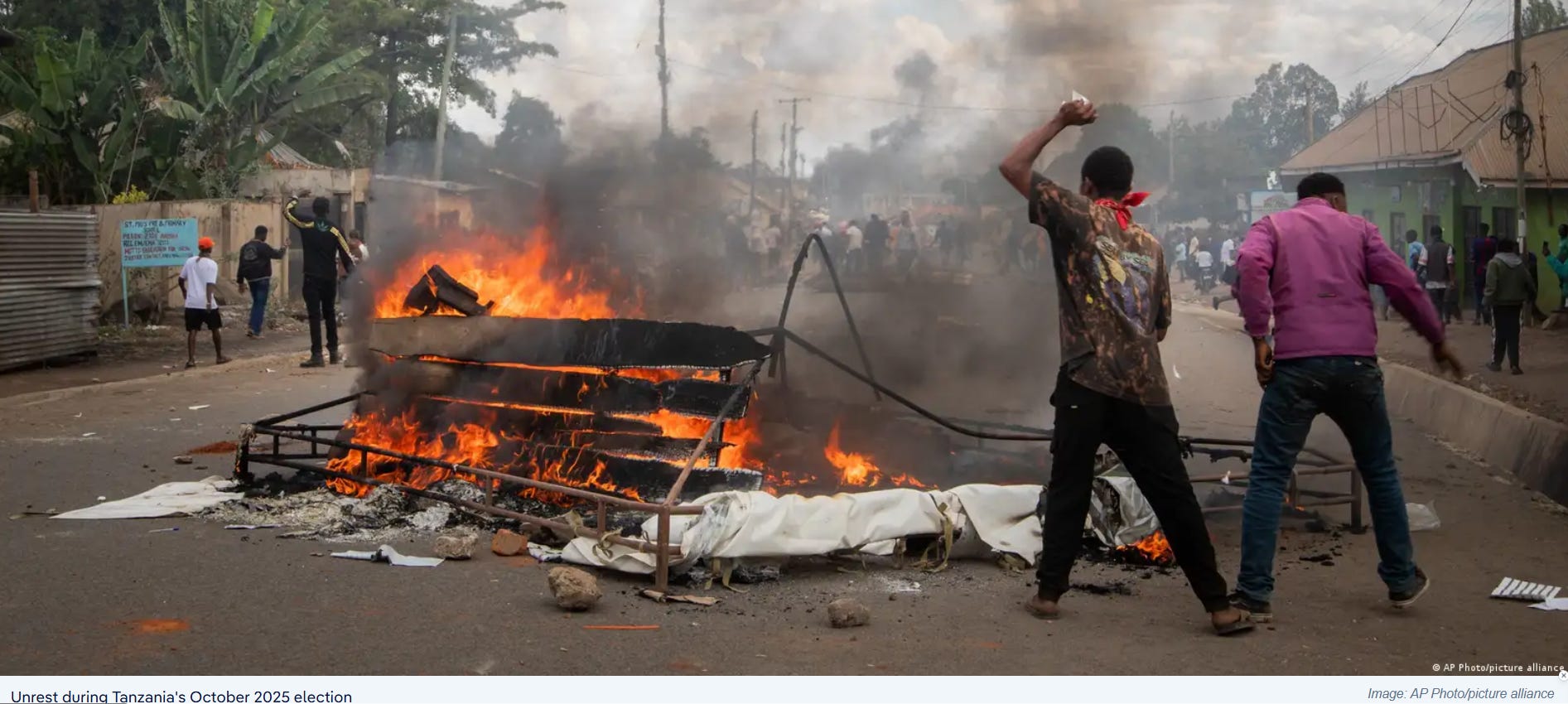
On October 29, eight protests took place in Dar es Salaam and quickly spread to Arusha, Dodoma and Mwanza, fueled by anger over alleged electoral fraud, opposition suppression and heavy‑handed policing.
As violence erupted and unrest spread — buses and gas stations were torched and factories looted — the government imposed a 6 p.m. curfew and shut down the internet.
A DW investigation found that during that blackout in Mwanza, security forces gunned down people in residential areas.
A government investigation is underway.
UN experts estimate at least 700 individuals were killed and the opposition puts the number at up to 2,000 countrywide.
DW cannot confirm those figures, but we found evidence to suggest that many of the victims in Mwanza were not protesters.
‘They told them to lie down — then they shot them’
The first incident occurred in Kisesa, a town along the road between Mwanza and the suburb of Mji Mwema.
The road became a death artery on the night of October 29 into October 30. According to multiple eyewitnesses, police killed four men in Kisesa at around 7 p.m., after a day of protests.
All survivors and eyewitnesses spoke to DW on condition of anonymity. They say police are trying to silence them and destroy evidence. DW has changed their names.
Nuru, who witnessed the shooting, described how the men were executed.
“Akida had been sitting behind his house with two other young men. They were eating chips,” Nuru said. “Then the police arrived and told them to line up. There is a salon nearby, and there was a man ending his shift there. Police told him to join the others who were already lined up.”
What happened next, Nuru said, was swift and brutal: “Then the police ordered them to lie down. The man from the salon tried to run away, and they shot him in the back, in the chest and then in the head. The ones who had been ordered to lie down were all shot dead.”
The victims were Akida, 31; Chacha, 40, the man from the salon; Hamu, 31; and Zuberi, 24.
Sporadic gunfire continued throughout the night, said Tanga, another witness, making it impossible for families to retrieve the bodies.
“Even if he was your friend, after he had been shot, you could only run away — you wouldn’t dare come back to collect his body.”
According to Tanga, it was soldiers who removed the dead. “They had special lorries for carrying the bodies.”
Shot while watching the news
The second incident took place the following evening, October 30, in Mji Mwema. This time, the victims were inside a video hall, watching the news.
Imani, one of the survivors, was inside with about 14 other people when shooting began outside. “We were inside watching the news,” he said. “Suddenly, we heard bullets firing outside. Some of us were hiding under the benches.”
Then the gunfire moved inside.
“When we lay down, I heard bullets being fired again. I felt like they were firing into the air, but they were actually shooting at us,” Imani said. “The whole incident took less than a minute, and then they left.”
Imani realised he had been shot only after the attackers were gone. “I felt something warm on my cheek,” he said. “The flesh of my cheek had been ripped off. I had been shot.”

Eyewitnesses told DW that several bodies lay in and around the video hall after the shooting. Neema lost two relatives that night — her son, Simba, and her brother, Khamisi.
“I went out to assist a man who had been shot in the back and thigh; he had managed to crawl to our door. He survived,” she said. “While we were helping him, a young man came crying, ‘Mama Simba, come see — Uncle Khamisi and Jabali have been killed!’”
Neema tried to reach the scene. “I tried to cross the road, but the shooting continued. We had to turn back,” she said.
Usi, another survivor, was with Simba moments before he died. “I told Simba, we need to run but he refused,” Usi recalled. “He said, ‘we haven’t done anything wrong; we should just stay quiet.’”
Usi hesitated — and then made a split-second decision. “I realized the only way out was to run right through the line of officers. I just bolted.”
Ballistics and removal of bodies
Using geolocation data and eyewitness accounts, DW traced the attackers’ movements: The shooters approached the video hall from the south, first attacking people near the TAG Church Nyasaka Centre before driving about one minute up the road to the video hall.
DW obtained several bullets from both the Kisesa and Mji Mwema incidents. Ballistics expert Byron Adera examined the images.
“You can almost certainly say 7.62 by 39 millimetres,” Adera said. “They are ammunition widely used by small arms and light weapons of the nature of AK-47 variants.”
Those weapons, he said, are standard issue. “In Tanzania, the small arms and light weapons of the type of AK-47 happen to be the majority of the first-line weapon systems in the hands of the Tanzanian police,” Adera said. “And, of course, the defence forces also use AK-47 variants.”
Police violence reports emerge after Tanzania election row
Eyewitnesses in Kisesa say police in uniform carried out the shootings. In Mji Mwema, eyewitnesses say the shooters wore black combat gear. Soldiers collected the bodies in both places, according to the eyewitnesses.
Akida’s mother went to Bugando the day after her son was killed. “There were a lot of bodies piled on each other all over,” she said. “They managed to set him aside and told us to pay 300,000 shillings [$120, €102].”
She said the family was forced to wait days before being allowed to bury him.
A leaked police report — and no official answers
An internal Mwanza police report leaked to DW lists 68 “deceased civilians.” The report identifies 58 of them by name, including several who were killed in the incidents DW investigated.
The DW investigation found that excessive force was used against innocent citizens and that the government may have more questions to answer.
DW repeatedly contacted the Mwanza police and requested comment from the Tanzanian government on the two incidents. DW also wrote to the government spokesperson. There was no response.
Months after election crackdown, hundreds of people remain unaccounted for.