

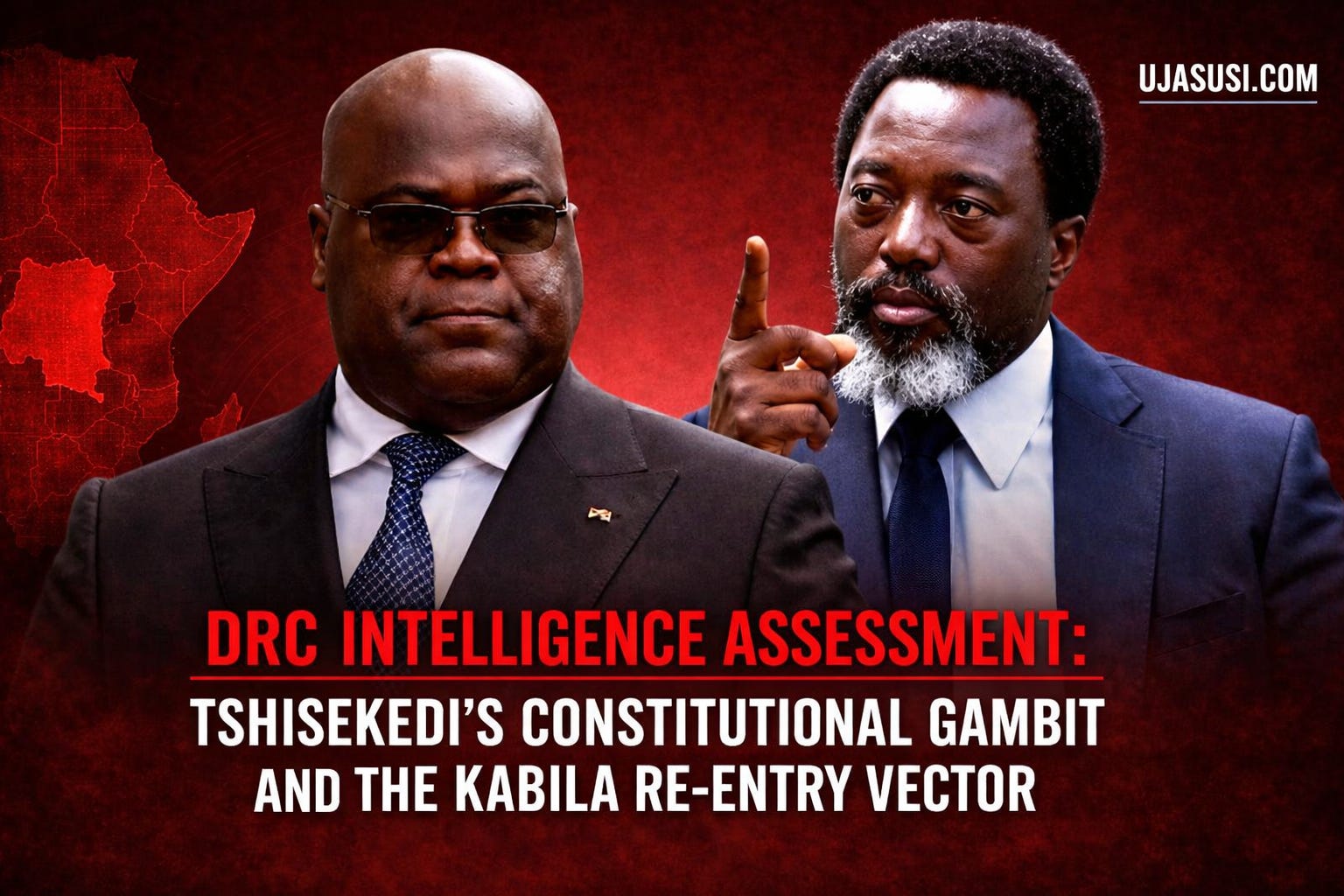
Ujasusi Great Lakes Region Monitoring Team | 19 June 2026 | 0115 BST
Key Judgements
This assessment makes four principal analytical judgements:
KJ-1. Tshisekedi’s referendum bill is a structured attempt to legally circumvent the 2006 DRC Constitution through a constituent assembly mechanism rather than direct amendment. The legal pathway is constitutionally contestable and faces a non-trivial probability of being struck down by the Constitutional Court.
KJ-2. The bill has, as a second-order effect, consolidated a fragmented opposition into the C64 coalition, whose breadth and institutional backing (Catholic and Protestant churches, civil society, multiparty figures) exceeds any prior anti-Tshisekedi formation in organisational coherence.
KJ-3. Joseph Kabila is not pursuing a direct path to the presidency. The evidence supports a candidate-placement strategy, assessed with moderate confidence, in which Kabila’s networks position a surrogate for the 2028 contest or any post-crisis succession arrangement.
KJ-4. Washington’s concurrent sanctioning of Kabila and permissive posture toward the referendum bill represents a deliberate strategic alignment with Tshisekedi’s incumbency, driven primarily by the critical minerals cooperation framework signed in 2025. This alignment is assessed as conditionally stable and holds unless political violence in Kinshasa generates congressional pressure that forces a State Department posture distinct from Treasury’s.
Actor Assessment
Félix Tshisekedi | Intent: Tenure Extension | Capability: Constrained
Tshisekedi has been in office since 2019, is currently serving his second term, and is due to leave office in 2028 under the existing constitution. His stated public position, that he would only accept a third term if demanded by the people, is the standard deniability formulation used by incumbents pursuing term-limit revision across the African continent. It structurally parallels the referendum mechanisms used by Paul Kagame in 2015, when citizen petitions provided the initiating pretext, and by Alassane Ouattara before Côte d’Ivoire’s 2016 constitutional revision, which Ouattara subsequently argued reset his presidential term clock to permit a third-term candidacy in 2020.
READ ALSO
Introducing “A Spy’s Guide to Deception” — The First in the Spy Guide Series

Intelligence work is built on deception. Every service that has ever run an agent, mounted a cover operation, or manufactured a false narrative has done so through principles that remain largely invisible to the public. Not because they are secret, but because no one has taken the time to explain them plainly.
The mechanism Tshisekedi has chosen is technically indirect. The bill formally leaves DRC’s presidential term prohibition, which prohibits any amendment to the number or duration of presidential terms, untouched, but introduces an exceptional pathway allowing constitutional changes through a constituent assembly when state institutions experience a “major dysfunction.” Applied to the DRC’s current condition, an ongoing Ebola epidemic, M23 territorial control of North and South Kivu, and a contested electoral commission, the threshold for invocation is effectively at executive discretion.
Tshisekedi’s capability to execute this strategy is constrained by three factors: the Constitutional Court’s pending review, street-level opposition that has already produced political violence, and the conditional nature of US backing. None of these factors is individually decisive. Together, they raise the operational risk of the referendum pathway to a level that a competent political risk analyst would rate as high.
Joseph Kabila | Intent: Surrogate Placement | Capability: Network-Retained
Kabila’s legal status as of June 2026 is as follows: sentenced to death in absentia by a Congolese military court for treason and complicity with the M23, with the conviction effectively blocking any immediate political comeback within the country; sanctioned by US Treasury’s OFAC under Executive Orders 13413 and 13671 for providing funds, encouragement, and political direction to the AFC/M23, including efforts to lure defections from the Congolese armed forces; and his PPRD party assets seized by the DRC Interior Ministry.
These are significant legal and institutional constraints. They do not, however, constitute network destruction. Kabila governed the DRC for eighteen years, from January 2001 to January 2019, and built penetrating relationships across the FARDC officer corps, the intelligence services, the mining sector, and provincial administration. No suspension order reaches those networks. The US Treasury stated specifically that Kabila worked to install a candidate opposed to the current president with the intent to regain influence over the DRC government, a finding that identifies a named operational objective, not merely a general destabilisation effort.
Kabila convened a meeting with opposition leaders in Nairobi, where participants bearing the signatures of twelve opposition and civil society groups vowed to launch a diplomatic offensive to alert the international community to the DRC’s crisis. The Nairobi coordination structure functions as an exile political bureau. Its formal declarations create a paper trail of legitimacy; its informal communications channel Kabila’s network instructions. This is a standard dual-track format for exiled political actors with retained state penetration.
The C64 Coalition | Intent: Constitutional Defence | Capability: Mobilisation-Level
At the end of May 2026, figures including Moïse Katumbi, Martin Fayulu, Matata Ponyo, and Jean-Marc Kabund, alongside civil society groups, launched the Article 64 opposition coalition, formally the “Coalition for the Defence of Constitutional Order.” The coalition’s name references the constitutional provision requiring Congolese citizens to resist power exercised in violation of constitutional provisions, a framing designed to place street-level resistance within a legal rather than insurrectionist register.
The C64’s principal asset is breadth. It has unified actors who have been adversarial to each other, among them Katumbi and Kabila, Fayulu and the PPRD networks, around a single constitutional red line. That unity is issue-specific and assessed as fragile beyond the immediate term-limit question. However, fragility beyond a single issue does not reduce tactical effectiveness in the near term. Martin Fayulu announced a march on 8 July to the presidential palace demanding Tshisekedi’s resignation, a date that signals intent to escalate street pressure through organised mobilisation rather than spontaneous protest.
The C64’s intelligence-relevant weakness is the absence of any institutional pathway to power. It can block or delegitimise; it cannot govern without a constitutional mechanism for transition. This creates a structural dependency on the Constitutional Court delivering a favourable ruling, which the coalition cannot compel.
The United States | Intent: Minerals Access and Stability | Capability: Decisive
Washington’s posture is the single most consequential external variable in this assessment. Under the minerals cooperation framework, Kinshasa handed cobalt and coltan mines and one of the world’s richest tantalum deposits to US miners, with Tshisekedi arguing that certain reforms required under the strategic partnership with the United States would necessitate constitutional amendments, especially within the justice sector. Tshisekedi has embedded the constitutional revision within the US partnership framework, making the two politically inseparable in his public presentation.
Analysts assessed that the Washington-Tshisekedi strategic alignment may further embolden the Congolese leader domestically, particularly as his coalition tests public opinion around constitutional reform. The OFAC designation of Kabila serves the dual function of neutralising Tshisekedi’s principal rival while sustaining the fiction that US engagement in the DRC is accountability-driven rather than transactional.
This posture holds under one condition: that political violence in Kinshasa does not reach a threshold that triggers congressional oversight mechanisms. If 8 July mobilisation produces documented state-perpetrated casualties, pressure from Senate Foreign Relations or House Intelligence committees is a plausible second-order effect that would complicate the executive branch’s current alignment.