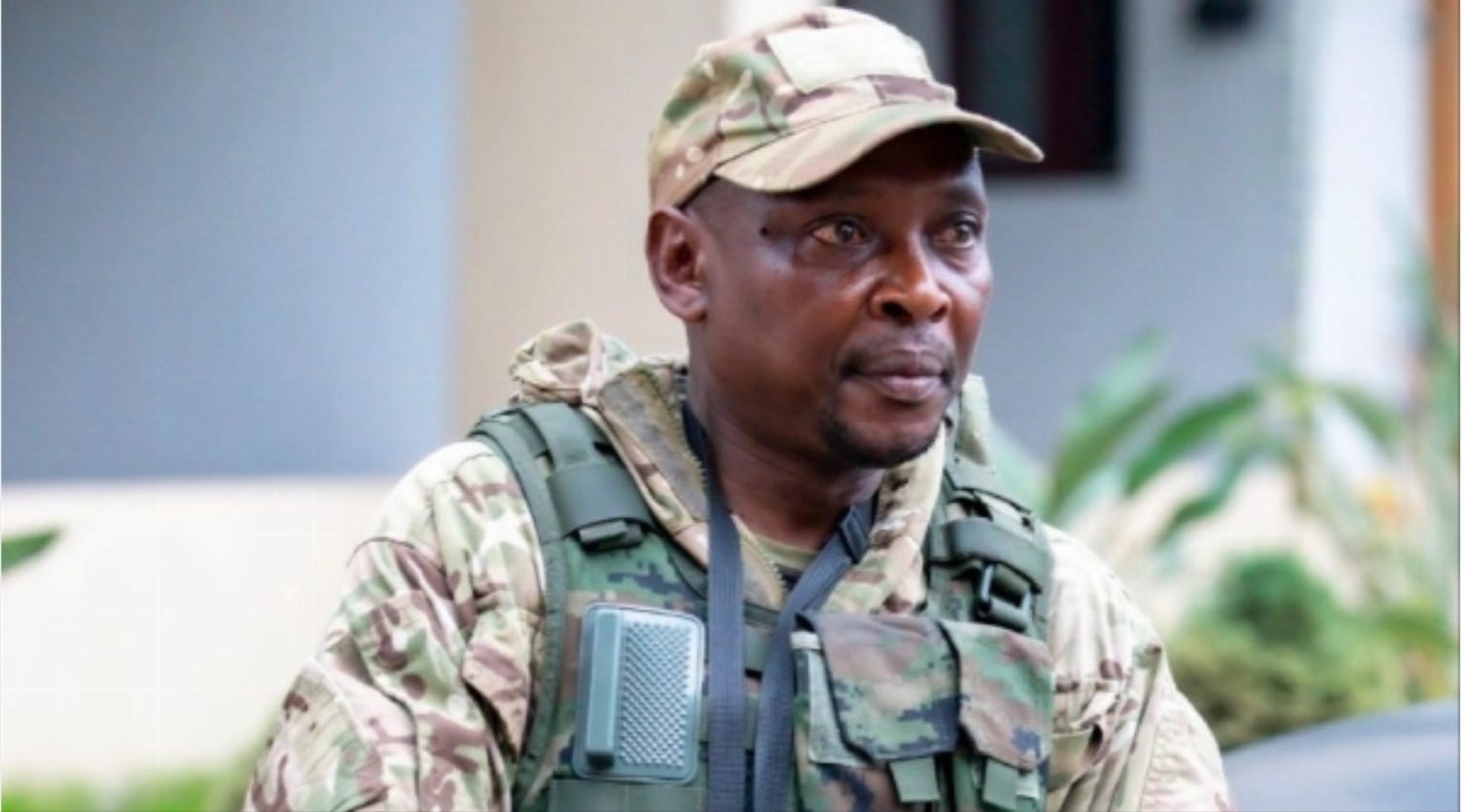
DRC Army Drone Strike Kills Willy Ngoma, Rwanda-Backed M23/AFC Military Spokesperson, in North Kivu
Ujasusi Blog’s Great Lakes Region Monitoring Team | 25 February 2026 | 2305 GMT
In the early hours of 24 February 2026, a drone strike attributed to the Armed Forces of the Democratic Republic of Congo (FARDC) killed Lieutenant-Colonel Willy Ngoma, the military spokesperson of the Rwanda-backed March 23 Movement (M23/AFC), near the coltan-mining hub of Rubaya in North Kivu province. The strike, which occurred at approximately 03:00 local time, dealt one of the most significant single blows to M23/AFC’s command and communications structure since the movement’s resurgence in November 2021. Multiple independent sources — including two senior rebel officials, a regional diplomat, and a Western government adviser — confirmed Ngoma’s death to Reuters, making this among the most consequential targeted killings in the ongoing eastern DRC conflict.
The elimination of Ngoma is not merely a military event. It is an intelligence, psychological operations, and geopolitical development that simultaneously degrades M23/AFC’s command architecture, signals an evolution in FARDC’s tactical drone warfare doctrine, threatens the fragile Qatar-mediated ceasefire framework, and intersects directly with an emerging US-DRC critical minerals partnership. This assessment examines each of those dimensions in turn.
👤 Who Was Willy Ngoma? Profile of a High-Value Target
To properly calibrate the significance of this killing, one must first establish a clear profile of the individual eliminated. Lieutenant-Colonel Willy Ngoma was not a conventional media officer or communications functionary. He was one of the most operationally, symbolically, and institutionally consequential figures within the M23/AFC structure — a former FARDC soldier who defected to the rebellion, survived its first defeat, endured years of exile, and returned to become its most visible and credible military voice.
After M23’s defeat at the end of its first offensive in 2012–2013, Ngoma was part of the contingent that withdrew to Uganda alongside General Sultani Makenga, the movement’s senior military commander. His presence within that inner circle during the movement’s most vulnerable period is analytically significant: it speaks to his ideological commitment to the cause and to the trust the senior leadership placed in him. When M23 resurged in November 2021, Ngoma was appointed military spokesperson — a role that, within the M23/AFC structure, carried genuine operational authority and not merely communicative functions.
He was recognisable for always appearing in full combat fatigues, Kalashnikov slung across his shoulder, filming himself and his fighters at strategically captured sites — airports, markets, government buildings — to assert territorial dominance and project psychological pressure on both enemy forces and civilian populations. He communicated in Swahili to address local populations and in Lingala to directly challenge and taunt loyalist forces, demonstrating a sophisticated, multi-register approach to information environment operations. Some of his most widely circulated videos showed captured FARDC soldiers being interrogated on camera — a deliberate and calculated exercise in humiliation and demoralisation directed at Kinshasa.
Beyond communications, UN expert panels and multiple sanctions documentation consistently described Ngoma as a senior military strategist. The OpenSanctions database records his designation under UN Security Council Resolution 2293 (2016) for “planning, directing, committing acts in the DRC that constitute human rights violations or abuses or violations of international humanitarian law, including those acts involving the targeting of civilians, including killing and maiming, rape and other sexual violence, abduction, forced displacement, and attacks on schools and hospitals.” These were not peripheral or political designations. They were predicated on direct evidentiary findings by UN investigators with access to ground-level documentation.
The European Union sanctioned Ngoma on 8 December 2022, freezing his assets, banning his entry into EU territory, and prohibiting any EU entity from extending him financial assistance. The UN Security Council issued its own formal designation in February 2024. The United States sanctioned him in December 2023, specifically citing atrocities committed in Kishishe in November 2022 — a village massacre that drew international condemnation and in which M23 fighters were credibly implicated in mass killings and sexual violence. By the time of his death, Ngoma carried the simultaneous sanctions designations of the EU, UN, and US — a rare trilateral designation that reflects both his seniority within M23/AFC and the scale of the human rights documentation assembled against him.
💥 Operational Details: The Strike and Its Execution
The strike occurred at approximately 03:00 local time (01:00 GMT) on Tuesday, 24 February 2026, near Rubaya in Masisi territory, North Kivu province. The operation was not opportunistic. It followed several days of sustained FARDC drone activity targeting M23/AFC positions across Masisi territory, indicating that FARDC had established persistent ISR (Intelligence, Surveillance, and Reconnaissance) coverage over the operational area and was conducting deliberate, methodical targeting rather than reactive strikes.
Additional detail from ground-level reporting indicates that Ngoma and several other M23/AFC personnel, including individuals described as foreign fighters, were travelling in a convoy when it was struck. Local witnesses placed the strike at approximately 02:40 local time in an elevated position overlooking Rubaya. At least nine bodies were reportedly recovered from the rubble of a residential structure that sustained a direct hit. Two individuals described as white mercenaries are also reported among the dead, though this detail remains unverified at time of publication and warrants further investigation given its implications for the involvement of private military contractors in eastern DRC.
The M23/AFC communications response to the strike is itself analytically instructive. M23 political spokesperson Lawrence Kanyuka posted on X at 03:43 local time — barely an hour after the strike — accusing FARDC of “blindly bombing” Rubaya and “massacring innocent civilians.” The timing of that post, combined with its frantic and accusatory tone, suggests that M23/AFC’s communications apparatus was already in reactive disarray, responding to the loss of its primary military voice in real time with improvised messaging rather than coordinated crisis communication. Analysts noted that the content and timing of Kanyuka’s posts “betrayed a form of disorganisation in the rebel ranks.” M23/AFC’s official social media pages posted a black image with a broken-heart emoji several hours before a formal obituary was issued — an implicit confirmation of catastrophic loss before the movement was ready to officially acknowledge it.
The formal M23/AFC statement, when it eventually came, read: “It is with pain and deep sorrow that the AFC/M23 announces the death of Comrade Willy Ngoma, military spokesperson within the political coordination. Comrade Willy Ngoma was taken from life under tragic circumstances.” The measured grief of the formal statement contrasted sharply with the chaos of the initial real-time social media response — a contrast that reveals the extent to which Ngoma’s death caught the movement’s command structure off guard.
🗺️ Why Rubaya? The Strategic and Geopolitical Geometry of the Strike Location
The selection of Rubaya as the operational theatre for this strike carries dimensions that extend well beyond the immediate military engagement. Rubaya is not merely a contested town in North Kivu. It is one of the most economically and geopolitically significant locations in the entire eastern DRC conflict architecture, and its centrality to the strike cannot be analytically decoupled from the broader interests at play.
Rubaya produces approximately 15 per cent of the global coltan supply — a mineral indispensable to the production of capacitors used in smartphones, laptops, electric vehicles, satellite systems, and defence electronics. M23/AFC’s control of Rubaya and the surrounding Masisi territory has functioned as a primary revenue stream for the movement, financing its operations and underpinning its capacity to sustain a prolonged military campaign across North and South Kivu. The site is, in economic terms, the movement’s treasury.
Kinshasa has recently added Rubaya to a shortlist of strategic mining assets being offered to the United States under a minerals cooperation framework — a geopolitical manoeuvre that simultaneously seeks American investment interest in DRC’s mineral wealth and raises the strategic stakes around FARDC’s recapture of the area. Washington’s interest in securing critical mineral supply chains outside Chinese dominance gives Kinshasa a powerful lever to attract US diplomatic attention and, potentially, military-adjacent technical support.
The FARDC drone campaign against Rubaya therefore represents a dual-track operation: military attrition of M23/AFC leadership and a deliberate effort to demonstrate, both to Washington and to the international community, that Kinshasa possesses the will and the capability to exercise control over a site it is actively marketing as a future American economic partnership asset. A FARDC victory at Rubaya is not merely a military objective — it is a prerequisite for fulfilling an emerging commitment to a major power partner. The killing of Ngoma at this precise location, at this precise diplomatic moment, is unlikely to be coincidental.
🧠 Intelligence Assessment: The Operational and Strategic Implications
Command and Communications Degradation
The loss of Willy Ngoma represents a qualitative degradation of M23/AFC’s command and communications capacity that cannot be readily or quickly replaced. Within the M23/AFC structure, the role of military spokesperson was not disaggregated from operational authority in the way that civilian communications roles typically are. Ngoma carried genuine command credibility, battlefield presence, and institutional memory stretching back to the movement’s first offensive in 2012. His ability to appear publicly at captured sites, to address multiple audiences simultaneously in multiple languages, and to project battlefield confidence served critical functions across psychological operations, recruitment messaging, external legitimacy-building, and morale maintenance within the rank and file.
His replacement, whoever is eventually appointed, will face a structural credibility deficit. No successor inherits Ngoma’s more than a decade of accumulated presence within the movement, his name recognition among regional and international media, or his tactical battlefield profile. M23/AFC’s information warfare capacity has been materially weakened, and it will require months — not weeks — to reconstitute a communications function of comparable effectiveness.
FARDC’s Evolving Drone Warfare Doctrine
The strike also signals a meaningful evolution in FARDC’s tactical doctrine. The Congolese army has historically struggled to conduct precision targeting operations, often relying on conventional ground engagements in which M23/AFC has held consistent tactical advantages in terms of training, discipline, and command cohesion. The sustained multi-day drone campaign against Rubaya — culminating in the pre-dawn elimination of a senior, multiply-sanctioned commander during a convoy movement — demonstrates that FARDC has either developed or acquired ISR and strike drone capabilities sufficient for targeted leadership elimination.
Key analytical questions remain open: whether these drone capabilities are indigenous, provided by allied states, operated with external technical assistance, or represent a combination of these factors. The involvement of Burundian forces, Wazalendo fighters, and reported contingents from multiple other countries on the FARDC-aligned side of the conflict introduces additional variables. What is analytically certain is that the nature of FARDC’s targeting capability has demonstrably shifted, and M23/AFC’s operational security protocols must now account for persistent aerial surveillance over its command and logistics nodes in ways that were not previously necessary.
Rwanda’s Strategic Calculus
Kigali has consistently denied providing support to M23/AFC despite extensive UN Group of Experts documentation to the contrary — including findings that Rwanda exercised de facto control over M23/AFC operations and deployed between 3,000 and 4,000 Rwandan Defence Force troops inside Congolese territory. The killing of a senior M23/AFC commander in circumstances that expose the movement’s operational vulnerabilities on the ground creates a nuanced and uncomfortable challenge for Rwanda. Kigali must now balance several competing imperatives: its continued material interest in M23/AFC’s control of eastern DRC territory and its mineral revenues; the need to avoid being seen internationally as doubling down on a losing proxy position; the management of domestic narratives about Rwanda’s role; and the pressure from Brussels and Washington, both of which have sanctioned Ngoma and whose intelligence services have extensively documented Rwanda’s material support for the movement.
Ngoma’s death removes one of the most internationally prominent faces of a movement that Kigali officially denies supporting. In one sense, this reduces Kigali’s exposure. In another sense, it weakens a proxy asset that Rwanda has invested considerable resources in sustaining, at a moment when the movement’s military fortunes are under pressure and diplomatic negotiations are producing commitments that could constrain its operational freedom.
The Doha Ceasefire Architecture Under Severe Strain
The killing occurred against the backdrop of Qatar-mediated ceasefire negotiations between Kinshasa and M23/AFC. Both parties had signed agreements in Doha to establish a joint ceasefire monitoring and verification mechanism under the observation of Qatar, the United States, and the African Union. The FARDC drone campaign — and the killing of Ngoma in particular — has severely complicated this diplomatic environment. M23/AFC has publicly framed the Rubaya strikes as a deliberate violation of the Doha commitments, and the death of its most senior military spokesperson will almost certainly harden the movement’s negotiating posture.
There is also a signalling dimension to Kinshasa’s actions that must not be overlooked. By conducting sustained drone strikes — including a strike that killed a multiply-sanctioned commander — during an active ceasefire mediation process, Kinshasa is signalling to both its domestic audience and its international partners that it retains both the will and the capability to pursue military solutions in parallel with diplomatic ones. Whether this dual-track posture strengthens or ultimately undermines Kinshasa’s negotiating position is an open question, but the short-term effect is an unambiguous escalation of pressure on M23/AFC at the negotiating table.
📌 Ujasusi Blog Assessment
The targeted elimination of Lieutenant-Colonel Willy Ngoma is the most significant single leadership loss sustained by M23/AFC since the movement’s resurgence in 2021. It is a development that operates simultaneously across four distinct analytical registers: the military, the intelligence, the diplomatic, and the geopolitical. FARDC has demonstrated a precision targeting capability that changes the operational security calculus for M23/AFC’s entire command structure. M23/AFC has lost its most credible and experienced military communicator at a moment when it faces sustained military pressure on multiple fronts. The Doha ceasefire architecture has been placed under severe strain. And the killing has occurred at a site that sits at the intersection of a global minerals competition and an emerging US-DRC strategic partnership.
The eastern DRC conflict has long defied resolution. But the killing of Ngoma represents a genuine inflection point — one whose downstream effects on M23/AFC’s cohesion, Rwanda’s strategic calculations, and the trajectory of the Doha process will define the conflict’s next chapter. Ujasusi Blog will continue to monitor developments on the ground, the M23/AFC command reconstitution process, and the trajectory of the ceasefire mechanism.
🔗 Sources & Further Reading
Reuters — M23 rebel spokesperson killed in DRC army drone strike
The Africa Report — Willy Ngoma, military spokesperson for AFC/M23, killed in drone strike
Irish Times — M23 rebel spokesperson killed in DRC army strike, officials say
Africanews — Senior M23 commander killed in Eastern DR Congo drone strike
Afro News Wire — M23 Spokesperson Willy Ngoma Killed in Drone Strike Near Rubaya
Xtrafrica — Willy Ngoma Killed in Drone Strike Near Rubaya
OpenSanctions — Willy Ngoma Sanctions Profile
TUKO — Willy Ngoma, M23 spokesperson, killed in army drone attack
The Herald (South Africa) — M23 rebel spokesperson killed in DRC army drone strike
UN Group of Experts Final Report (2024) — S/2024/432 — Rwanda/M23 Documentation
Al Jazeera — Rwanda’s de facto control over M23, UN experts