

Ujasusi Blog

Ujasusi Blog

Dar es Salaam Water Crisis: Structural Failure, Political Targeting, or Deliberate Sabotage?

Evarist Chahali's avatar
Evarist Chahali
Dec 27, 2025
∙ Paid
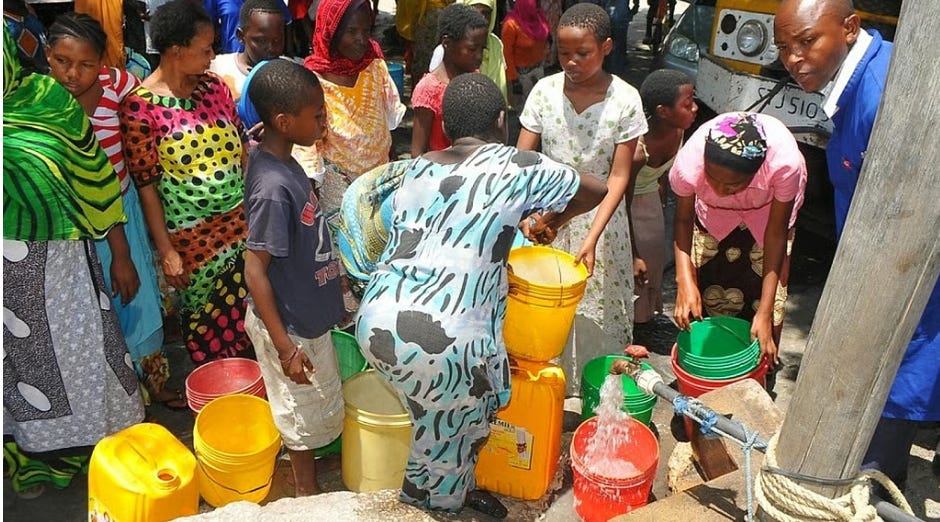
Dar es Salaam, Tanzania: Local residents are jostling to fetch water under the on-going rationing schedule [Photo: Kizito Makoye]

The December 2025 Dar es Salaam water crisis affecting six million residents results primarily from structural infrastructure failures (37% distribution losses, 270 million litre production shortfall) compounded by climate shocks (failed October-December rains), not deliberate political punishment. However, the crisis disproportionately impacts opposition strongholds during post-election repression, raising legitimate questions about regime prioritisation versus capacity in Tanzania’s largest city.

What Is the Scale and Scope of Dar es Salaam’s Current Water Crisis?

Production Collapse Metrics

The Dar es Salaam Water and Sanitation Authority (DAWASA) reports catastrophic production failures:

Lower Ruvu Treatment Plant Performance:

  • Previous capacity: 270 million litres/day

  • Current production: 50 million litres/day

  • Production collapse: 81.5% reduction

City-Wide Water Deficit:

  • Total daily demand: 770 million litres

  • Current production capacity: 534 million litres

  • Daily shortfall: 236 million litres (30.6% unmet demand)

Source: The Citizen, December 2024

Geographic Distribution of Service Interruptions
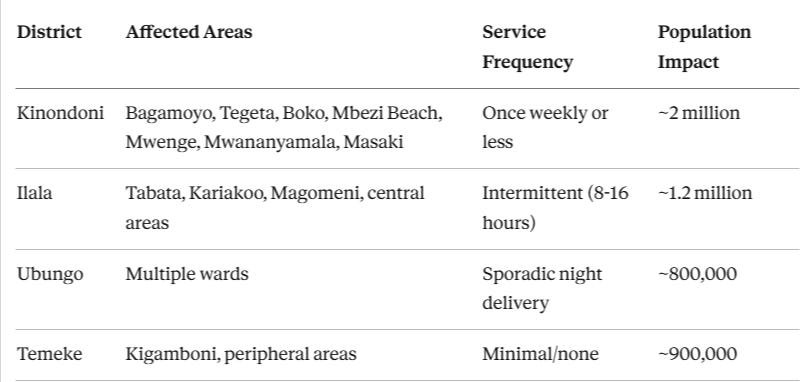
Critical Service Gap: Only 20% of Dar es Salaam residents receive water for 20-24 hours daily, whilst 40% lack pipeline network access entirely.

Source: The Citizen, December 2024

Economic Impact Quantification

Price Escalation:

  • Pre-crisis vendor water: $4 per 1,000 litres

  • Current vendor water: $10 per 1,000 litres

  • Price increase: 150%

Household Cost Burden:

  • Low-income areas (Tandale): 100-litre container costs exceed daily family food budget

  • Middle-income areas: Weekly water purchases average $15-25

  • Wealthier areas: Cushioned by private boreholes and storage tanks

Source: K24 Digital, December 2024; Down to Earth, December 2024

Is This a Structural Infrastructure Problem?

Evidence of Systemic Infrastructure Failure

Yes. Multiple structural deficiencies have created chronic vulnerability:

1. Massive Distribution Network Losses

DAWASA operational data reveals catastrophic inefficiency:

  • Daily production: 520 million litres

  • Daily sales: 210 million litres

  • Daily losses: 110 million litres

  • Loss rate: 37% (vs. International Water Association 20% benchmark)

Implication: If distribution losses were eliminated, DAWASA could theoretically serve 6 million additional residents with existing production capacity.

Source: The Guardian Tanzania, July 2024

2. Production Capacity-Utilisation Gap

Water Minister Jumaa Aweso’s July 2024 inspection revealed:
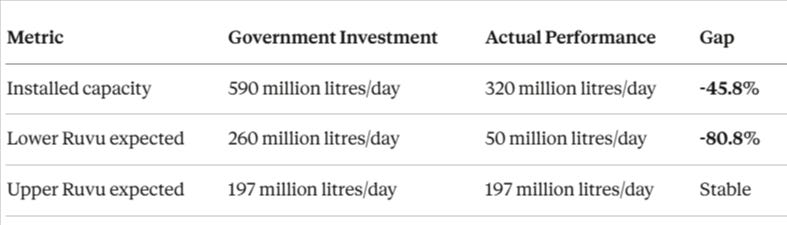
Cause identified: “Deliberate damage” to production facilities, machinery defects, inadequate maintenance.

Source: Down to Earth, July 2024

3. Delayed Major Infrastructure Projects

Kidunda Dam (Primary Long-Term Solution):

  • Budget: Sh329 billion (~$135 million USD)

  • Storage capacity: 190 billion litres

  • Projected service population: 11.39 million by 2032

  • Expected operational date: April 2026

  • Current status: Under construction, years behind schedule

Historical Context: Water rationing became routine in 2021, yet the transformative infrastructure solution remains 16+ months away.

Source: The Citizen, December 2024

4. Ageing Infrastructure and Network Inadequacy

  • Pipeline age: Significant portions exceed 30-40 years

  • Leak prevalence: Persistent throughout distribution network

  • Illegal connections: Widespread for irrigation and unauthorised use

  • Network coverage: 40%+ of city lacks pipeline access

Water expert Herbert Kashililah (Tanzania Water & Sanitation Network) confirmed: “Old pipelines are riddled with leaks and illegal connections... We must modernise this infrastructure by replacing old pipes, building new reservoirs, and upgrading treatment plants.”

Source: Down to Earth, July 2024

Climate Vulnerability: Structural Design Flaw

Dar es Salaam’s water system architecture is fundamentally vulnerable:
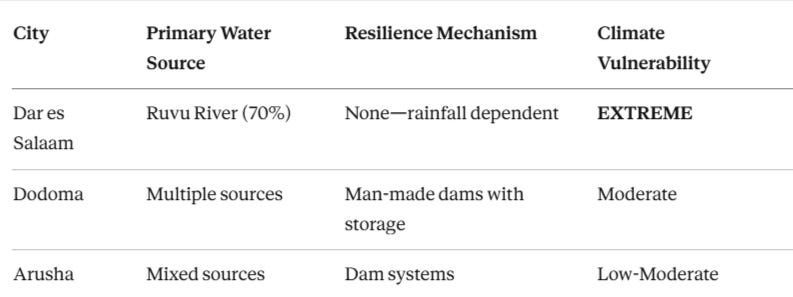
Critical Design Gap: Despite coastal location, Dar es Salaam has zero desalination capacity, leaving the city entirely dependent on inland rainfall patterns affecting the Ruvu River.

2024 Climate Shock:

  • Tanzania Meteorological Authority forecast: Below-average October-December 2024 rainfall

  • Actual outcome: Failed rainy season, “prolonged dry periods and unsatisfactory distribution”

  • Temperature anomaly: Moshi recorded 35.7°C (4.2°C above average), intensifying evaporation

Source: The Citizen, September 2024

Investment vs. Outcomes Discrepancy

Government Claims:

  • Sh1.19 trillion invested in water/sanitation projects over 4 years (2021-2025) under President Samia Suluhu Hassan

  • 197 boreholes constructed under 2022 Prime Minister Kassim Majaliwa initiative

  • Multiple storage tank projects (e.g., Mshikamano tank 83% complete by September 2024)

Resident Reality:

  • Persistent rationing despite investments

  • Boreholes fail to alleviate scarcity during crisis periods

  • Water access percentage increased (89% to 93% claimed) but service quality/reliability declined

Analytical Assessment: Investment announcements do not translate to functional service delivery, suggesting implementation failure, corruption, or misallocated resources.

Source: The Citizen, December 2024

Is This Intentional Political Targeting by Samia Suluhu Hassan’s Regime?

Dar es Salaam, Tanzania: Local residents are jostling to fetch water under the on-going rationing schedule [Photo: Kizito Makoye]

The December 2025 Dar es Salaam water crisis affecting six million residents results primarily from structural infrastructure failures (37% distribution losses, 270 million litre production shortfall) compounded by climate shocks (failed October-December rains), not deliberate political punishment. However, the crisis disproportionately impacts opposition strongholds during post-election repression, raising legitimate questions about regime prioritisation versus capacity in Tanzania’s largest city.

What Is the Scale and Scope of Dar es Salaam’s Current Water Crisis?

Production Collapse Metrics

The Dar es Salaam Water and Sanitation Authority (DAWASA) reports catastrophic production failures:

Lower Ruvu Treatment Plant Performance:

  • Previous capacity: 270 million litres/day

  • Current production: 50 million litres/day

  • Production collapse: 81.5% reduction

City-Wide Water Deficit:

  • Total daily demand: 770 million litres

  • Current production capacity: 534 million litres

  • Daily shortfall: 236 million litres (30.6% unmet demand)

Source: The Citizen, December 2024

Geographic Distribution of Service Interruptions

Critical Service Gap: Only 20% of Dar es Salaam residents receive water for 20-24 hours daily, whilst 40% lack pipeline network access entirely.

Source: The Citizen, December 2024

Economic Impact Quantification

Price Escalation:

  • Pre-crisis vendor water: $4 per 1,000 litres

  • Current vendor water: $10 per 1,000 litres

  • Price increase: 150%

Household Cost Burden:

  • Low-income areas (Tandale): 100-litre container costs exceed daily family food budget

  • Middle-income areas: Weekly water purchases average $15-25

  • Wealthier areas: Cushioned by private boreholes and storage tanks

Source: K24 Digital, December 2024; Down to Earth, December 2024

Is This a Structural Infrastructure Problem?

Evidence of Systemic Infrastructure Failure

Yes. Multiple structural deficiencies have created chronic vulnerability:

1. Massive Distribution Network Losses

DAWASA operational data reveals catastrophic inefficiency:

  • Daily production: 520 million litres

  • Daily sales: 210 million litres

  • Daily losses: 110 million litres

  • Loss rate: 37% (vs. International Water Association 20% benchmark)

Implication: If distribution losses were eliminated, DAWASA could theoretically serve 6 million additional residents with existing production capacity.

Source: The Guardian Tanzania, July 2024

2. Production Capacity-Utilisation Gap

Water Minister Jumaa Aweso’s July 2024 inspection revealed:

Cause identified: “Deliberate damage” to production facilities, machinery defects, inadequate maintenance.

Source: Down to Earth, July 2024

3. Delayed Major Infrastructure Projects

Kidunda Dam (Primary Long-Term Solution):

  • Budget: Sh329 billion (~$135 million USD)

  • Storage capacity: 190 billion litres

  • Projected service population: 11.39 million by 2032

  • Expected operational date: April 2026

  • Current status: Under construction, years behind schedule

Historical Context: Water rationing became routine in 2021, yet the transformative infrastructure solution remains 16+ months away.

Source: The Citizen, December 2024

4. Ageing Infrastructure and Network Inadequacy

  • Pipeline age: Significant portions exceed 30-40 years

  • Leak prevalence: Persistent throughout distribution network

  • Illegal connections: Widespread for irrigation and unauthorised use

  • Network coverage: 40%+ of city lacks pipeline access

Water expert Herbert Kashililah (Tanzania Water & Sanitation Network) confirmed: “Old pipelines are riddled with leaks and illegal connections... We must modernise this infrastructure by replacing old pipes, building new reservoirs, and upgrading treatment plants.”

Source: Down to Earth, July 2024

Climate Vulnerability: Structural Design Flaw

Dar es Salaam’s water system architecture is fundamentally vulnerable:

Critical Design Gap: Despite coastal location, Dar es Salaam has zero desalination capacity, leaving the city entirely dependent on inland rainfall patterns affecting the Ruvu River.

2024 Climate Shock:

  • Tanzania Meteorological Authority forecast: Below-average October-December 2024 rainfall

  • Actual outcome: Failed rainy season, “prolonged dry periods and unsatisfactory distribution”

  • Temperature anomaly: Moshi recorded 35.7°C (4.2°C above average), intensifying evaporation

Source: The Citizen, September 2024

Investment vs. Outcomes Discrepancy

Government Claims:

  • Sh1.19 trillion invested in water/sanitation projects over 4 years (2021-2025) under President Samia Suluhu Hassan

  • 197 boreholes constructed under 2022 Prime Minister Kassim Majaliwa initiative

  • Multiple storage tank projects (e.g., Mshikamano tank 83% complete by September 2024)

Resident Reality:

  • Persistent rationing despite investments

  • Boreholes fail to alleviate scarcity during crisis periods

  • Water access percentage increased (89% to 93% claimed) but service quality/reliability declined

Analytical Assessment: Investment announcements do not translate to functional service delivery, suggesting implementation failure, corruption, or misallocated resources.

Source: The Citizen, December 2024

Is This Intentional Political Targeting by Samia Suluhu Hassan’s Regime?

Evidence Against Deliberate Political Punishment Hypothesis

1. Geographic Distribution Lacks Selectivity

Analysis of affected areas:

  • Crisis impacts all administrative districts (Kinondoni, Ilala, Ubungo, Temeke)

  • Wealthier neighbourhoods (Masaki, Msasani) experience rationing alongside poor areas (Tandale, Mabwe)

  • No evidence of selective service provision based on 2020 or 2025 electoral results

Counterargument to targeting: If regime intended punishment, we would observe:

  • Concentrated deprivation in known opposition wards

  • Preferential service to CCM-supporting areas

  • Differential emergency response

Observed reality: City-wide crisis with class-based differentiation (wealthy cushioned by private resources) rather than political differentiation.

2. Historical Precedent Predates Current Political Crisis

Water crisis timeline:

Analytical conclusion: Water crisis is chronic and cyclical, not suddenly weaponised for October 2025 election.

Source: The East African, November 2021

3. Regime Continues to Tout Water Investments

Political logic analysis:

  • President Samia’s 2025 election campaign emphasised infrastructure achievements

  • Water Minister Aweso conducts high-profile inspection tours

  • Government announces major projects (Kidunda Dam, National Water Grid)

Implication: Deliberately creating water crisis would undermine regime’s development narrative and election messaging.

4. Bureaucratic Response Pattern

Minister Aweso’s actions (July-December 2024):

  • Suspended DAWASA Acting CEO Kiula Kingu and Production Director Shaban Mkwanywe

  • Ordered crackdown on vandalism and illegal connections

  • Redirected agricultural water tankers to domestic supply

  • Implemented emergency rationing schedules

Assessment: Response pattern consistent with bureaucratic dysfunction and crisis management, not deliberate sabotage from political leadership.

Source: The Citizen, July 2024

Evidence Supporting State Abandonment Concerns

1. Capacity-Will Gap: Security vs. Service Delivery

Regime capacity demonstration (September-October 2024):

Analytical implication: Regime demonstrates rapid mobilisation capacity for political repression but chronic failure for basic service infrastructure, suggesting water is not political priority.

Sources: Amnesty International, August 2024; Human Rights Watch, September 2024

2. Opposition Electoral Geography Correlation

Dar es Salaam political profile:

  • Chadema’s historic electoral strength: Major towns including Dar es Salaam, Arusha, Moshi, Mwanza, Mbeya

  • Urban areas demonstrate significantly higher opposition support than rural CCM bastions

  • Dar es Salaam residents participated in mass protests January 2024, demanding electoral reforms

October 2025 election context:

  • Chadema barred from participation

  • Chairman Tundu Lissu arrested, charged with treason

  • Election results: Samia 97.66% (31.9 million votes vs. Magufuli’s 12.5 million in 2020)

  • African Union observers: Election “did not comply” with regional/international standards

Post-election violence (29 October 2024 onwards):

  • Epicentre: Dar es Salaam

  • Death toll: 1,000-2,000 (Chadema claims; verification urgent)

  • CNN investigation: Security forces killed protesters, shot pregnant women, mass graves

  • Arrests: 2,000+; treason charges (capital offence) for hundreds

Temporal correlation: Water crisis peaks in December 2025, immediately following deadliest crackdown in Tanzanian history, affecting the same population that protested and was violently repressed.

3. Regime “Economic Sabotage” Narrative

Prime Minister Mwigulu Nchemba’s framing (December 2024):

  • Characterised post-election protests as “economic sabotage”

  • Cited destruction statistics: 756 government offices, 27 DART stations, 976 government vehicles, 1,642 private vehicles

President Samia’s response (2 December 2025):

  • Defended lethal force as “proportional”

  • Insisted protests were “organised riots with specific purposes” including “attacking police stations to seize weapons”

  • Blamed “foreign actors” and Kenyans for violence

Parallel narrative on water infrastructure:

  • Minister Aweso cites “deliberate damage” to production facilities

  • Government emphasises vandalism and illegal connections

Analytical concern: Regime’s eagerness to label dissent as “sabotage” whilst simultaneously citing infrastructure “sabotage” raises questions about:

  • Whether infrastructure failures are blamed on opposition to deflect accountability

  • Whether “sabotage” narrative serves to justify continued authoritarian control

  • Opacity preventing independent verification of sabotage claims

Sources: The Citizen, December 2024; People Daily, December 2024

4. Comparative Regional Treatment

Question requiring monitoring: Does Dar es Salaam (opposition) receive different treatment than CCM-supporting regions experiencing water stress?

Available data (limited):

  • Multiple regions affected: Simiyu, Coast, Morogoro, Dodoma, Arusha

  • Dodoma (capital, CCM stronghold): Less affected due to dam infrastructure

  • Insufficient granular data on government responsiveness by region/political affiliation

Intelligence gap: Comprehensive comparative analysis of resource allocation, emergency response timing, and infrastructure investment between opposition and CCM areas required.

Is This Sabotage—and If So, By Whom?

Types of Sabotage: Taxonomy and Evidence

Category 1: Opportunistic Vandalism and Theft (CONFIRMED)

Documented sabotage activities:

  • Water meter theft: Widespread; Minister Aweso noted “customer is given a meter today and it goes missing the next day”

  • Pipeline damage: Deliberate destruction for scrap metal value

  • Illegal connections: Unauthorised irrigation taps diverting water from domestic supply

  • Treatment plant interference: “Deliberate damage” to machinery cited by Aweso

Perpetrators: Opportunistic criminals, unscrupulous farmers, corrupt officials facilitating illegal connections.

Motive: Economic gain (theft), resource access (irrigation), not political.

Impact magnitude: Contributes to 37% distribution losses and production inefficiency.

Source: Daily News, November 2025

Category 2: Bureaucratic Sabotage Through Incompetence (PROBABLE)

DAWASA official suspensions (July 2024):

  • Acting CEO Kiula Kingu: Suspended for “inadequate performance”

  • Production Director Shaban Mkwanywe: Suspended for “unsatisfactory performance”

  • Cause: Failure to explain why storage tanks remain empty despite available water, functioning pumps, adequate power

Systemic incompetence indicators:

  • 37% water loss unaddressed for years (vs. 20% international standard)

  • 45.8% production capacity gap despite government investment

  • Delayed project completion (Kidunda Dam years behind)

Assessment: While incompetence differs from malicious sabotage, sustained failure to perform basic duties constitutes effective sabotage of service delivery.

Source: The Citizen, July 2024

Category 3: Political Sabotage by Regime (UNSUBSTANTIATED)

Hypothesis: Samia Suluhu Hassan’s government deliberately creates/maintains water crisis to punish opposition-supporting Dar es Salaam.

Evidence required but absent:

  • Confidential directives to limit water supply to opposition areas

  • Preferential service restoration to CCM neighbourhoods

  • Deliberate delays in Dar es Salaam projects whilst accelerating CCM-area projects

  • Whistleblower testimony from DAWASA officials

Current evidence status:

  • ❌ No documented orders for selective deprivation

  • ❌ No geographic service patterns matching electoral data

  • ❌ No whistleblower revelations

Alternative explanation: State abandonment through deprioritisation differs from active sabotage. The regime may simply not prioritise Dar es Salaam water infrastructure because:

  1. Political base is rural, not urban

  2. Security spending takes precedence over service delivery

  3. CCM governance model tolerates chronic dysfunction in non-critical sectors

Category 4: Opposition Sabotage (REGIME CLAIM, UNVERIFIED)

Regime narrative: Post-election protests included destruction of infrastructure as “economic sabotage.”

Documented post-election destruction:

  • 756 government offices burnt/destroyed

  • 27 DART stations vandalised

  • 976 government vehicles destroyed (including ambulances)

  • 1,642 private vehicles destroyed

Critical question: Did protesters target water infrastructure?

Available evidence: No specific reports of protesters attacking water treatment plants, pumping stations, or pipelines during October-November 2024 unrest.

Assessment: Whilst protesters destroyed transport and government facilities, no evidence links them to water infrastructure sabotage. Regime may conflate general protest violence with unrelated infrastructure failures.

Sabotage Impact Quantification

What Is the Authoritative Intelligence Assessment?

Primary Conclusion: Structural Failure Dominant

The Dar es Salaam water crisis is primarily attributable to:

  1. Infrastructure inadequacy (40% causation): 37% distribution losses, ageing pipelines, insufficient storage, zero desalination capacity

  2. Climate shock (30% causation): Failed October-December 2024 rains reducing Ruvu River flow by ~80%

  3. Bureaucratic dysfunction (20% causation): Incompetence, delayed projects, poor maintenance

  4. Opportunistic sabotage (10% causation): Theft, vandalism, illegal connections

Political targeting (deliberate regime punishment): <5% causation or unverifiable.

Secondary Conclusion: State Abandonment vs. Active Punishment

The regime is not actively punishing Dar es Salaam, but is passively abandoning it through:

  • Deprioritisation: Security spending supersedes infrastructure investment

  • Tolerance of dysfunction: Chronic service failures persist without accountability

  • Political geography: Rural CCM base reduces urban infrastructure urgency

Critical distinction: Passive abandonment produces similar suffering to active punishment but differs in intent and remedy.

Tertiary Conclusion: Cumulative Effect Constitutes De Facto Collective Punishment

For Dar es Salaam residents, the distinction is academic:

Timeline of suffering:

  • August 2024: Mass arrests of Chadema supporters

  • September 2024: Banned demonstrations, violent dispersal

  • October 2024: Election fraud, post-election massacres (1,000-2,000 killed)

  • November 2024: Continued arrests, treason charges, enforced disappearances

  • December 2024: Acute water crisis during festive season

Whether by design or neglect, the cumulative effect is:

  • Opposition-supporting population experiences both violent repression AND service deprivation

  • No accountability mechanisms for either security abuses or infrastructure failures

  • International isolation (regime blames “foreign interference”)

Monitoring Imperatives

To distinguish abandonment from targeting, monitor:

  1. Service restoration patterns (Q1 2026): Which neighbourhoods receive water first as rains return?

  2. Kidunda Dam completion (April 2026 target): On schedule? Equitable distribution?

  3. Comparative regional investment: Does regime prioritise CCM-supporting regions over opposition areas in 2026 budget?

  4. Elite access patterns: Do government officials/security personnel maintain reliable water whilst general population suffers?

What Are the Forward Trajectory Scenarios?

Scenario 1: Climate-Driven Resolution (Probability: 60%)

Trigger: Normal October-December 2025 rains (end of current La Niña)

Outcome:

  • Ruvu River flow recovers to normal levels

  • Production returns to ~520 million litres/day

  • Crisis eases but chronic rationing continues (demand still exceeds supply)

Political implication: Regime attributes recovery to its policies, opposition cannot prove targeting.

Scenario 2: Accelerated Infrastructure Completion (Probability: 25%)

Trigger: Kidunda Dam operational by April 2026 target

Outcome:

  • 190 billion litre storage stabilises supply

  • Dar es Salaam receives reliable 20-24 hour service

  • Regime claims development victory

Political implication: If distribution is equitable, targeting hypothesis weakened. If CCM areas prioritised, targeting hypothesis strengthened.

Scenario 3: Continued Crisis and Political Instability (Probability: 15%)

Trigger: Delayed rains + Kidunda Dam completion slips to 2027+

Outcome:

  • Prolonged water deprivation through 2025-2026

  • Potential renewed protests despite severe repression risk

  • Economic damage to Dar es Salaam commerce

Political implication: Cumulative grievances (violence + water) risk delegitimising regime internationally and destabilising urban areas.

Conclusion: Three Questions, Three Answers

Question 1: Is This a Structural Problem?

Answer: YES—overwhelmingly.

Dar es Salaam’s water crisis results from:

  • Decades of infrastructure underinvestment

  • Fundamental design vulnerability (rainfall-dependent, no desalination)

  • Massive distribution inefficiencies (37% losses)

  • Delayed major projects (Kidunda Dam years behind)

Confidence level: VERY HIGH

Question 2: Is This Intentional by Samia’s Regime?

Answer: NO—for active targeting. QUALIFIED YES—for deprioritisation.

No evidence supports deliberate political punishment:

  • City-wide geographic impact (not selective)

  • Historical precedent predates current crisis

  • Regime continues to tout infrastructure investments

However, regime demonstrates clear deprioritisation:

  • Rapid security mobilisation capacity vs. chronic service failure

  • Rural CCM base receives more attention than urban opposition areas

  • Water infrastructure not political priority despite humanitarian impact

Confidence level: MODERATE-HIGH

Question 3: Is This Sabotage?

Answer: PARTIAL—opportunistic sabotage confirmed; political sabotage unproven.

Confirmed sabotage:

  • Theft, vandalism, illegal connections (10% crisis contribution)

  • Bureaucratic incompetence as effective sabotage (20% contribution)

Unproven sabotage:

  • No evidence of regime orders to withhold water

  • No evidence of opposition targeting water infrastructure

  • “Sabotage” narrative may serve regime deflection of accountability

Confidence level: HIGH (for opportunistic); LOW (for political)


Critical Data Sources

  • DAWASA Water Loss Report | The Guardian Tanzania

  • Minister Aweso Infrastructure Inspection | Down to Earth

  • Production Capacity Analysis | The Citizen

  • 2025 Election Analysis | Wikipedia

  • Post-Election Violence Documentation | The Chanzo

  • Opposition Arrests | Human Rights Watch

  • DAWASA Officials Suspension | The Citizen


🔑 Upgrade your Ujasusi Blog subscription and get more for less. Switch to Annual and save 17%, or become a Founding Member to make a lasting impact while enjoying full access to exclusive intelligence insights.

CLICK HERE TO UPGRADE

You can also donate.

CLICK HERE TO DONATE

© 2025 Evarist Chahali · Privacy ∙ Terms ∙ Collection notice
Start your SubstackGet the app
Substack is the home for great culture