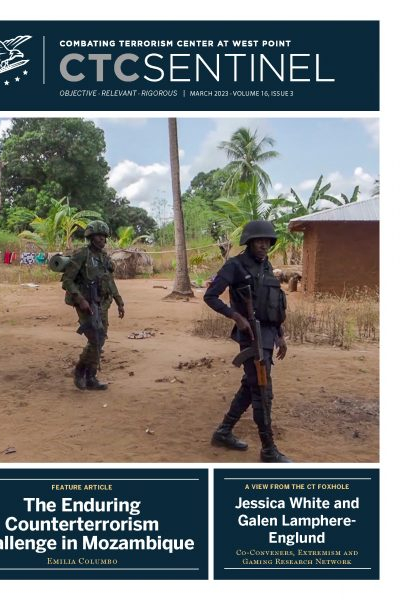



MARCH 2023, VOLUME 16, ISSUE 3
Authors:
Abstract: The deployment of regional military and police forces to Cabo Delgado Province in northern Mozambique to assist the Mozambican government against what was then a growing jihadi insurgency nearly two years ago has introduced new dynamics into the conflict, expanding the insurgency’s presence in the region and increasing the importance of the information space as each side works to persuade its constituencies that the conflict is proceeding in its favor. For the Mozambican government, showing progress on security and a return to normalcy in the province is of vital importance in order to accelerate the resumption of a $20 billion liquefied natural gas project, an imperative all the more significant as ruling party elements begin preparing for the 2024 presidential election. The Islamic State-affiliated Ahl al-Sunnah wa al Jamma’ah (ASWJ) insurgency—or as it is more commonly called locally, al-Shabaab—similarly must demonstrate that the increase in offensive operations did not significantly diminish its capabilities as it attempts to persuade civilians that it is a viable alternative to the state in northern Mozambique, an effort that the Islamic State regularly supports through its global media channels. The sustainability of security gains along the coast and the prospects for long-term stability, however, will depend largely on the government’s willingness to develop and implement a more balanced counterterrorism approach that addresses the underlying grievances driving this conflict. Furthermore, as the cast of both domestic and foreign armed actors supporting the government grows, improved coordination and clearer definitions of what these actors’ roles are and how they fit into the broader strategy will be essential to maximizing the impact of their contributions.