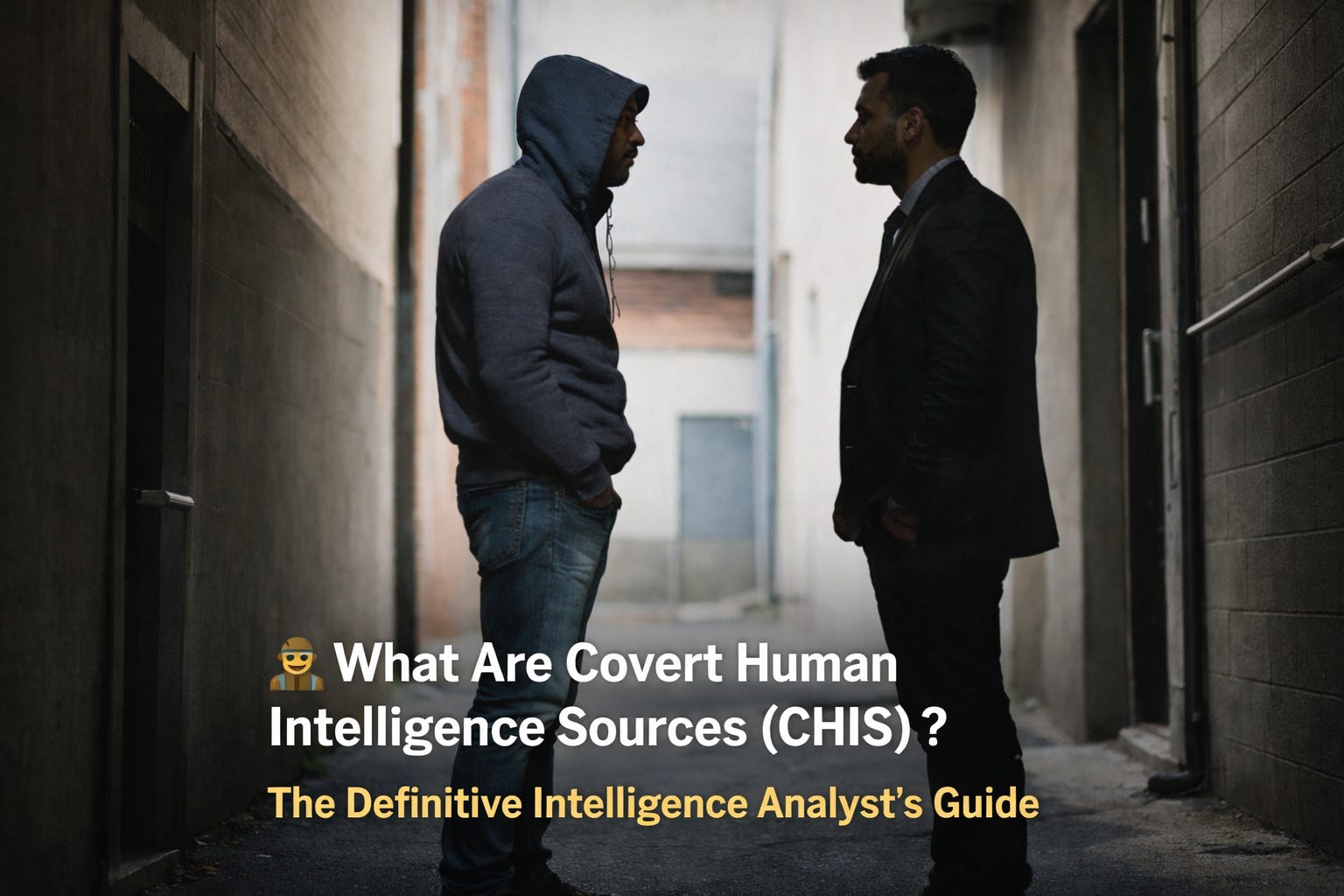
🕵️ What Are Covert Human Intelligence Sources (CHIS)? The Definitive Intelligence Analyst’s Guide
Ujasusi Blog Tradecraft Desk | 03 March 2026 | 0045 GMT
🔍 Direct Answer: What Is a Covert Human Intelligence Source (CHIS)?
A Covert Human Intelligence Source (CHIS) is an individual who establishes or maintains a covert relationship with a target person or organisation for the purpose of obtaining, disclosing, or facilitating the acquisition of intelligence. CHIS operations form a foundational pillar of HUMINT collection doctrine across across law enforcement, domestic security services, and foreign intelligence agencies worldwide.
❓ What Distinguishes a CHIS from a Conventional Intelligence Officer?
Unlike a directly employed state intelligence officer, a CHIS is typically a civilian, criminal associate, or insider operative who functions within a target environment without revealing their true allegiance. The distinction is legally and operationally significant:
Characteristic Intelligence Officer CHIS Employment status Direct state employee Civilian, asset, or agent Legal accountability Covered by official immunity Governed by specific CHIS legislation Operational exposure Moderate (diplomatic cover available) High (no official cover) Recruitment basis Competitive state selection MICE model: Money, Ideology, Compromise, Ego Training level Formal tradecraft training Variable; handler-dependent Primary role Collection, analysis, direction Access, infiltration, elicitation
In the United Kingdom, the legal definition of a CHIS is codified under RIPA 2000 CHIS definition, which was substantially amended by the CHIS Criminal Conduct Act 2021 — legislation that controversially authorised CHIS to commit criminal acts within sanctioned parameters.
❓ How Are CHIS Recruited? Breaking Down the MICE Model
Recruitment is the most operationally sensitive phase of any CHIS programme. Intelligence doctrine universally recognises that understanding a source’s motivation is the single most important variable in predicting reliability and longevity.
🎯 The MICE Model — Core Recruitment Framework
Money: Financial incentives remain the most statistically prevalent recruitment lever. The FBI’s most significant espionage cases — including Aldrich Ames and Robert Hanssen — were primarily financially motivated.
Ideology: Ideologically-driven sources, such as Oleg Penkovsky GRU spy, the Soviet GRU colonel who provided Western intelligence with critical nuclear order-of-battle data during the 1962 Cuban Missile Crisis, are often the most prolific but also the most volatile.
Compromise (Coercion): Blackmail, outstanding criminal liability, or personal vulnerability. Legally and ethically the most contested category, with significant human rights implications under ECHR Article 8 privacy rights.
Ego: Desire for recognition, revenge, or power. Often exploited during the access phase, particularly in corporate and political intelligence environments.
🔄 Recruitment Lifecycle
Spotting — Identifying individuals with access, motivation, and acceptable operational risk profiles
Assessment — Psychological and background evaluation, often conducted without the target’s knowledge
Development — Rapport-building; establishing a personal or professional relationship
Pitching — The formal or informal approach to recruit
Vetting — Verification of identity, access, and preliminary reliability testing
Induction — Assignment of a handler, communication protocols, cover story development
❓ How Are CHIS Operationally Managed?
Effective CHIS management — referred to in British intelligence doctrine as source handling — is a specialist discipline requiring tradecraft proficiency, psychological acuity, and operational security rigour.
📡 Secure Communication Methods
Dead drops: Physical or digital pre-arranged exchange locations with no direct handler-source contact
One-time pads: Mathematically unbreakable encryption for written communications, still employed in high-risk environments
Encrypted applications: Signal-protocol tools and custom agency platforms for lower-risk urban environments
Live cut-outs: Human intermediaries used to insulate the handler from direct source contact
🛡️ Operational Security (OPSEC) Protocols
Randomised meeting schedules and locations to defeat surveillance pattern analysis
Plausible cover stories consistent with the source’s known social and professional profile
Exfiltration and emergency extraction planning for sources in hostile environments
Strict compartmentalisation — the source typically knows only their handler, never the broader intelligence product chain
🧠 Psychological Welfare and Source Longevity
The IALEIA source handling standards and academic literature on source handling consistently identify psychological deterioration as a primary cause of CHIS compromise or defection. Best-practice handler protocols include:
Regular welfare assessments, particularly for sources inside violent extremist or criminal organisations
Financial security planning extending beyond the operational period
Identity and relocation support for sources facing exposure risk
❓ What Legal Frameworks Govern CHIS Operations?
🇬🇧 United Kingdom
The most codified CHIS legal architecture in the democratic world exists in the UK:
RIPA 2000, Part II — Establishes the authorisation regime for CHIS deployment by public authorities
Investigatory Powers Act 2016 — Broadens oversight and introduces Judicial Commissioners as independent authorisation checks
CHIS (Criminal Conduct) Act 2021 — Grants statutory cover for criminal conduct by CHIS where authorised; subject to significant parliamentary scrutiny from Liberty rights organisation and Amnesty International UK
🇺🇸 United States
Executive Order 12333 — The foundational framework governing intelligence community activities including HUMINT collection
Attorney General Guidelines — FBI-specific directives governing informant use, payment, and criminal conduct authorisation
National Security Act 1947 — Establishes CIA authority for clandestine HUMINT operations overseas
🌍 International Standards
UN Basic Principles on the Use of Force and related human rights instruments constrain CHIS use in Member States
European Convention on Human Rights Articles 8 (privacy) and 6 (fair trial) — Frequently cited in legal challenges to CHIS evidence admissibility
❓ What Are the Primary Operational Risks of CHIS Programmes?
Risk Category Description Notable Case Example Source unreliability Fabrication, exaggeration, or double agency Curveball (Iraq WMD) — fabricated intelligence that contributed to the 2003 Iraq War Exposure and compromise Discovery by the target organisation Freddie Scappaticci (”Stakeknife”) — alleged Force Research Unit agent within the IRA; identity exposed publicly in 2003 Double agency Source simultaneously working for a hostile service Aldrich Ames — CIA officer turned KGB asset responsible for compromising dozens of HUMINT sources Legal and political fallout Judicial challenge, public exposure, parliamentary inquiry Operation Kenova UK inquiry — ongoing UK investigation into agent handling during the Northern Ireland conflict Handler capture Identifies source chain if not compartmentalised Multiple documented cases across ISI Afghanistan proxy operations
❓ What Are the Most Significant CHIS Cases in Intelligence History?
🔴 Oleg Penkovsky — GRU Colonel, Soviet Union (1961–1963)
Penkovsky volunteered his services to MI6 and the CIA, providing over 5,000 photographs of classified Soviet military documents. His intelligence on Soviet missile capabilities proved decisive during the Cuban Missile Crisis. He was arrested by the KGB in October 1962, convicted of treason, and executed in May 1963.
🟠 Freddie Scappaticci — IRA (Alleged), Northern Ireland (1970s–2003)
Allegedly the British Army’s most highly placed agent inside the Provisional IRA, codenamed Stakeknife, Scappaticci reportedly headed the IRA’s internal security unit whilst passing intelligence to handlers. His case raises profound ethical questions about state-sanctioned criminal conduct, including allegations that his cover required authorising murders. Operation Kenova ongoing inquiry continues to examine these allegations.
🟡 Morten Storm — Al-Qaeda in the Arabian Peninsula (2006–2012)
A Danish convert to Islam who infiltrated AQAP threat assessment profile for the CIA, PET (Danish intelligence), and MI5. Storm’s intelligence reportedly contributed to the targeted killing of Anwar al-Awlaki in September 2011. His subsequent public disclosures caused a significant intelligence fallout across three agencies.
❓ What Ethical Dilemmas Are Inherent in CHIS Operations?
Entrapment: The legal and ethical prohibition against CHIS inducing criminal conduct that would not otherwise have occurred — a central issue in post-9/11 FBI sting operations scrutinised by the Center on National Security at Fordham Law
Coercive recruitment: Use of criminal vulnerability or personal compromat as leverage raises questions of consent and agency under international human rights law
Failure of duty of care: Documented cases in which intelligence agencies exposed or abandoned sources — including multiple abandoned Afghan interpreters report left behind after the 2021 Kabul withdrawal — demonstrate systemic source protection failures
Intelligence laundering: The use of CHIS-derived intelligence in judicial proceedings without disclosure of its covert origin, compromising fair trial rights under Article 6 ECHR
❓ How Is AI and Technology Reshaping CHIS Operations?
The INSA intelligence alliance and leading intelligence studies scholars at institutions including King’s College War Studies identify several transformative pressures on traditional HUMINT:
AI-assisted targeting: Machine learning tools now analyse open-source behavioural data to identify individuals with access and potential motivation — effectively automating the spotting phase of recruitment
Digital footprint vulnerability: CHIS operating in environments with pervasive CCTV, mobile metadata collection, and financial surveillance face unprecedented exposure risks compared to Cold War operational environments
OSINT-HUMINT convergence: Platforms such as Maltego OSINT platform and Palantir analytics platform enable handlers to build detailed relational maps that were previously achievable only through physical surveillance
Deepfake and synthetic identity risks: Adversarial use of AI-generated personas creates new vulnerabilities in source vetting — a handler may be cultivating a fabricated digital identity rather than a real access agent
Encrypted communications fragility: End-to-end encryption facilitates CHIS communication security but is increasingly subject to lawful access debates involving agencies such as GCHQ
Despite these developments, the 2023 US threat assessment explicitly reaffirms that HUMINT remains irreplaceable in producing intelligence on intent — a dimension that signals intelligence and cyber collection cannot reliably access.
🧭 Key Takeaways for Intelligence Practitioners
CHIS operations are governed by the MICE model for recruitment and require sustained handler investment to remain operationally viable
The UK’s CHIS (Criminal Conduct) Act 2021 represents the world’s most explicit statutory authorisation of agent criminality — a significant legal precedent with unresolved human rights implications
Source reliability remains the central operational vulnerability; the most consequential intelligence failures of the past three decades (Iraq WMD, pre-9/11 threat assessments) involved CHIS fabrication or mismanagement
The convergence of AI, OSINT, and HUMINT is redefining both the recruitment targeting cycle and the exposure risk profile for active sources
Duty of care to sources is not merely ethical — it is operationally rational; agencies with poor source protection records face long-term HUMINT degradation as potential assets decline to cooperate