Central African Republic Presidential Election 2025: Intelligence Assessment and Electoral Analysis

Ujasusi Blog’s Central Africa Monitoring Team | 28 Dec 2025 | 0810 GMT

🔓FREE ACCESS
Please consider becoming a paid subscriber
You can also donate.
In Nutshell
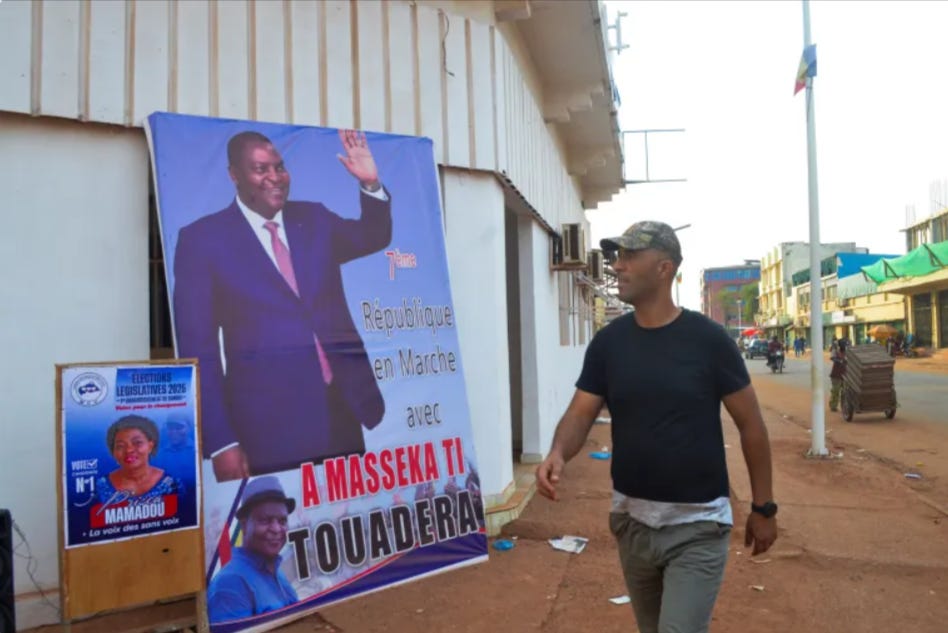
The Central African Republic’s December 28 presidential election represents a constitutional crisis wherein incumbent President Faustin-Archange Touadera seeks an unprecedented third term following a 2023 referendum that abolished presidential term limits and extended terms from five to seven years. Opposition coalitions have declared a boycott, citing electoral manipulation, whilst armed groups control significant territorial swaths, threatening voter security across approximately 800 polling stations.
What Are the Core Parameters of CAR’s December 28, 2025 Election?
The 2025 electoral cycle encompasses simultaneous presidential, legislative, and municipal elections—the latter representing the first local polls in four decades. According to the International Foundation for Electoral Systems and CAR’s National Elections Authority, the following parameters govern the electoral process:
Electoral Demographics:
Registered voters: 2.3 million citizens (age 18+)
New registrations: 749,000 since 2020
Polling units: Approximately 6,700 nationwide
Historical turnout: 62% average (IFES)
Compromised polling stations: Approximately 800 units closed in 2020 due to rebel control
Key Electoral Parameters:
Campaign period: Commenced December 13, 2025
Victory condition: Absolute majority (50%+1); run-off if needed
Term length: Seven years (increased from five)
Term limits: Abolished via 2023 constitutional referendum
Municipal elections: Originally scheduled August 2025, postponed citing “insufficient funds and technical challenges”
The last-minute consolidation of three election types raises operational capacity concerns amongst international observers, particularly given the electoral authority’s acknowledged funding and organisational limitations.
Who Are the Presidential Candidates?
The constitutional court approved eight candidates. The Republican Bloc coalition (BRDC) boycotted the election, declaring it a “sham” and presenting no unified opposition candidate.
Faustin-Archange Touadera (Age 68)
A mathematician and former University of Bangui vice chancellor, Touadera served as Prime Minister (2013-2015) under François Bozizé before winning the presidency in 2016 and 2020. He runs under the United Hearts Movement (MCU).
Security & Foreign Relations Record:
In 2018, CAR became the first African nation to contract Russian Wagner Group mercenaries under a security-for-minerals arrangement. This strategic pivot prompted France to suspend military cooperation and reduce aid budgets in 2021. Touadera has met Russian President Putin twice—in 2023 and January 2025—praising Russia for “saving CAR’s democracy.” In December 2025, his government signed a Starlink contract with Elon Musk for rural internet expansion.
Constitutional Controversies:
Touadera’s path to a third term involved systematic institutional manoeuvring. In October 2022, he dismissed the constitutional court chief judge after she ruled his referendum project illegal. The 2023 referendum proceeded whilst opposition groups boycotted, delivering predictable “yes” votes. In 2025, the constitutional court rejected civil society legal challenges to his candidacy.
Economic Initiatives:
In 2022, Touadera launched Bitcoin as legal tender—making CAR the second country after El Salvador to do so—though the initiative was abandoned after one year given less than 10% internet penetration. In February 2025, the government launched the $CAR meme coin as an “experiment.” Whilst new roads and highways have been constructed, the World Bank rates CAR’s economy as “stagnant.”
Anicet-Georges Dologuele (Age 68)
The main opposition leader from the Union for Renewal (URCA) party broke from the boycotting coalition to maintain his candidacy. A former Prime Minister in the 1990s under President Patassé, Dologuele finished as runner-up in the 2020 presidential race.
His candidacy faced systematic obstruction through citizenship challenges. In September 2025, he renounced French citizenship to comply with new constitutional requirements. However, in October 2025, a CAR court stripped his CAR citizenship citing the old constitution’s dual-citizenship prohibition. After Dologuele reported the matter to the UN human rights agency, his name appeared on the final ballot, suggesting quiet reinstatement though the process remains opaque.
Governing camp supporters have deployed xenophobic rhetoric questioning whether dual-citizenship candidates are “real Central Africans.”
Henri-Marie Dondra (Age 59)
A career banker and former Finance Minister, Dondra served as Prime Minister (2021-2022) before his dismissal—RFI reporting suggests this stemmed from pro-France positions during the administration’s Russia pivot. He runs under the Republican Unity party (UNIR).
Touadera accused Dondra of holding Congolese citizenship, delaying candidacy approval until November 14, 2025. According to Human Rights Watch testimony in late November, two of Dondra’s brothers were arrested and detained without charge before the election.
Other Notable Candidates:
Aristide Briand Reboas (46): A former intelligence official and Sports Minister until 2024, he runs under the Christian Democratic Party promising better amenities including electricity and water infrastructure.
Serge Djorie (49): Government spokesperson until 2024, this medical doctor and published researcher runs under the Collective for Change party, campaigning on public health reforms, poverty reduction, and pan-Africanism.
What Security Threats Compromise Electoral Integrity?
CAR’s ongoing civil war (2013-present) between predominantly Muslim Seleka rebels and largely Christian Anti-balaka armed groups has displaced one million people and threatens electoral security across rural territories.
Conflict Background:
In March 2013, the Seleka rebel alliance staged a coup that overthrew President François Bozizé. In retaliation, Bozizé assembled the Anti-balaka forces—Christian and animist armed groups. International rights organisations have accused both sides of war crimes and civilian targeting. Bozizé now leads a rebel coalition from exile in Guinea-Bissau; his 2020 attempted attacks were repelled by Russian Wagner mercenaries.
Active Conflict Zones:
Armed groups maintain operational control in northwest, northeast, and southeast regions. The impact on electoral infrastructure is substantial—approximately 800 polling units were forced to close during the 2020 election due to rebel violence. One million people remain internally displaced.
Foreign Security Forces Deployment:
MINUSCA (UN Peacekeeping): The 17,000-strong force has been extended through November 2026, though the United States opposes further extensions, preferring CAR develop self-sufficiency. At least three peacekeepers were killed in attacks during 2025.
Wagner Mercenaries: Contracted since 2018, Russian forces have secured major urban areas but face accusations of mass killings and human rights violations. Personnel numbers remain undisclosed.
Rwandan Troops: Government security support of limited public scope.
Pre-Electoral Peace Accords:
Touadera signed multiple agreements with armed groups before the election. However, analysts quoted in source documentation assess these accords “will only hold until after the polls,” suggesting tactical ceasefires rather than sustainable conflict resolution.
What Are CAR’s Structural Development Challenges?
According to World Bank data and the 2022 Human Development Index, CAR ranks amongst the world’s poorest nations despite significant natural resource endowments.
Poverty & Economic Indicators:
Poverty rate: Over 60% of population
Economic growth: 1.5% average annual rate
Electricity access: 16% of population
Internet penetration: 7.5% of population
HDI ranking: 191st of 193 countries (2022)
The Resource-Curse Paradox:
CAR possesses substantial reserves of crude oil, gold, uranium, diamonds, and timber, yet faces persistent fuel shortages and economic stagnation. Most citizens depend on subsistence agriculture with minimal state-propelled industry. The population of 5.5 million remains largely rural, with limited access to basic amenities including electricity and water infrastructure.
Geopolitical Position:
CAR’s landlocked status creates strategic vulnerabilities. Bordered by Chad to the north and the Democratic Republic of Congo to the south, the capital Bangui sits on the Ubangi River forming a natural border with DRC. Following CAR’s 2018 Wagner precedent, Mali, Burkina Faso, and Niger subsequently contracted Russian security forces, suggesting CAR served as proof-of-concept for broader Sahelian security arrangements.
What Are the Post-Electoral Trajectory Assessments?
Intelligence assessment suggests several probable scenarios based on documented structural factors, though electoral dynamics remain inherently unpredictable.
Scenario 1: Touadera First-Round Victory
The opposition BRDC coalition’s documented boycott, combined with Russian security forces controlling major urban areas and the historical pattern of approximately 800 compromised rural polling stations proving insufficient to prevent majorities in 2020, creates substantial structural advantages for the incumbent. International legitimacy challenges from Western observers appear probable, whilst Russian and Chinese recognition seems likely based on established diplomatic patterns.
Confidence level: Medium-high, contingent on armed group behaviour and turnout patterns.
Scenario 2: Electoral Violence Escalation
The historical pattern of 800+ polling station closures, analyst assessments that peace accords are temporary, and MINUSCA’s extension through November 2026 all suggest ongoing security requirements. Armed groups retain documented operational capacity in northwest, northeast, and southeast conflict zones, creating potential for violence exploitation during the electoral period.
Confidence level: Medium, dependent on peace accord durability and armed group strategic calculations.
Long-Term Governance Implications
Term Limit Abolition Consequences:
The 2023 referendum’s removal of term limits establishes precedent for indefinite presidential tenure. Opposition groups demand constitutional reforms to restore limits, though Touadera’s institutional control—demonstrated through the constitutional court judge dismissal and candidacy challenge rejections—suggests low probability of voluntary reversals. This pattern aligns with broader Sahelian democratic backsliding observed in Guinea and Burkina Faso.
Russian Influence Consolidation:
CAR’s security dependence on Wagner mercenaries since 2018, documented through minerals-for-security arrangements and Touadera’s repeated Putin meetings, creates asymmetric leverage dynamics. France’s 2021 departure left a vacuum filled exclusively by Russian forces. Available evidence suggests long-term Wagner presence is incentivised, though characterising the relationship as “client state” versus “strategic partnership” requires nuanced assessment of sovereignty constraints and policy autonomy.
What Human Rights Violations Are Documented?
Pre-Electoral Violations:
Human Rights Watch documented that two of Dondra’s brothers were detained without charge in late November. The October 2022 dismissal of the constitutional court chief judge, Dologuele’s citizenship stripping and opaque reinstatement, and xenophobic rhetoric targeting dual-citizenship candidates all feature in documented pre-electoral irregularities.
Conflict-Related Violations:
Wagner mercenaries face accusations of mass killings and human rights violations. Both Seleka and Anti-balaka forces have been accused of war crimes by international rights groups, with documented civilian targeting in conflict zones.
Intelligence Assessment Summary
CAR’s December 28 election operates under a constitution that abolished term limits via a 2023 referendum conducted during opposition boycott, enabling President Touadera’s unprecedented third-term candidacy. Documented delays in opposition candidate confirmation—including Dologuele’s citizenship stripping and Dondra’s brothers’ detention—combined with the major BRDC coalition boycott, create substantial structural advantages for the incumbent.
Approximately 800 polling stations face potential closure due to armed group territorial control in northwest, northeast, and southeast regions, whilst the National Elections Authority manages three simultaneous election types for the first time in four decades despite acknowledged funding and organisational limitations.
The post-electoral trajectory suggests high probability of Touadera victory, deepening Russian security dependence through continued Wagner presence, and marginalisation of opposition voices. This pattern aligns with broader Sahelian democratic backsliding observed in Mali, Burkina Faso, and Niger, where term limit removals, Russian security contracts, and French military withdrawals follow similar sequences.
Priority Monitoring Recommendations:
International observers should focus documentation efforts on post-electoral violence patterns, Wagner Group human rights violations in secured urban areas, and whether peace accords with armed groups survive beyond December 28. The durability of these tactical ceasefires will indicate whether conflict de-escalation is genuine or merely electoral theatre.
The constitutional legitimacy crisis—stemming from the dismissed judge, boycotted referendum, and systematic candidate obstruction—raises fundamental questions about democratic governance sustainability in resource-rich, conflict-affected states dependent on foreign security forces.