[FREE ACCESS] Benin Coup Attempt December 2025: Anatomy of West Africa’s Growing “Fake Coup” Phenomenon
Ujasusi Blog’s West Africa Monitoring Team | 08 December 2025 | 0200 GMT
🔓FREE ACCESS
Please consider becoming a paid subscriber
You can also donate.
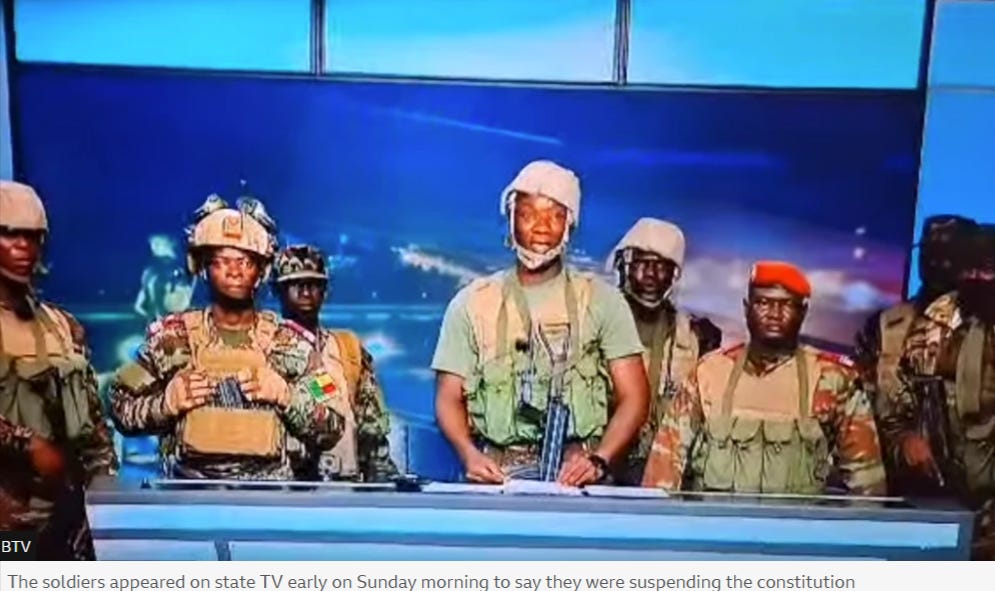
On 7 December 2025, a group of soldiers calling themselves the Military Committee for Refoundation briefly seized Benin’s state television to announce the overthrow of President Patrice Talon. Within hours, Interior Minister Alassane Seidou declared the coup attempt foiled, with approximately 13-14 soldiers arrested. The incident occurred less than two weeks after Guinea-Bissau’s widely-suspected staged coup on 26 November 2025, raising critical intelligence questions about an emerging pattern of manufactured political crises designed to subvert democratic processes across West Africa.
This intelligence assessment examines available open-source evidence to evaluate whether Benin’s coup attempt was genuine or orchestrated, contextualises it within Guinea-Bissau’s confirmed staged takeover, and analyses whether Africa has entered a dangerous new era where autocrats weaponise “fake coups” to consolidate power and evade electoral accountability.
🔍 The Benin Incident: Factual Timeline and Evidentiary Analysis
Chronology of Events
0600-0800 Hours, 7 December 2025: Gunfire reported around Camp Guézo near President Talon’s residence in Cotonou. The French Embassy issued security warnings advising French nationals to remain indoors.
Early Morning Hours: A group of at least eight soldiers, led by Lieutenant Colonel Pascal Tigri, seized control of Benin’s national television headquarters. The mutineers broadcast a statement dissolving all state institutions, suspending political activities, closing borders, and announcing Tigri as president of their newly-formed junta.
Mid-Morning: Broadcast signals to state television and radio were cut by authorities. The presidential office maintained communications, with government spokesperson Wilfried Houngbedji telling media “everything is fine” while declining further comment.
Afternoon: Interior Minister Seidou released a video statement confirming that “a small group of soldiers launched a mutiny to destabilise the state and its institutions” but that “the Beninese Armed Forces and their leadership, true to their oath, remained committed to the republic.” Approximately 13 soldiers were arrested, though it remains unclear whether Tigri himself was apprehended.
Evening: President Talon addressed the nation, expressing condolences to “victims of this senseless adventure” and referencing “those still being held by the fleeing mutineers,” suggesting casualties occurred during the attempted takeover.
Subsequent Hours: ECOWAS condemned the coup attempt and ordered deployment of regional troops from Nigeria, Sierra Leone, Ivory Coast, and Ghana to support Benin’s constitutional order.
Intelligence Assessment: Real or Staged?
Based on OSINT analysis, the available evidence suggests Benin’s coup attempt was likely genuine but poorly planned and rapidly suppressed, rather than a staged operation. Key indicators supporting this assessment include:
Evidence of Genuine Mutiny:
Tactical Incompetence: The plotters controlled only state television infrastructure, not critical military installations, government ministries, or communication hubs—a fundamental failure in coup tradecraft that suggests spontaneous action rather than calculated theatre.
Swift Suppression: The coup collapsed within hours due to lack of support from the broader military establishment, consistent with an opportunistic faction acting without institutional backing.
Casualties and Hostages: President Talon’s reference to “victims” and “those still being held by fleeing mutineers” indicates violent confrontation and casualties, unlike Guinea-Bissau where the “deposed” president freely communicated with international media.
Presidential Silence During Crisis: Unlike Embaló in Guinea-Bissau, Talon did not appear publicly until after the coup was suppressed, with gunfire heard near his residence suggesting genuine security threats.
Political Context: Talon was scheduled to step down in April 2026 after the presidential election, with his preferred successor already favoured to win. Unlike Embaló facing electoral defeat, Talon had less incentive to manufacture a crisis.
Complicating Factors:
However, several contextual elements warrant continued scrutiny:
Previous Coup Allegations: In January 2025, two Talon associates received 20-year sentences for an alleged 2024 coup plot, suggesting ongoing conspiratorial activity within elite circles.
Recent Constitutional Changes: In November 2025, Benin’s legislature extended presidential terms from five to seven years, raising questions about Talon’s succession planning despite his stated intention to step down.
Opposition Exclusion: Opposition candidate Renaud Agbodjo was rejected by the electoral commission for insufficient sponsors, narrowing the competitive field ahead of the 2026 elections.
Analytical Conclusion: While Benin’s incident displays tactical characteristics inconsistent with orchestrated theatre, the broader political context—including constitutional manipulation and opposition exclusion—creates conditions where future manufactured crises cannot be ruled out.
🎪 The Guinea-Bissau Paradigm: Anatomy of a Staged Coup
The 26 November 2025 military takeover in Guinea-Bissau provides a textbook case study of a manufactured political crisis designed to subvert electoral outcomes. The evidence for staging is overwhelming:
Indicators of Orchestration
1. Presidential Self-Announcement: President Umaro Sissoco Embaló himself announced his own overthrow to international media while allegedly “under arrest”—a fundamental absurdity in coup dynamics.
2. Media Access During “Detention”: Embaló conducted phone interviews with French broadcaster France 24 and other outlets while supposedly in military custody, a behaviour inconsistent with genuine overthrow scenarios.
3. Coup Leadership Composition: The military officers who declared the takeover were Embaló’s close allies, including Brigadier General Dinis N’Canha (head of the presidential military office) and General Horta Inta-a (presidential guard chief).
4. Selective Detention Patterns: While Embaló was permitted to flee to Senegal and subsequently the Republic of Congo, opposition leaders Domingos Simões Pereira and Fernando Dias da Costa faced detention and harassment, revealing the coup’s true targets.
5. Electoral Timing: The military intervention occurred 24 hours before official results were scheduled for release, with both domestic and international observers indicating Embaló had lost.
6. Transitional Government Composition: The junta appointed Ilídio Vieira Té—Embaló’s campaign director—as prime minister, creating a proxy regime poised to facilitate Embaló’s future candidacy.
International Recognition of Fraud
Former Nigerian President Goodluck Jonathan, present as an ECOWAS electoral observer, delivered devastating testimony: “I wouldn’t call it a coup...maybe it was a ceremonial coup. It is the president, President Embaló, who announced the coup...The military doesn’t take over governments, and the sitting president that they overthrew would be allowed to be addressing press conferences and announcing that he has been arrested. Why does this happen? Who is fooling whom?”
Senegalese Prime Minister Ousmane Sonko described the takeover as a “scheme” while civil society coalition Frente Popular accused Embaló of staging a “simulated coup” to prevent electoral result publication and enable future re-election through proxy governance.
The Popular Front characterised the episode as “the biggest political deception the country has seen in years” and “a fake coup d’état with the sole purpose of derailing the electoral process in which the people had defeated his dictatorship.”
🌍 Contextualising the Pattern: West Africa’s Coup Epidemic
The Statistical Reality
Since 2020, Africa has experienced 11 successful military coups, with nearly three-quarters of all global coup attempts occurring in West Africa and the Sahel region. This unprecedented clustering affects less than 10% of the world’s states but accounts for the vast majority of successful unconstitutional government changes.
The “Coup Belt” now stretches continuously across the African continent, encompassing Mali, Burkina Faso, Niger, Chad, Sudan, Guinea, and now Guinea-Bissau, with Madagascar experiencing a military takeover in October 2025 following Gen Z protests.
Typology of Contemporary African Coups
Intelligence analysis identifies three distinct coup categories currently operating:
Type 1: Insurgency-Justified Takeovers (Mali, Burkina Faso, Niger)
Rationale: Military criticism of civilian government’s counterterrorism failures
Characteristics: Anti-French sentiment, Russian alignment, indefinite transition periods
Outcome: Formation of Alliance of Sahel States, ECOWAS withdrawal
Type 2: Anti-Corruption Interventions (Guinea 2021, Chad 2021)
Rationale: Corruption, dynastic succession, constitutional violations
Characteristics: Promised but delayed transitions to civilian rule
Outcome: Consolidated military governance with cosmetic democratic facades
Type 3: Veto/Staged Coups (Guinea-Bissau 2025, potentially emerging pattern)
Rationale: Prevention of electoral defeat, maintenance of incumbent networks
Characteristics: Electoral manipulation, proxy leadership, manufactured crises
Outcome: Subversion of democratic transitions through controlled military theatre
The Emerging “Fake Coup” Phenomenon
Guinea-Bissau represents a potentially dangerous innovation: the instrumentalisation of military intervention as political theatre rather than a genuine institutional rupture. This tactical evolution presents several intelligence concerns:
Strategic Advantages for Autocrats:
Electoral Result Nullification: Coups suspend constitutional processes, preventing unfavourable results from taking effect.
Opposition Neutralisation: Military emergencies justify detention, harassment, and exile of political rivals.
International Sympathy Generation: Leaders can present themselves as victims while controlling events behind the scenes.
Proxy Governance Installation: Transitional governments staffed by loyalists maintain incumbent networks and facilitate future candidacies.
Constitutional Manipulation: Crisis periods enable rule changes (term extensions, eligibility modifications) under emergency conditions.
Precedent and Proliferation Risk:
Analyst Beverly Ochieng of Control Risks warned that Guinea-Bissau’s model could inspire copycats: “Some believe that the coup was staged to prevent Embaló from losing the election. It enables the military to consolidate power. So, it is not unlikely that Embaló will return as the head of this junta or run for office at the end of the transition.”
The Sierra Leone analysis noted historical parallels to Brigadier David Lansana’s 1967 staged intervention to prevent Siaka Stevens from assuming office after electoral victory, demonstrating that manufactured coups have precedent but may be increasing in sophistication and frequency.
🔐 Intelligence Implications and Strategic Assessments
ECOWAS Institutional Degradation
The Economic Community of West African States has demonstrated profound weakness in responding to the coup epidemic:
Failed Consensus: ECOWAS could not marshal agreement for military intervention against Niger’s 2023 coup.
Membership Collapse: Mali, Burkina Faso, and Niger withdrew in January 2024, forming their own Alliance of Sahel States and permanently weakening regional enforcement mechanisms.
Inconsistent Responses: Some coups face sanctions while others receive tacit recognition, creating incentive structures that reward military takeovers.
Leverage Deficiency: In Guinea-Bissau, ECOWAS suspended membership but lacks mechanisms to reverse the junta’s control or compel electoral result publication.
Multipolar Exploitation
The international community’s fragmented response enables coup proliferation:
Strategic Pragmatism: Morocco, Turkey, and the UAE have forged relationships with military governments, prioritising counterterrorism and economic interests over democratic norms.
Russian Opportunism: The Wagner Group and Russian military advisers have embedded themselves across Sahel juntas, leveraging anti-French sentiment for geopolitical gain.
Western Ambivalence: Fear of pushing juntas toward Russia has paralysed decisive Western responses, creating permissive environments for constitutional violations.
Selective Summitry: While coup states were excluded from the US-Africa Leaders Summit (2022), they were welcomed at Russia-Africa and Saudi Arabia-Africa summits (2023), demonstrating inconsistent international messaging.
Democratic Erosion Indicators
Afrobarometer data shows declining support for democratic governance across Africa, with only 44% of respondents believing elections can remove unwanted leaders. This attitudinal shift creates fertile ground for military interventions to gain popular acceptance, particularly when autocrats manipulate systems for personal gain.
📈 Predictive Analysis: Is This the New Era of Fake Coups?
Assessment of Future Trajectory
Based on current trend analysis, the intelligence community should anticipate:
High Probability Scenarios (60-75% likelihood):
Increased Coup Theatre Attempts: Leaders facing electoral defeat in fragile democracies will attempt Guinea-Bissau-style staged interventions, particularly in states with factionalised militaries and weak institutions.
ECOWAS Further Fragmentation: Additional West African states may withdraw from regional mechanisms, accelerating institutional collapse and creating a normative vacuum where coups face minimal consequences.
Transition Period Extensions: Existing juntas will continue postponing elections indefinitely, with Mali’s election delay to 2077 setting a precedent for permanent military rule with cosmetic civilian facades.
Medium Probability Scenarios (40-55% likelihood):
Contagion to Coastal West Africa: States previously insulated from the Sahel coup belt—including Senegal, Ghana, and potentially Nigeria—may experience increased coup plotting as military factions observe successful power seizures elsewhere.
Counter-Coup Dynamics: In Guinea-Bissau and similar contexts with factionalised militaries, rival military factions may launch genuine coups against staged juntas, creating compounding instability.
International Intervention Decline: Western powers and regional actors will continue avoiding military intervention, creating expectations of impunity for coup plotters.
Low Probability Scenarios (15-30% likelihood):
Robust Democratic Restoration: ECOWAS and AU develop effective mechanisms to reverse coups and compel constitutional order, reversing current permissive trends.
Popular Mobilisation Success: Civil society movements successfully resist staged coups through mass protest and civil disobedience, as attempted by Guinea-Bissau’s Popular Front.
📋 Assessment
Benin’s 7 December 2025 coup attempt appears to have been a genuine, if poorly executed, military mutiny rather than an orchestrated theatre. The incident’s tactical incompetence, rapid suppression, and casualties distinguish it from Guinea-Bissau’s manufactured crisis. However, the broader political context—including constitutional manipulation and opposition exclusion—suggests Benin remains vulnerable to future antidemocratic manoeuvres.
Guinea-Bissau’s 26 November 2025 takeover represents a confirmed case of staged coup theatre, evidenced by the president’s self-announcement, continued media access during alleged detention, loyalist military leadership, selective opposition targeting, and transitional government composition designed to facilitate future incumbent candidacy.
Africa has entered a dangerous phase where staged coups may become tactical instruments for evading electoral accountability. The convergence of ECOWAS institutional weakness, inconsistent international responses, multipolar geopolitical competition, and declining democratic legitimacy creates permissive conditions for autocrats to weaponise military theatre. While not yet a dominant pattern, the Guinea-Bissau model presents a replicable blueprint that intelligence services must monitor vigilantly.
The fundamental question is not whether fake coups will proliferate, but whether regional and international actors can develop effective countermeasures before this tactical innovation becomes institutionalised across Africa’s fragile democracies. Current trajectories suggest pessimism is warranted absent significant policy recalibration.
Sources: