
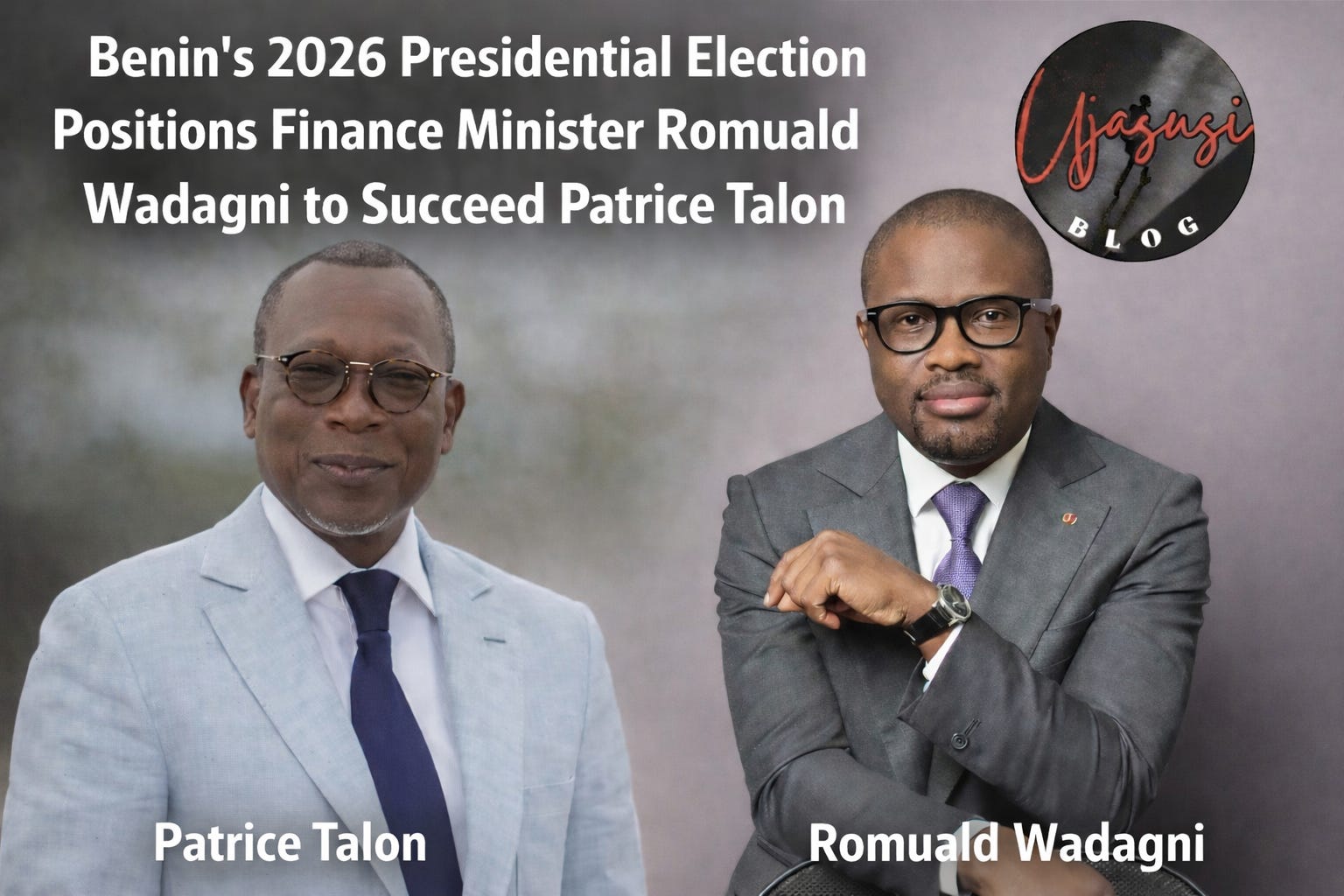
Benin’s 2026 Presidential Election Positions Finance Minister Romuald Wadagni to Succeed Patrice Talon

Ujasusi Blog’s West Africa Monitoring Team | 13 April 2026 | 0140 BST
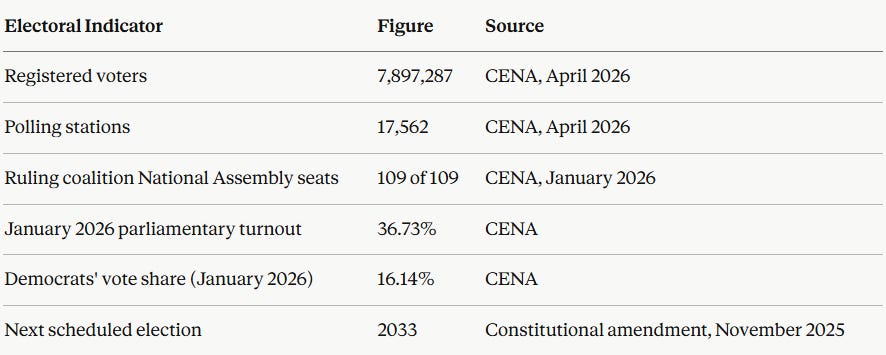
Benin’s presidential election of 12 April 2026 concluded voting with Finance Minister Romuald Wadagni holding a commanding lead, pending certification by the Commission Electorale Nationale Autonome. The contest, contested by just two candidates across 17,562 polling stations serving nearly 7.9 million registered voters, marks the first electoral transfer of executive power since President Patrice Talon took office in 2016. Its outcome carries direct consequences for West African security architecture, French strategic interests in the Sahel’s southern tier, and the Economic Community of West African States’ residual coherence following the exit of Mali, Burkina Faso, and Niger.
Wadagni’s Decade at the Finance Ministry Produced a Quantified Mandate
Romuald Wadagni was appointed Minister of Economy and Finance on 7 April 2016 under Patrice Talon and reappointed in May 2021, accumulating a ten-year record that his campaign presented as its primary argument for the presidency. The record is substantive. Benin’s GDP grew at 7% in 2025, among the highest rates in West Africa. The national budget tripled over his tenure. In April 2022, Wadagni led the Beninese delegation to Washington for a $700 million IMF agreement combining an Extended Credit Facility and a Resilience and Sustainability Facility. In January 2025, Benin issued $500 million in international bonds at 8.625%, well below the initial guidance range of 9.25% to 9.375%, on the back of $3.5 billion in demand.
The 2023 Open Budget Survey ranked Benin first among French-speaking countries for budget transparency with a score of 79 out of 100, double the 2017 figure, placing the country second on the continental ranking behind South Africa. As Chairman of the WAEMU Finance Ministers’ Council from 2018 to 2020, Wadagni led negotiations that produced the December 2019 agreement to phase out the CFA franc in West Africa, a reform the African Development Bank described as historic. Before entering government, he had spent 17 years at Deloitte, serving as Director of Quality and Risk for all Francophone Africa subsidiaries from 2007 to 2016.
A Lagos-based political analyst summarised the electoral logic concisely: ten years at the Finance Ministry produced something rare in African politics, a quantified record that is verifiable and resistant to challenge in any serious policy debate. That record was the foundation of Wadagni’s candidacy, and in the absence of credible opposition, it was sufficient.
Benin’s Electoral Commission Administered a Contest Decided Before Polling Day
The CENA administered an election in which the outcome was structurally determined by the legislative framework months before any vote was cast. Renaud Agbodjo, leader of the Democrats and the most credible opposition figure, was barred from candidacy after failing to secure sufficient parliamentary endorsements. The requirement, introduced through Talon’s 2019 constitutional reforms, demands signatures from at least 10% of Members of Parliament and mayors. Following January 2026’s parliamentary elections, in which the ruling coalition’s two allied parties captured all 109 National Assembly seats after the Democrats failed to reach the 20% constituency threshold required for seat allocation, no opposition figure could meet the endorsement requirement without majority cooperation.
Paul Hounkpè, a former culture minister, reached the ballot only because ruling coalition lawmakers extended him the endorsements his own party could not provide. The arrangement produced a two-candidate race in which the opposition’s sole representative owed his presence on the ballot to procedural permission from the government he nominally challenged. Amnesty International assessed that the exclusion of major opposition figures undermined the competitiveness of the electoral process. Freedom House recorded sustained narrowing of Benin’s democratic space under Talon, citing restrictions on political participation, arbitrary detentions, and mounting pressure on independent media.
The November 2025 constitutional amendment extended presidential and legislative terms from five to seven years, meaning no further elections are scheduled until 2033. The next president governs with a reinforced mandate and no electoral accountability for seven years.
The ECOWAS Electoral Observation Mission, headed by former Ghanaian President Nana Akufo-Addo, was charged with assessing whether the process met regional democratic standards. Its final report, pending at the time of writing, will carry weight within ECOWAS institutional deliberations on Benin’s democratic standing, though observer missions have historically stopped short of recommending punitive measures against member states that restrict rather than abolish electoral competition.
JNIM’s Escalating Campaign in Northern Benin Is the Presidency’s Defining Security Problem
Wadagni inherits a northern security situation that has deteriorated sharply through each year of his Finance Ministry tenure, and for which his institutional background provides no direct preparation. ACLED recorded 2025 as the deadliest year in the Beninese Armed Forces’ history. On 17 April 2025, JNIM’s Katiba Hanifa subgroup conducted a coordinated assault on military positions at Point Triple and Chutes de Koudou in the W National Park complex along the Burkina Faso border, killing at least 54 soldiers in a single engagement. That attack followed a January 2025 assault on the Point Triple forward operating base that killed at least 28 soldiers, then the deadliest incident on record. The Critical Threats Project concluded that JNIM attacks in Benin have grown more lethal each year since 2021 without a proportionate increase in frequency, indicating improving targeting capacity rather than simple operational expansion.
The threat geography spans Benin’s Alibori and Atacora departments, with JNIM’s W-Arly-Pendjari Complex serving as the primary staging ground for cross-border incursions. By February 2025, the Beninese Armed Forces had 8,200 soldiers active on northern frontlines with a further 1,500 in training. France delivered 26 armoured personnel carriers to the FAB in 2023 and 15 more in 2024, alongside Puma helicopters and supporting vehicles. AFRICOM engaged Beninese military officials in January 2025, a bilateral relationship that expanded after Niger’s junta expelled American forces from Agadez in 2024, leaving Benin as one of Washington’s primary remaining partners in the West African coastal tier.
Defence expenditure has risen at double-digit annual rates to absorb the northern campaign’s costs, compressing the fiscal space that Wadagni’s economic stewardship created. The tension between sustaining Benin’s investment-grade reputation and funding an open-ended counterinsurgency will define his first budget cycle more than any inherited development agenda.
Wadagni’s Western Alignment Shapes Benin’s Foreign Policy Before He Takes Office
Wadagni’s formation at Grenoble School of Management and Harvard Business School, combined with a decade managing programmes financed by the Agence Française de Développement, positions him as the most France-compatible Beninese executive in a generation. The bilateral defence cooperation agreement between Paris and Cotonou, under which French forces provided logistical support in suppressing the December 2025 coup attempt, will require renegotiation under a new presidency. Wadagni has made no public commitment on its revised terms, but his campaign’s pledge to restore dialogue with Niger signals an intention to use economic leverage, specifically Niger’s loss of transit revenues through the Port of Cotonou following border closures, as a diplomatic instrument rather than seek security cooperation through the Alliance of Sahel States framework.
The EU-OACPS Partnership Agreement, signed in Samoa in November 2023 as the successor to the Cotonou Accord, reconfigures the conditionality of development financing for African, Caribbean and Pacific states. Wadagni’s decade of managing IMF and World Bank programme conditionality gives him institutional fluency in that framework that few incoming African heads of state possess. For Paris, a Wadagni presidency represents a residual French intelligence and security foothold in the Sahel’s southern tier at a moment when France has lost its three primary Sahelian partners. That function will be institutionalised through bilateral arrangements, the operational content of which will not be publicly disclosed.
Strategic Outlook
The presidency Wadagni is positioned to assume carries a structural vulnerability that his economic record cannot resolve. A head of state whose authority derives from institutional performance rather than an independent political organisation loses his primary source of legitimacy the moment that performance deteriorates.
JNIM disruption of northern trade corridors, cotton revenue volatility, or the compounding fiscal pressure of sustained defence expenditure increases could each trigger that erosion; in combination, they would do so rapidly.
The seven-year term without electoral accountability removes one pressure mechanism, but it also removes the democratic corrective that might otherwise discipline governance failures before they become crises.
Independent intelligence analysis takes time and resources — if this work matters to you, please consider supporting it by donating HERE