

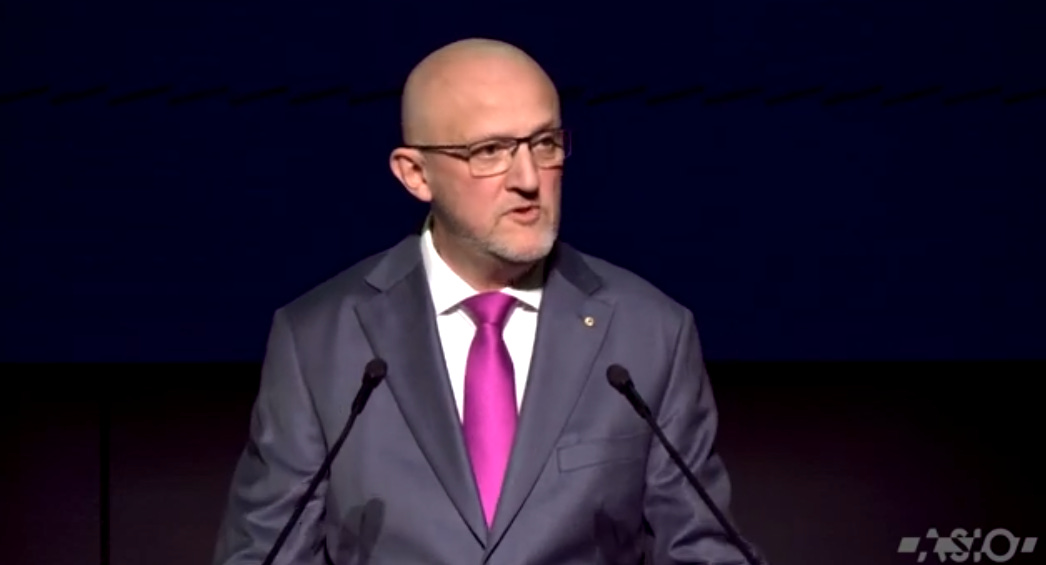
Summary of Mike Burgess’s Annual Threat Assessment Speech
In his address at the Ben Chifley Building, Director‑General of Security ASIO, Mark Burgess, presented his sixth Annual Threat Assessment—a speech notably distinguished by its future‑focused approach. Departing from previous assessments that concentrated on past and current threats, this year’s assessment charts broad trends anticipated to shape Australia’s security landscape up to 2030.
Burgess emphasized that Australia is entering an era of strategic surprise and security fragility, describing the future environment as more dynamic, diverse, and degraded. He explained that while recent shocks such as the war in Europe, the global pandemic, and turmoil in the Middle East have already tested Australia’s security foundations, these events are now converging with pre‑existing challenges such as espionage, foreign interference, and domestic extremism.
ASIO’s Futures Team was highlighted for its role in analyzing classified intelligence, open‑source data, and expert opinions to anticipate significant long‑term shifts rather than predicting isolated events. Burgess outlined ASIO’s mandate to counter seven key security threats: espionage, foreign interference, politically motivated violence (including terrorism), the promotion of communal violence, sabotage, attacks on Australia’s defence system, and threats to border integrity.
The speech further explored the evolving nature of terrorism. Burgess noted that while religious extremism remains a concern, a growing proportion of threats now stem from mixed or hybrid ideologies, often involving lone actors or small groups—and alarmingly, minors. He underscored the need for a whole‑of‑society response, involving government, communities, and key sectors like education and technology, to counter these complex challenges.
Burgess also addressed the intensification of espionage and foreign interference, the rise in sophisticated sabotage (particularly targeting critical infrastructure and defence projects such as AUKUS), and coercive tactics like forced repatriations. Concluding his address, he reaffirmed ASIO’s commitment to using all available tools, partnerships, and human intelligence to protect Australia’s security while calling for a collective, national response to emerging threats.
Article: Navigating a Dynamic, Diverse, and Degraded Security Environment
Reflections on ASIO’s Future‑Focused Threat Assessment
Dear Evarist,
In a speech delivered at the Ben Chifley Building, Director‑General Mark Burgess of ASIO offered a sobering yet resolute analysis of Australia’s security landscape as it approaches 2030. This annual threat assessment, distinguished by its forward‑looking perspective, is a clarion call for a comprehensive, whole‑of‑society response to an environment increasingly marked by complexity and unpredictability.
A New Paradigm in Threat Assessment
Burgess began his address by acknowledging the evolution in ASIO’s analytical approach. Unlike previous assessments, which predominantly focused on past and present dangers, this year’s speech is future‑focused. He articulated that the assessment would not forecast specific events but rather chart broader trends—much like a meteorologist predicting shifts in weather patterns rather than pinpointing the exact time and place of a storm. This analogy underscored the inherent uncertainty in anticipating future challenges, while simultaneously emphasizing the importance of understanding long‑term shifts that have profound implications for national security.
The Triple Threat: Dynamic, Diverse, and Degraded
Central to Burgess’s speech is the depiction of the future security environment as being more dynamic, diverse, and degraded. The term “dynamic” encapsulates the expectation of increased frequency and unpredictability of security surprises. Reflecting on recent shocks—the protracted conflict in Europe, a global pandemic, and ongoing turmoil in the Middle East—Burgess stressed that these events have not only exposed vulnerabilities but also fueled further domestic challenges. Such shocks have intensified nationalist sentiments, spurred aggressive foreign intelligence operations, and amplified domestic grievances, thereby creating a volatile security climate.
The environment is also becoming “diverse.” Burgess pointed to the blurring of traditional distinctions between state and non‑state actors. Advances in technology, particularly in artificial intelligence and data analytics, enable foreign intelligence services to exploit vulnerabilities and disseminate disinformation through sophisticated means, including deep fakes. Moreover, hybrid ideologies are emerging, as individuals increasingly cherry‑pick contradictory belief systems, thereby defying conventional categorization. This diversification of threat actors complicates intelligence gathering and response, as the motivations behind politically motivated violence now range from religious extremism to issue‑driven radicalisation spurred by conspiracy theories and personal grievances.
Perhaps most disconcerting, however, is the notion of a “degraded” security environment. Here, degradation refers to the erosion of the foundational pillars that have historically underpinned Australia’s security, prosperity, and democratic values. Burgess warned that authoritarian regimes are now more willing to engage in “high harm” activities. The examples he cited—sabotage against defence projects, state‑sponsored espionage, and even plots involving the physical harm of dissidents—illustrate a strategic environment where traditional red lines are blurred and the risks of significant harm are elevated. This degradation is compounded by the rapid evolution of technology, which not only enables sophisticated espionage but also facilitates cyber‑enabled sabotage against critical infrastructure.
The Evolving Face of Terrorism and Extremism
A particularly compelling portion of Burgess’s address was his examination of the changing nature of terrorism. He noted that while terrorism as a concept is not new, its manifestations are evolving rapidly. In the past, terrorist activities were largely driven by established extremist groups with a clear religious or ideological agenda. Today, however, the threat is increasingly characterized by self‑radicalisation and the rise of lone actors. Disturbingly, many of these individuals are minors, whose radicalisation processes can occur in a matter of days—rather than the protracted periods witnessed in earlier decades. This acceleration, coupled with the diffusion of extremist content online through encrypted channels and algorithm‑driven recommendations, poses a formidable challenge to traditional counter‑terrorism measures.
Burgess made it clear that addressing these emerging threats will require a coordinated effort that extends beyond the traditional domains of law enforcement and intelligence. The government’s counter‑violent extremism strategy, which calls for collaboration among education, health, social services, and technology companies, is a crucial step in mitigating the radicalisation of youth and the spread of extremist propaganda.
Espionage, Foreign Interference, and Sabotage
The speech also significantly emphasised the enduring threat of espionage and foreign interference. In an increasingly complex global environment, nation‑states are competing for strategic advantage and leveraging technological innovations to gather intelligence. Burgess observed that advances in artificial intelligence and data collection are making it easier for foreign powers to infiltrate Australian institutions, compromise critical infrastructure, and manipulate public opinion through disinformation campaigns.
In particular, the defence sector, including major initiatives such as AUKUS, is at heightened risk. Burgess warned that as these projects mature, they will attract even more intense scrutiny and potentially disruptive activities by foreign intelligence services. He noted that sabotage—both physical and cyber‑enabled—poses an acute threat, as evidenced by recent coordinated efforts by adversarial states to undermine critical infrastructure in other parts of the world.
A Call for a Collective Response
Perhaps the most resonant message of the speech is the call for collective responsibility. Burgess asserted that national security is not solely the domain of ASIO or law enforcement agencies; it is a shared responsibility that requires active participation from all sectors of society. This “whole‑of‑society” approach is essential to countering the multifaceted threats of the future. Strengthening partnerships with community organisations, the education sector, and technology firms will be crucial in identifying and mitigating the early signs of radicalisation and extremist propaganda.
Burgess’s declassification of parts of the 2030 Outlook was a deliberate and courageous step aimed at fostering transparency and public awareness. By revealing elements of the forecast, he underscored that the challenges facing Australia are not abstract or remote but are immediate and tangible. He urged all Australians to remain vigilant, to support robust public debate about security policy, and to contribute to a collective effort in safeguarding the nation’s democratic values.
The Human Element in Intelligence
Concluding on a reflective note, Burgess paid tribute to the human sources whose discreet yet indispensable contributions have long underpinned ASIO’s success. He reminded the audience that, despite rapid technological advancements, the human capacity for observation, judgment, and interpersonal insight remains irreplaceable. These individuals' sacrifices are a cornerstone of Australia’s national security, and their recognition is both long overdue and deeply appreciated.
Conclusion
Mark Burgess’s Annual Threat Assessment provides a comprehensive and unsettling portrait of an increasingly unpredictable security environment. Dynamic, diverse, and degraded threats—ranging from state‑sponsored espionage and sabotage to the rapid radicalisation of youth—demand a paradigm shift in both strategy and societal engagement. While the challenges are formidable, Burgess’s resolute message conveys that with robust intelligence, enhanced partnerships, and a collective commitment to safeguarding democratic values, Australia can and will rise to meet tomorrow's threats.
SOURCE: Osint