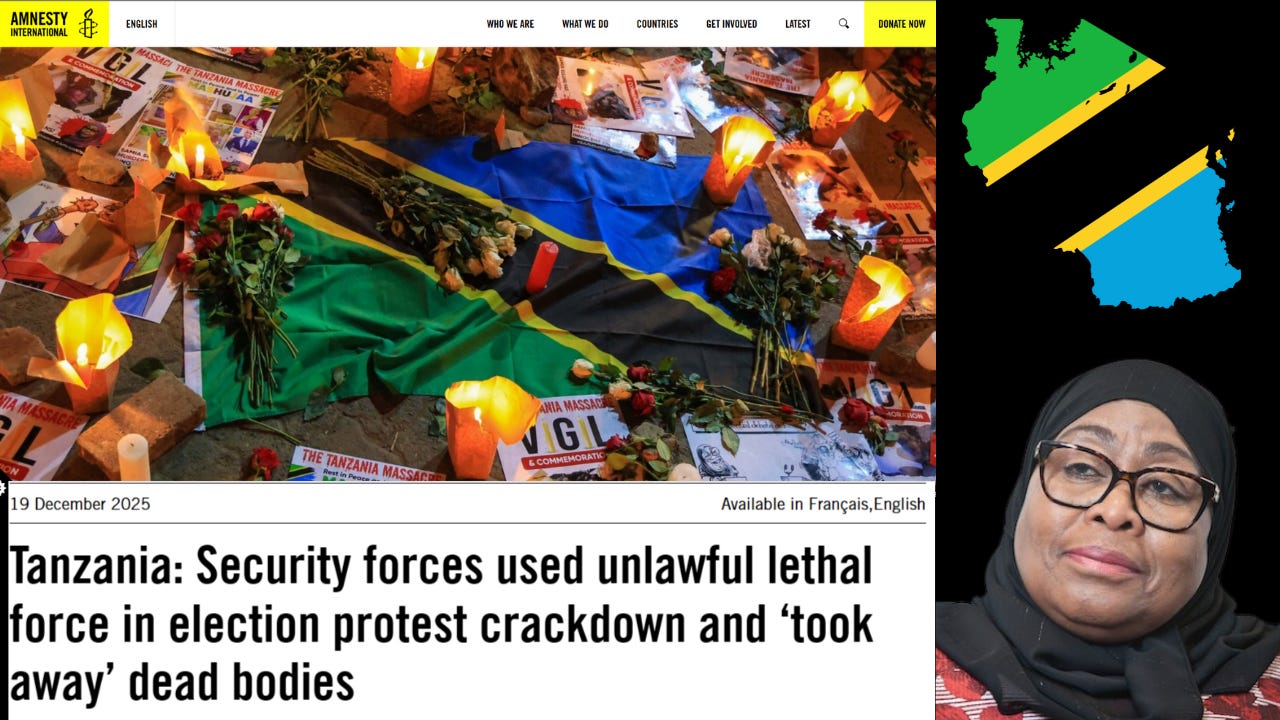
Amnesty International: Tanzania's security forces used unlawful lethal force in election protest crackdown and ‘took away’ dead bodies
Ujasusi Blog’s East Africa Monitoring Team | 20 Dec 2025 | 0630 GMT
🔓FREE ACCESS
Please consider becoming a paid subscriber
You can also donate.
Snapshot
Amnesty International has published investigative findings concluding that Tanzanian security forces used unlawful lethal force to suppress post-election protests between 29 October and 3 November 2025. The report documents killings, torture, denial of medical care, removal of bodies, and a nationwide internet shutdown—violations of the right to life and peaceful assembly under international law.
🔍 What Amnesty International Published
Amnesty International released a formal public investigation into state conduct during Tanzania’s 2025 election protests, based on field research and independently verified digital evidence.
Scope of the publication
Period examined: 29 October – 3 November 2025
Locations covered: Dar es Salaam, Arusha, Mwanza, Mbeya, Moshi, Tunduma
Nature of report: Field investigations, eyewitness and medical testimony, digital verification
Status: Official Amnesty findings, not allegations or media commentary
🧾 How the Findings Were Established
Amnesty details a multi-layered evidentiary methodology consistent with international investigative standards.
Evidence base
35 interviews with survivors, eyewitnesses, lawyers, healthcare professionals, and relatives of victims
26 videos and six photographs independently verified by Amnesty’s Evidence Lab
Forensic pathology review identifying high-velocity gunshot wounds consistent with military-grade rifles
Corroboration across hospital records, morgue observations, and open-source footage
🔐 What the Investigation Concludes
Amnesty reaches explicit determinations regarding state responsibility.
Key conclusions
Security forces fired live ammunition at unarmed protesters and bystanders posing no imminent threat
Lethal force was used without warning and failed tests of necessity and proportionality
Tear gas was deployed abusively, including firing directly at individuals and into private homes
Security personnel carried out torture and other ill-treatment during arrests and dispersal operations
Wounded civilians were denied healthcare or removed from hospitals while still bleeding
Bodies of those killed were removed from mortuaries to unknown locations
A nationwide internet shutdown obstructed reporting, emergency response, and accountability
Amnesty describes this conduct as showing a shocking disregard for the right to life and freedom of peaceful assembly.
🏥 What Hospitals and Medical Staff Reported
Medical testimony forms a central pillar of the findings.
Hospital impacts
Hundreds of gunshot victims admitted within days, with injuries to the head, neck, chest, abdomen, and limbs
Morgues overwhelmed, with bodies left outdoors due to lack of space
Police ordered medical staff to hand over severely injured patients
Medical personnel were threatened, monitored, and warned against documenting events
Some wounded civilians reportedly avoided hospitals altogether for fear of arrest.
⚰️ What Happened to the Dead
Amnesty documents patterns consistent with concealment of unlawful killings.
Observed patterns
Police removed bodies from hospital mortuaries without family consent
Families were unable to locate remains despite searching multiple facilities
Some families conducted symbolic burials of clothing or photographs
Amnesty assesses these actions as potential evidence concealment
⚖️ Legal Standards Violated
Amnesty assessed the documented conduct against binding international and regional frameworks.
Applicable standards
International Covenant on Civil and Political Rights
African Charter on Human and Peoples’ Rights
UN Basic Principles on the Use of Force and Firearms
Legal determinations
Lethal force was arbitrary and unlawful
Violations include the right to life, freedom of peaceful assembly, prohibition of torture, and the right to health
🌍 Why These Findings Matter Internationally
Amnesty’s findings elevate Tanzania from a domestic political crisis into an issue of international legal and diplomatic concern.
International implications
Creation of a documented evidentiary record usable by UN and regional mechanisms
Increased reputational and diplomatic exposure for Tanzania
Heightened scrutiny by human rights bodies, donors, and bilateral partners
Placed in a broader regional context, Tanzania’s 2025 crackdown reflects patterns Amnesty International has documented across multiple African election cycles.
🌍 Comparative Africa Intelligence Context
The table below situates Tanzania (2025) within a documented continental pattern of election-period repression identified by Amnesty International. This is intended for pattern recognition, not moral ranking.
Recurring pattern
Militarisation of election policing
Use of live ammunition against civilians
Medical interference and information suppression
Post-event accountability mechanisms with limited independence
🧭 Intelligence Outlook
Short-term (weeks to 3 months)
Intensified international scrutiny through UN special procedures
Heightened reputational risk and diplomatic pressure
Short-term protest suppression masking unresolved grievances
Medium-term (3–12 months)
Risk of aid conditionality, sanctions discourse, or diplomatic cooling
Amnesty’s findings likely cited in UN Human Rights Council processes
Growing legitimacy deficit surrounding electoral governance
Long-term (12+ months)
Entrenchment of Tanzania’s classification as a repressive electoral environment
Structural erosion of public trust in elections
Amnesty’s evidentiary record may feed into future international inquiries or universal-jurisdiction cases