

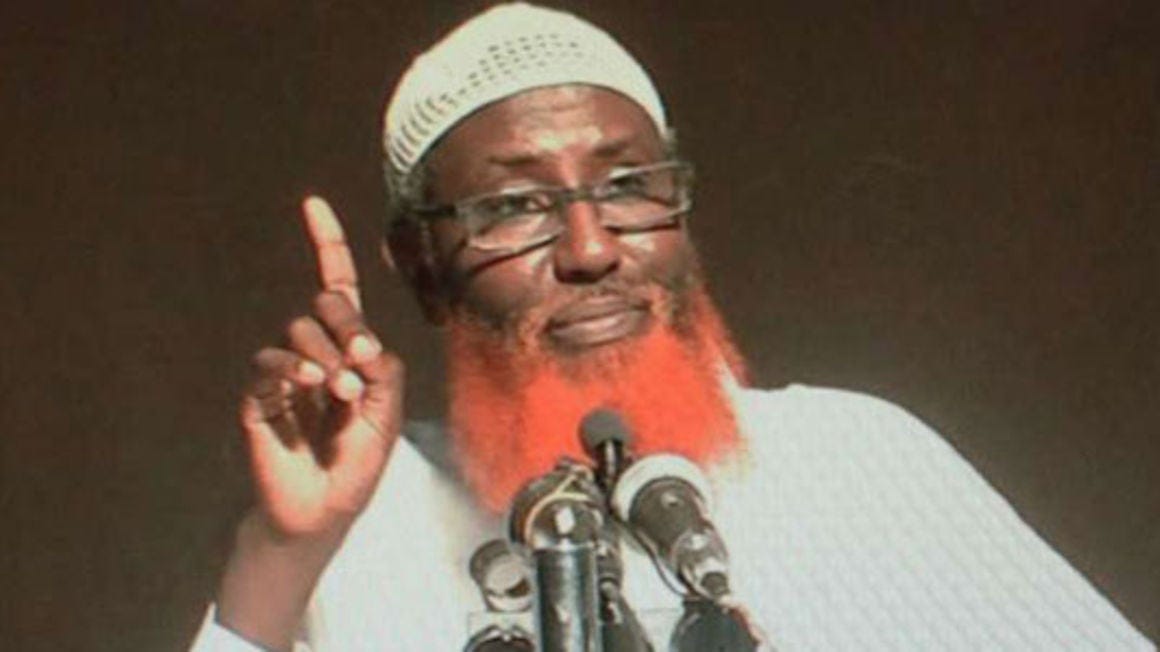
The U.S. announced May 31 that it killed three militants in a Somalia airstrike. Officials now say the target was ISIS leader Abdulqadir Mumin, but also say they aren’t certain he is dead.
However, one Somali security official said he doubted Mumin would have been in the area during the strike since the IS-Somalia leader is careful to avoid areas where telecommunication infrastructure is working, which it was at the time.
But who is he?
According to this profile
The appearance of Sheikh Abdulcaadir Mumin, alongside al-Shabaab’s senior leadership, in May 2011 at the group’s official press conference acknowledging Osama bin Laden’s death was something of a coming out for Mumin. Largely unknown outside the Somali-speaking community, he has until now lurked in the background of overtly radical Somali circles. Previously a prominent feature on the London Somali scene, Mumin, first appointed as the head of propagation for the Banaadir administrative region and its capital Mogadishu, appears at present to have risen into a senior position as one of al-Shabaab’s key theological guides.
The United Kingdom
Very little is known publicly about Sheikh Abdulcaadir Mumin’s background prior to his arrival in London. Apparently hailing from the northern semi- autonomous Puntland region, by the mid-2000s he relocated to the United Kingdom. It is believed he may have been in Denmark prior and if this is the case, then it is likely that he would have initially moved to Leicester. In Leicester there is a strong Somali community with links to the large Somali community in Scandinavia whose beginnings largely stemmed from were resettled in several European welfare states. In other instances, this connection has revealed extremist called Musse Yusuf who was arrested by British authorities on May 28, 2008. Yusuf was eventually cleared of charges against him but was found in possession of substantial volumes of radical material, including a video providing detailed instruction on how to create a suicide bomb vest. Yusuf claimed the information was intended to help Somali militants resist the Ethiopian troops then occupying parts of his homeland. Yusuf was quoted asking police when he was arrested whether it was British or Swedish police who wanted him. As he put it, “in Sweden we were active with the Islamic Courts [Union]. My friends are in Sweden” (This is Leicestershire, September 30 2010).
Whether Yusuf was connected to Sheikh Mumin is unclear, but it does seem as though Sheikh Mumin would have been moving in similar circles. At around the Mumin was listed as a speaker in at least one event at the Quba Mosque in Leicester. [1] This event sparked off local concerns, with a number complaining publicly and privately of Mumin’s extremist leanings. According to Londoners spoken to over the next few years, he was also a regular in London at mosques in Woolwich and Greenwich. He also appears to have taken on something of a public persona as a spokesman for East African and Somali affairs, appearing at events at the London Muslim Centre sponsored by the East Africa Welfare & Development Association and hosted by a former Hizb-ut-Tahrir member. [2] In early 2010, a bespectacled Mumin donning a long henna dyed beard appeared alongside outspoken former Guantanamo detainee, Moazzam Begg, speaking on behalf of his London-based Islamic NGO, Cageprisoners, to launch their report on East Africa criticizing American and Ethiopian cooperation there. [3]
However, by some point mid-year it became clear to Sheikh Abdulcaadir that he felt under heavy and potentially menacing surveillance from security services and he decided to leave the UK. In an interview conducted with Somali-language news site Somalimemo sympathetic to al-Shabaab, Sheikh intelligence surveillance as his reasons for abandoning the UK to join al-Shabaab. [4]
Mumin’s Return to Somalia
In the same interview, Sheikh Abdulcaadir described toward the end of 2010, and having stayed in Kenya for a brief period, he entered into Somalia via the town of Beled Hawo at the junction of the Ethiopia-Kenya- Somalia triple border, which was under al-Shabaab control at the time. [5] Once in Somalia, Mumin gave a sermon to hundreds of worshippers in the Dabaqeynka mosque, situated in the then al-Shabaab-held Yashid district of Mogadishu. There, he proceeded to rip up and burn his British passport and other legal documents, vowing to never return to the UK. Mumin pledged to spend the remainder of his life dedicated to serving the cause of jihad.
Nothing is publicly available on the whereabouts of his family and whether they followed or preceded him to Somalia. It is ambiguous whether the event at which he supposedly burned his passport is the same one in which he was seen at in late 2010 in Mogadishu where by May 2011, he was willing to stand alongside al- Shabaab’s leadership at a public press conference in which they praised Osama bin Laden in the wake of his death. [7]
In a brief discussion about the news article reporting on the Sheikh’s move to Somalia, a commentator expressed his certainty that Mumin and his wife belong to the powerful Majerteen ’Ali Salesian and the ‘Umar Mohamud sub-sub clans respectively of the larger Darood clan. In parts of Somalia, the sheikh is remembered for causing outrage whilst on a visit to Bosasso, Puntland’s principal city, where he declared the local governing authorities to be apostates in a lecture he gave to a packed audience. Apparently made a year before leaving the UK for al-Shabaab held areas in Somalia, the event would seem to presage Sheikh Abdulcaadir’s later development as an al-Shabaab hardliner. [8]
The al-Shabaab Theologian
For al-Shabaab the war to topple the African Union and United Nations-backed Transitional Federal Government (TFG) is ideological as much as it is military. In areas under al-Shabaab control, the group led an ardent campaign to portray its enemies as morally corrupt Western stooges that are a menace to the local clan-structured population. All sides in heavyweights within the country’s theological circle to discredit each other. No faction has employed this divisive tactic more so than al-Shabaab.
One can argue that al-Shabaab’s choice to present Sheikh Abdulcaadir as one of its foremost ideologues serves a number of purposes. He not only holds resonance with Somalis in the West and elsewhere in the Somali diaspora, but his rousing lectures and speeches are marked with fervent quotes beyond just the standard Quran and Hadith. Mumin references works by classical Muslim theologians who undergird Taymiyah and Muhammed Ibn Abdul-Wahab. Most importantly, he provides a bellicose counterweight to the comparatively quietist al-I’tisam bil Kitab w’al-Sunnah (also known as Jamaat al-I’tisam or simply group, which maintains a wide audience in Somalia and regards the frail TFG as the nation’s legitimate authority. The TFG has attempted to draft them to act as interlocutors between the government and al- Shabaab without any success thus far. Al-Shabaab path and thus condemned it.
Conclusion
At the time of this writing, it is unclear exactly what impact Sheikh Abdulcaadir’s presence in Somalia will reported that he was heard on a pro-Shabaab radio station as part of a series of speeches condemning the recent Kenyan military intervention analogous to his earlier bashing of the Ethiopian campaign in Somalia. [9] While he clearly stirs loyalty amongst followers in the West, it is unclear that he speaks much English so he is not likely to be that useful in al-Shabaab’s English-language campaigns spearheaded by American jihadi Omar Hammami. Nor is it clear that he is playing much of an operational role for the group as a warrior. Nevertheless, his repeated presence as a speaker at al-Shabaab events is indicative of his growing importance for the movement as a theological leader.