
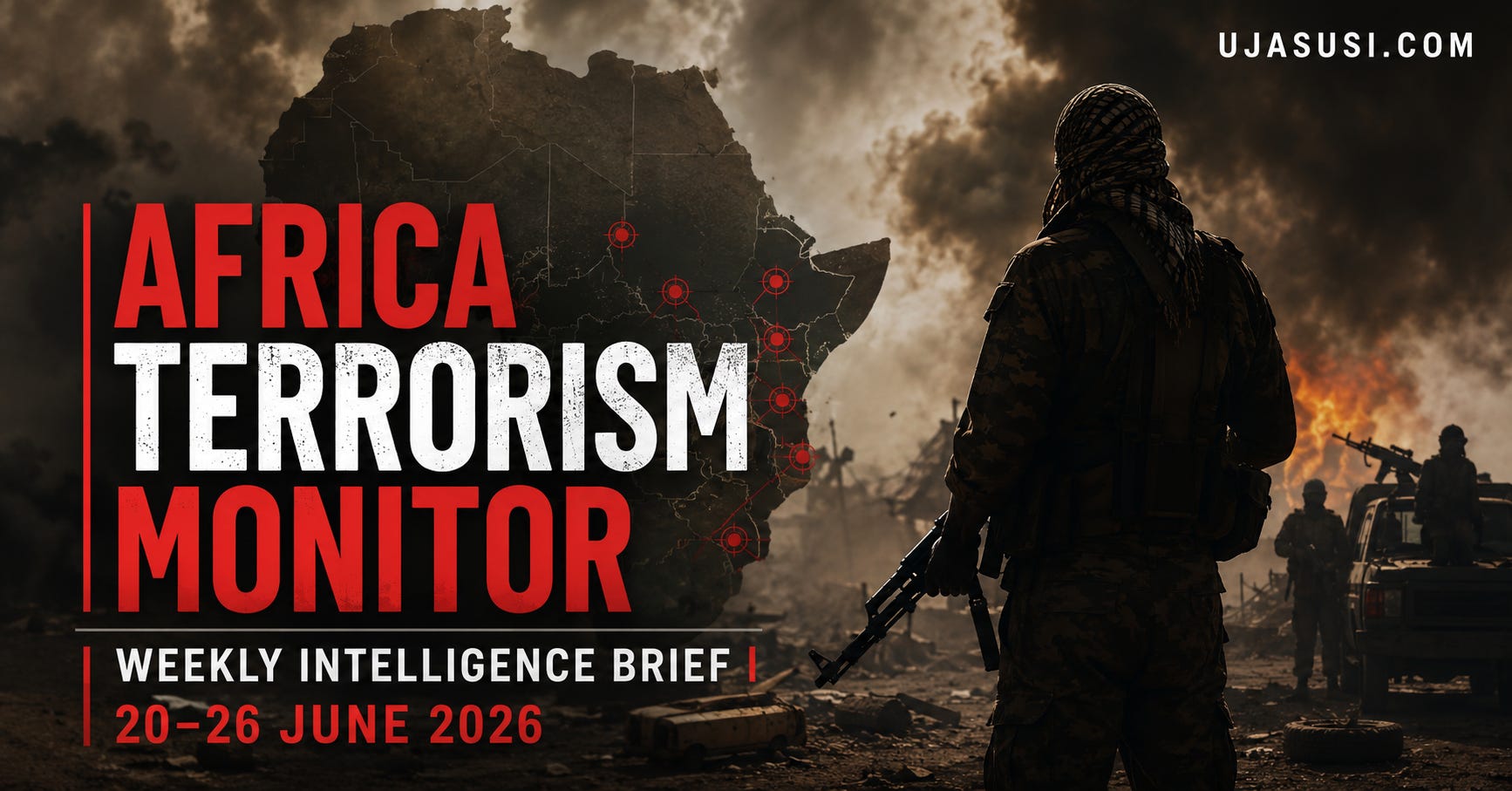
Africa Terrorism Monitor | Weekly Intelligence Brief | 20–26 June 2026

Ujasusi Terrorism Monitoring Desk | 27 June 2026 | 0145 BST
The Africa Terrorism Monitor (ATM) is back. After a period of suspension, the ATM resumes this week with the 20–26 June 2026 brief. The Monitor tracks armed group activity, terrorism incidents, and security developments across the African continent and connected theatres, drawing on GDELT-derived open-source data filtered and assessed by the Ujasusi analytical team. As always, ATM outputs are indicative rather than definitive and require cross-referencing with verified field reporting before operational or policy use. Subscribers to Ujasusi will receive the brief as part of the standard intelligence feed on a weekly basis going forward.
Methodology note: ATM incident data is machine-classified from GDELT open-source media feeds. GDELT classifiers frequently duplicate incidents across co-located armed groups, particularly Boko Haram and ISWAP in the Lake Chad Basin, and JNIM and IS-Sahel in the Sahel tri-border area, when those groups share operational geography. All incidents require human verification and cross-referencing with primary reporting before operational or policy use. Casualty figures are drawn from source URL metadata and are not independently confirmed by the ATM.
Executive Summary
The Africa Terrorism Monitor flagged sustained operational tempo across five African theatres and three globally relevant external developments during 20–26 June 2026. In the central Sahel, Russian-aligned forces are attempting to establish a counter-insurgency perimeter around Bamako amid continued encroachment by JNIM and IS-Sahel.
In Nigeria, armed violence in Borno and Zamfara states produced significant fatalities, while the Lake Chad Basin remained the continent’s most active terrorism node.
In eastern DRC, M23 and FARDC exchanged fire across North and South Kivu on the same day the DRC and Rwanda signed a ceremonial peace accord in Washington, a juxtaposition that illustrates the gap between diplomatic process and operational reality.
In northern Mozambique, Islamic State Mozambique completed a two-month southern incursion through Cabo Delgado’s informal mining belt before regrouping in Macomia, with both FADM and Rwandan forces largely passive throughout. In Kenya, security forces pre-emptively dispersed protesters marking the anniversary of the 2024 anti-government demonstrations.
Beyond the continent, this brief additionally covers three external theatres, Afghanistan/Pakistan, Yemen, and Syria, where Islamic State, AQAP, and ISIS-K activity carries direct relevance to African security dynamics. Known false positives, religious education stories, domestic political legislation, weather events, and celebrity coverage, have been excluded throughout.
Key Developments
West Africa: Mali — Bamako Perimeter Hardens
On 23 June, reporting indicated that Russian and Wagner Group-aligned forces were intensifying efforts to stem Islamist encroachment toward Bamako. The capital is the strategic depth threshold for both Jama’at Nusrat al-Islam wal-Muslimin (JNIM) and the Islamic State in the Greater Sahara (IS-Sahel). If anti-government armed groups breach this perimeter, the operational logic of the Sahelian insurgency shifts from rural attrition to a direct state-decapitation model. The monitor flagged this as a defensive mobilisation rather than a government offensive, suggesting that Bamako’s security architecture remains reactive.
West Africa: Nigeria — Borno and Zamfara Violence
The Lake Chad Basin generated the most lethal African incidents in this window. On 24 June, an armed attack in Borno State was reported by regional media, with source URLs indicating approximately twenty fatalities. Separately, on 22 June, suspected militants killed eleven farmers in Zamfara State, northeastern Nigeria. Zamfara lies outside the traditional Boko Haram/ISWAP core but falls within Nigeria’s wider banditry and militancy corridor. The co-occurrence of these events with Nigerian Senate debate on state police creation, flagged as a false positive but contextually relevant, suggests federal awareness that centralised security architecture is failing in peripheral states.
Horn of Africa: Somalia — AFRICOM Air Strikes
On 22 June, US Africa Command (AFRICOM) conducted air strikes against Al-Shabaab positions near Kismayo, in Somalia’s Lower Juba region. The target set and location suggest a focus on degrading Al-Shabaab’s revenue and logistics nodes in the southern corridor rather than a leadership decapitation strike. If confirmed, this continues the US policy of sustaining over-the-horizon pressure despite the absence of a permanent ground force presence. The operation generated only a single GDELT hit, indicating either limited media access to the area or deliberate operational discretion.
Central Africa: DRC — Peace Process Fractures, Ground War Continues
The eastern Democratic Republic of Congo generated two contradictory signals during the monitoring period. At the diplomatic level, the DRC and Rwanda signed a US-mediated peace agreement in Washington on 27 June, attended by Secretary of State Marco Rubio, marking the formal ratification of an accord originally signed in June 2025 and restated in December.
At the operational level, fighting continued. Pro-Congolese government forces clashed with M23 in several areas in Masisi district in North Kivu, while Wazalendo fighters repelled an M23 attack near the Masisi-Walikale district border. The Congolese army (FARDC) conducted a drone strike against an M23 position north of Goma, indicating that Kinshasa has begun integrating unmanned systems into its counter-insurgency posture.
The Washington deal has a critical structural flaw: it sidelines the M23, the armed group that controls much of eastern Congo and is central to any durable peace. The agreement focuses almost exclusively on Rwanda withdrawing troops and Kinshasa neutralising the Democratic Forces for the Liberation of Rwanda (FDLR), leaving M23’s cooperation largely unaddressed.
Separately conducted Doha negotiations between the Congolese government and the Alliance Fleuve Congo (AFC)/M23 political-military coalition, facilitated by Qatar, have stalled, with neither delegation present in Doha as of the close of this monitoring window.
The Allied Democratic Forces (ADF) threat compounded the M23 problem. An Amnesty International report published in May documented ADF war crimes across North Kivu, including a September 2025 attack in Ntoyo village in which fighters disguised as mourners killed more than sixty people, and a November attack in Byambwe in which fighters set a hospital ablaze. With FARDC forces redeployed to counter M23, the ADF exploited the security vacuum, killing at least fifteen people in Lubero territory in December 2025 and twenty in February 2026.
The political crisis in Kinshasa added a further dimension. On 12 June, police fired tear gas to break up a demonstration outside parliament organised by the opposition coalition C64, protesting a proposed law that could allow President Félix Tshisekedi to remain in power beyond his two-term constitutional limit. Opposition leader Martin Fayulu was injured during the confrontation. Tshisekedi’s move to extend his tenure, conducted simultaneously with a peace process premised on his government’s legitimacy, weakens Kinshasa’s negotiating authority with both M23 and international mediators.
READ ALSO
Introducing “A Spy’s Guide to Deception” — The First in the Spy Guide Series

Intelligence work is built on deception. Every service that has ever run an agent, mounted a cover operation, or manufactured a false narrative has done so through principles that remain largely invisible to the public. Not because they are secret, but because no one has taken the time to explain them plainly.
Southern Africa: Mozambique — ISM Southern Incursion and Force Passivity
Islamic State Mozambique (ISM) conducted a sustained multi-week incursion into southern Cabo Delgado during the monitoring period, the most significant geographic extension of insurgent activity since late 2024. After two months operating in the south of the province, ISM militants began returning to their bases in Macomia district around mid-June, having passed through at least four informal mining sites and generating revenue through mineral taxation and looting. ISM maintained parallel activity in the north, deploying IEDs in Macomia and Mocímboa da Praia districts and clashing with a Mozambican navy vessel.
The week’s most significant kinetic event occurred on the night of 22 June, when Islamic State fighters attacked the military position at Namabo in Macomia district; IS claimed five soldiers killed. The position had been targeted previously, including on 31 January. Repeated strikes against the same fixed location indicate that FADM has not implemented hardening measures between attacks. Separately, a Mozambican navy vessel sank on 18 June between Matemo and Ibo islands, with at least nine crew members feared dead.
The passivity of both FADM and Rwandan Defence Force (RDF) units during ISM’s southern incursion is the most significant operational finding of this section. Two camps, one RDF and one FADM, were well positioned to respond to ISM’s movements through the south, but neither deployed. ISM operated across at least four mining sites for two months without meaningful security force interdiction, extracted revenue, and withdrew.
The Mozambican government formally confirmed during the period that it will fund the continued RDF presence in Cabo Delgado, though amounts and duration were not disclosed. This keeps Kigali’s forces embedded in Cabo Delgado’s LNG security architecture while reducing Rwanda’s exposure to international pressure over its concurrent military commitments in eastern DRC.
East Africa: Kenya — Pre-emptive Protest Policing
Under the Monitor’s major non-terrorist incidents section: on 25 June, Kenyan security forces dispersed groups marking the anniversary of the deadly 2024 anti-government protests in Nairobi. Police pre-emptively blocked roads around the capital ahead of anticipated demonstrations. The posture suggests heightened official sensitivity to renewed civil unrest and a hardening of state crowd-control protocols that could become relevant if opposition mobilisation escalates.
Key Developments — Global Theatres with African Relevance
The following theatres are covered where developments involve groups active on the African continent or carry strategic implications for African security dynamics.
Afghanistan and Pakistan: ISIS-K Summer Escalation
ISIS-K maintained a high operational signature across Pakistan’s northwestern and southwestern peripheries during the monitoring period. In Bannu, Khyber Pakhtunkhwa, twin blasts on 20 June killed at least seven people and injured three, according to multiple Pakistani media sources including Geo TV, Pakistan Today, and Daily Times, the Monitor’s highest-casualty flagged event of the week.
Four days later in Lower Dir, a joint Counter-Terrorism Department (CTD) operation reportedly killed six designated high-value targets, though the Monitor’s attribution of this operation specifically to ISIS-K was not independently verified; it falls within Pakistan’s broader anti-ISIS-K campaign in the former tribal areas.
On 25 June, a motorcycle-mounted IED detonated in Balochistan’s coastal Ormara area, killing one person, in a tactic consistent with documented ISIS-K and associated Baloch militant group methods in the province. The same day, security forces recovered the body of an Airport Security Force (ASF) deputy director in Qalat, Balochistan, weeks after his kidnapping; attribution to a specific group was not confirmed.
Cross-border dynamics remained fractious. The Afghan Taliban conducted strikes against what they termed militant hideouts inside Pakistan, characterising Islamabad’s conduct as “nefarious” in official statements, claims that Pakistan publicly rejected. Analysis published on 22 June indicated that the Taliban is undertaking a structural reorganisation of its frontier military formations along the Durand Line, a development that could alter escalation thresholds with Pakistani border forces.
Yemen: AQAP Low-Level Persistence
The Monitor recorded two AQAP-linked entries for the week, with activity on 22 and 23 June in Sana’a and at least one undisclosed location elsewhere in Yemen. Neither incident registered as a mass-casualty event. The pattern is consistent with assessments that the group’s capability has degraded significantly since 2015 but has not been extinguished. AQAP’s persistence in Yemen remains relevant to East African security given documented facilitation networks along the Gulf of Aden corridor and established logistical links to Al-Shabaab.
Syria: CENTCOM High-Value Targeting
On 24 June, US forces conducted an airstrike in Manbij, northern Syria, killing a senior Islamic State commander. Central Command (CENTCOM) confirmed the strike in separate reporting. The operation signals continued US willingness to target ISIS leadership in Turkish-influenced zones where ground force access is limited. Syria remains relevant to African security tracking given the movement of Islamic State-affiliated fighters between Syrian, Libyan, and Sahelian theatres documented across multiple UN Panel of Experts reports.
Assessment
The 20–26 June window points to four macro trends worth tracking.
The Sahelian conflict is entering a positional phase around Bamako. Russian and Wagner support has not translated into territorial recapture in the Niger-Mali-Burkina Faso tri-border area; instead it appears to be consolidating into a defensive cordon around the Malian capital. This is tactically prudent but strategically brittle: it cedes rural governance and customs revenue to JNIM and IS-Sahel while concentrating risk in a single high-value target. Any breach of the Bamako perimeter would represent a qualitative shift in the insurgency.
Nigeria’s security geography is fragmenting. Borno remains the formal epicentre of Boko Haram/ISWAP activity, but Zamfara’s farmer killings illustrate how bandit networks, often indistinguishable from designated terrorist groups at the tactical level, are expanding the violence footprint westward. The federal government’s concurrent legislative discussion on state police creation reflects growing recognition that centralised security architecture is inadequate for these peripheral corridors.
The AfPak corridor is exhibiting a summer escalation arc. ISIS-K’s Bannu attack, the Ormara IED, and the ASF kidnapping recovery all point to a group that has preserved operational capability despite Pakistani military claims of degradation. The Taliban’s cross-border strikes and Durand Line force reorganisation introduce a quasi-state/non-state dyad that complicates bilateral intelligence sharing and increases the risk of miscalculation between Islamabad and Kabul. The summer months historically see intensified militant activity in Khyber Pakhtunkhwa; the current trajectory is consistent with that pattern.
Both the DRC’s peace architecture and the Mozambique counter-insurgency exhibit the same structural defect: diplomatic frameworks that outpace and obscure operational reality. In the DRC, the Washington Accords ceremony proceeded on the same day that M23 and FARDC were trading fire in Masisi district. In Mozambique, a confirmed Rwandan security commitment did not translate into field responsiveness during ISM’s two-month southern incursion. In both theatres, external security partners, Rwanda in Cabo Delgado, the US as mediator in the DRC, provide a veneer of stability that allows strategic drift to continue beneath it. The risk in both cases is that the next escalation arrives before the diplomatic process has produced any structural change in the forces driving it.
What to Watch Next
Bamako’s perimeter: Any confirmed JNIM or IS-Sahel attack within 100km of the Malian capital would signal a tactical breakthrough for the insurgency. Monitor reports from Kati, Koulikoro, and the Bamako-Ségou road corridor.
Nigeria’s state police legislation: If the Senate bill advances, observe whether Borno or Zamfara immediately request equipment or federal training support. Such requests would indicate anticipated militant pressure rather than symbolic legislative action.
ISIS-K’s Pakistan campaign: July typically marks a seasonal intensification of militant activity in KP and Balochistan as improved terrain access and longer daylight hours extend operational windows. Watch for repeated IED patterns against security forces, high-value kidnappings, and any claims of responsibility via Amaq or Pakistani militant media channels.
Syria–Manbij fallout: US targeting in Turkish-influenced zones may irritate Ankara. Monitor diplomatic signalling from the Turkish defence ministry and any Turkish military movements in northern Aleppo governorates.
Kenya protest cycle: The 25 June pre-emptive police mobilisation suggests the administration anticipates renewed opposition pressure. Monitor social media mobilisation around the 2024 protest anniversary and opposition coalition cohesion for indicators of a renewed flashpoint.
DRC — M23 talks in Switzerland: The ninth round of DRC-M23 negotiations is expected to resume under the Doha framework. Disagreements over agenda and attendees have already disrupted the process. Monitor whether the AFC/M23 delegation arrives and whether the US applies direct pressure on Kigali to implement its troop withdrawal obligations under the Washington Accords, now formally one year old with minimal implementation.
Mozambique — ISM northern consolidation: Having extracted revenue from four mining sites in the south, ISM’s return to Macomia and Mocímboa da Praia represents a logistical reset before the next expansion cycle. Monitor IS central media claims from Mocímboa da Praia district for indicators of a renewed northern offensive, and watch for any RDF or FADM forward deployments in the Quissanga corridor, which ISM has used as a transit route toward Mucojo.
Report generated by Ujasusi Terrorism Monitor Desk. Data source: GDELT Project (gdeltproject.org). All incidents are machine-classified from open-source media and require human verification before policy or operational use. The Monitor does not independently confirm casualty figures; fatalities referenced are drawn from source URL metadata.