

Reporting period: 31 August–4 October 2026
Prepared: 7 October 2026
Publisher: Ujasusi | Intelligence & Security Analysis
Author: Evarist Chahali
🧭 Executive summary
September’s reviewed reporting shows pressure on security forces in Mali and Niger, contested militant authority in the Lake Chad Basin, and continuing civilian exposure in Mozambique and eastern DRC. Somali and international counterterrorism announcements provide evidence of operational activity, while leaving its lasting effects unresolved.
The Dioura attack in Mali and two late-September attacks in western Niger highlight military vulnerability. In Burkina Faso, Islamic State Sahel Province’s claimed victory over JNIM near Kacham underscores rivalry between militant organisations. These developments require separate attribution and careful treatment of disputed losses.
Nigeria’s reported ceasefire with Boko Haram drew a subsequent denial, leaving its authority and scope uncertain. Mozambique’s Niassa raid demonstrated mobility beyond Cabo Delgado, where later reporting described further killings and abductions. An ADF-attributed attack in Ituri adds a sourced eastern DRC incident without resolving the wider collection gap.
This assessment combines five supplied weekly exports with independently retrieved reporting and official statements. Their 166 African records are collection leads, not 166 confirmed attacks. Uniformly zero casualty fields cannot establish that nobody was killed. This is a selected regional assessment, not an exhaustive continental census.
🎯 Key judgements
Military resilience is a central Sahel concern. Dioura and the reported attacks in western Niger raise questions about force protection and resupply. Niger’s command changes add an institutional dimension, but do not prove that internal divisions caused battlefield losses. Confidence: moderate; casualty totals and causal relationships remain unresolved.
JNIM and Islamic State Sahel Province should be assessed separately. September reporting describes confrontation between them, making any suggestion of a unified jihadist campaign misleading. Confidence: high in the need for separate attribution; lower in the claimed scale of the Kacham losses.
The Niassa attack demonstrated operational mobility, not proven permanent territorial expansion. A successful raid does not establish that the attackers can maintain local supply, recruitment and protection networks. Confidence: moderate, supported by specialist assessment and reporting of the raid.
Somalia’s strikes and intelligence operations show sustained activity, with effects still uncertain. Weapons-infrastructure targeting and NISA’s reported operations indicate efforts to disrupt capability. Public announcements do not establish lasting degradation. Confidence: moderate in the reported activity; operational results remain attributed claims.
Nigeria’s reported dialogue requires caution. A reported Boko Haram truce was followed by a denial attributed to a figure within the movement. Neither establishes a basin-wide settlement or protection from ISWAP. Confidence: low in the arrangement’s scope and authority.
A reliable month-on-month African attack or fatality comparison is unavailable from the supplied exports. Repetition, uncertain actor attribution and missing source links prevent that calculation. Confidence: high, based on direct inspection of all five files.
🗺️ Regional situation
Sahel: pressure on the state and competition among militants
A major Mali development was the 10 September attack on Dioura. Reuters reporting published on 21 September, republished by MarketScreener described extensive military losses, citing a security source and a diplomatic source whose estimates differed. It also reported the army’s statement that troops had been evacuated and enemy positions struck. The exact casualty and captive totals remain unresolved.
Ujasusi assessment: The intelligence value lies in the attack’s implications for force protection, reinforcement and the management of captured personnel. The disputed totals should not obscure those questions, but neither should propaganda claims become confirmed losses through repetition.
Mali’s economic vulnerability also remained relevant. UK government security advice describes JNIM blockades targeting fuel traffic in southern and western Mali, including routes serving Bamako. This advice was checked on 6 October 2026 and is used as background context. It is not a dated September incident record and cannot establish the timing or number of convoy attacks within the reporting window.
Ujasusi assessment: Pressure on transport can produce effects beyond the immediate attack site. Disrupted deliveries can increase the cost of maintaining military positions and sustaining civilian services. Analysts should therefore track the reliability of movement and supply alongside battlefield reporting. The available material does not justify a September-specific estimate of fuel losses or economic damage.
In Burkina Faso, ACLED’s assessment published on 17 September described an Islamic State Sahel Province claim of victory over JNIM near Kacham earlier that month. ISSP claimed more than 200 JNIM fighters killed and more than 30 prisoners captured and subsequently executed. ACLED explicitly treated the scale as conditional on the claim’s accuracy.
Ujasusi assessment: This rivalry complicates any simple narrative of militant expansion. A group may strengthen its position against government forces while losing fighters or local influence to another insurgent organisation. Inter-group violence can also generate defections and new incentives for coercion, although those outcomes must be demonstrated locally rather than assumed.
Niger entered September after a failed military mutiny in Niamey on 28–29 August, described in ACLED’s 1 September assessment. The mutiny predates this reporting window; its aftermath provides context.
On 11 September, President Abdourahmane Tiani changed the military leadership. Niger’s official news agency reported that Mamane Sani Kiaou replaced Moussa Salaou Barmou as chief of defence staff, while Abdourahmane Abou Zataka became army chief.
More consequential battlefield reporting followed. Reuters reported on 28 September, citing two security sources, that more than 50 security personnel had been killed in two attacks: an ambush on a gendarme convoy near Abala-Filingué on 23 September, and an attack at Birni-N’Konni on 26 September. The sources attributed more than 30 deaths to the latter. Reuters also reported that ISSP claimed both attacks, according to SITE Intelligence Group. These are source-reported losses and an attributed responsibility claim, not an independently verified casualty total.
Ujasusi assessment: The attacks make field resilience a priority alongside command cohesion. The sequence of mutiny, leadership changes and battlefield losses warrants scrutiny, but does not establish that one caused the others. Relevant indicators include reinforcement, convoy protection and whether the new command can sustain exposed positions.
Lake Chad Basin: disputed dialogue and exposed civilians
The New Humanitarian reported on 7 September that Nigerian authorities and Boko Haram had reached a secret truce operating since June. Its investigation cited three people with contacts among Boko Haram members and said ISWAP was excluded. Government and military bodies had not responded before publication. The disclosure falls within this window; the reported arrangement’s start does not.
The account was subsequently challenged. Premium Times reported on 15 September a video denial, reported by HumAngle, from a man identified as Boko Haram judge Mallam Abdulrahman. He denied that the leadership had approved such a deal. This report has not independently authenticated the video or resolved the competing accounts.
Ujasusi assessment: Any dialogue must be assessed by the authority of those involved, which factions it covers and whether communities experience measurable protection. The available reporting does not establish an effective, movement-wide ceasefire.
The closing days of the reporting period brought another civilian attack. AP reported on 2 October, in a dispatch republished by Newser that suspected Boko Haram militants killed at least 15 farmers and firewood gatherers in Ala, Gummna and Musune, in Borno State’s Marte local government area. The attack occurred during the night of 30 September–1 October. Police also reported three people missing.
Ujasusi assessment: Protection of civilians pursuing ordinary livelihoods is a more meaningful test of local security than the presence of a garrison alone. Communities may remain exposed when farming, collecting fuel or travelling beyond protected settlements.
Actor attribution also matters. The exports repeatedly assign the same date and location to both Boko Haram and ISWAP. Those entries cannot independently demonstrate joint operations, separate attacks or equal activity levels. The Nigeria report uses suspected Boko Haram, which should remain an attributed identification rather than an unqualified finding.
Horn of Africa: strikes and intelligence operations
AFRICOM’s September strike register lists eight strike entries targeting al-Shabaab. This is an official operational record; it is not a count of insurgent attacks, confirmed militant deaths or separately verified successful missions.
The most informative announcements concerned military infrastructure. AFRICOM stated that a 14 September strike near Saacow targeted a weapons and ammunition factory. Its 18 September release announced a strike the previous day against a conventional-weapons warehouse in Sanaag, approximately 80 kilometres southwest of Bosaso.
The command also announced a 24 September strike near Quumbi and 25 September strikes near Welmaro and Ali Farhan. These were described as coordinated with Somalia’s federal government.
Ujasusi assessment: Targeting production and storage could constrain an organisation’s ability to sustain operations. Whether that happens depends on the importance of the facilities, the accuracy of the targeting and the availability of replacements. The reviewed releases do not provide enough evidence to resolve those issues.
Somalia’s National Intelligence and Security Agency also reported ground-level disruption. Hiiraan Online reported on 26 September that NISA said an operation at Buur-Saruur in Middle Shabelle killed 12 al-Shabaab members and destroyed facilities and supplies. The article also recorded NISA’s announcement of 11 suspected operatives arrested in Mogadishu and surrounding areas during September. The death toll, affiliations and operational effects remain agency claims.
Ujasusi assessment: Arrests and strikes address different parts of the threat. Follow-up should examine whether alleged networks are disrupted and whether targeted facilities are replaced. Announced activity alone cannot establish durable improvements in civilian security.
Kenya remained part of the regional monitoring picture. Hiiraan Online reporting described suspected al-Shabaab probing attacks in Garissa and Lamu, including an incident on 19 September along the LAPSSET corridor. Officials reported no injuries in the incidents described.
Ujasusi assessment: A non-fatal probing attack can still test defensive responses and affect movement. The supplied material does not establish a new sustained offensive in Kenya. It warrants attention to transport security and local warning systems rather than a claim of regional escalation unsupported by a comparable incident series.
Mozambique: wider reach, continuing civilian coercion
ACLED’s September Mozambique update describes Islamic State Mozambique fighters entering Niassa’s Marrupa district on 31 August and attacking a hunting camp near Nanlixa on 3 September. It reports two staff killed, the camp burned and vehicles taken. This was the group’s first incursion into Niassa since May 2025.
AP’s 7 September reporting recorded differing accounts of abductions and deaths, including a South African among the missing. The available accounts should not be combined into a single supposedly settled casualty or hostage total.
In a separate specialist assessment, ACLED’s Peter Bofin identified resupply, economic disruption and international publicity as likely objectives. He assessed the incident as more likely an isolated raid than evidence of a sustained presence, distinguishing local intelligence access from the supply networks needed to remain.
Ujasusi assessment: That distinction is the central finding for southern Africa. Security forces need to understand both where an armed group can move and where it can reproduce its presence. A successful incursion demonstrates a breach in prevention; it does not automatically establish a new territorial stronghold.
Later reporting showed continued violence inside Cabo Delgado. Zitamar’s 23 September report described at least three people killed and 12 abducted during incursions in Muidumbe and Macomia. These figures are attributed to its reporting; the full article was paywalled during this review.
A 30 September Zitamar report described insurgents entering Maputo village in Mocímboa da Praia district on 28 September. A local source confirmed their entry and abductions, without establishing a number. Islamic State separately claimed two civilian deaths. Maputo village here is not Mozambique’s capital, and the death claim is not independently confirmed.
Ujasusi assessment: The Niassa raid must be considered alongside continuing coercion in Cabo Delgado. The reviewed accounts demonstrate different forms of exposure; they do not establish coordinated operations or a common command decision across these locations.
The implications for Tanzania concern regional warning and liaison. The raid supports attention to militant movement and recruitment risks across northern Mozambique. It does not demonstrate an attack inside Tanzania, a confirmed Tanzanian support network or an imminent cross-border operation.
Great Lakes: a sourced Ituri attack, with wider gaps remaining
Radio Okapi reported on 28 September an ADF-attributed attack overnight on 27–28 September in Mambasa territory, Ituri, in which two people were killed, including a soldier. Its article also described separate military gunfire causing panic in Banana later on 28 September. Those episodes should not be conflated.
The supplied exports contain 13 ADF/ISCAP-labelled records, all in the week of 7–13 September, with locations including Kinshasa, Lubala and Walikale. They lack incident narratives and usable source links. They do not establish 13 separate attacks; a Kinshasa tag does not establish an ADF attack in the capital.
Ujasusi assessment: The sourced Ituri account improves coverage but cannot supply a September ADF attack total. Weeks without export entries also cannot prove inactivity. Actor-specific local reporting remains essential in eastern DRC’s overlapping conflicts.
North Africa: border cooperation beyond battlefield operations
INTERPOL announced on 16 September that Operation Phoenix, involving Algeria, Morocco, Tunisia, Jordan and Palestine, produced 48 arrests across the five participating countries, including eight people wanted under Red Notices and one under a Wanted Persons Diffusion. Women police officers held full operational responsibility. The operation targeted terrorism and criminal networks; the 48 arrests are not 48 confirmed terrorism arrests, nor an Africa-only total.
The announcement describes a three-week operation without specifying its exact dates. It is included as an in-period counterterrorism-related disclosure, not as a September incident count.
Ujasusi assessment: Border screening and international police liaison complement military operations. Their value should be assessed through verified identifications and subsequent case outcomes, rather than equating database hits with terrorist activity.
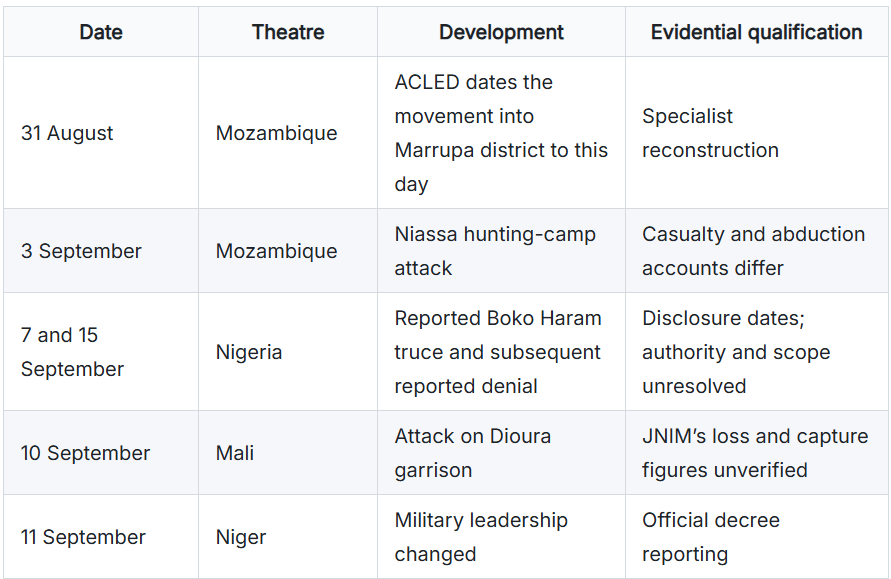
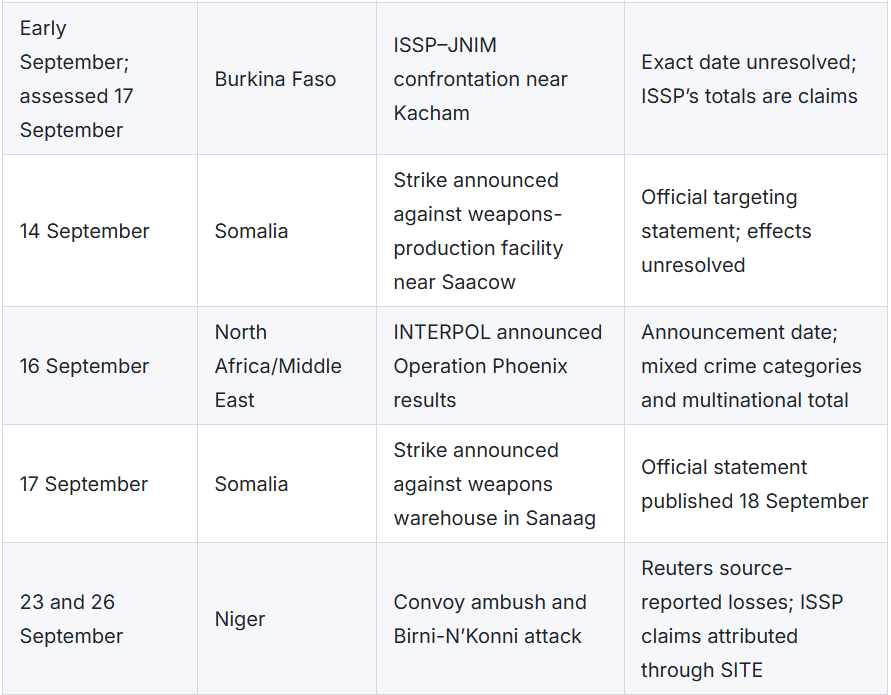
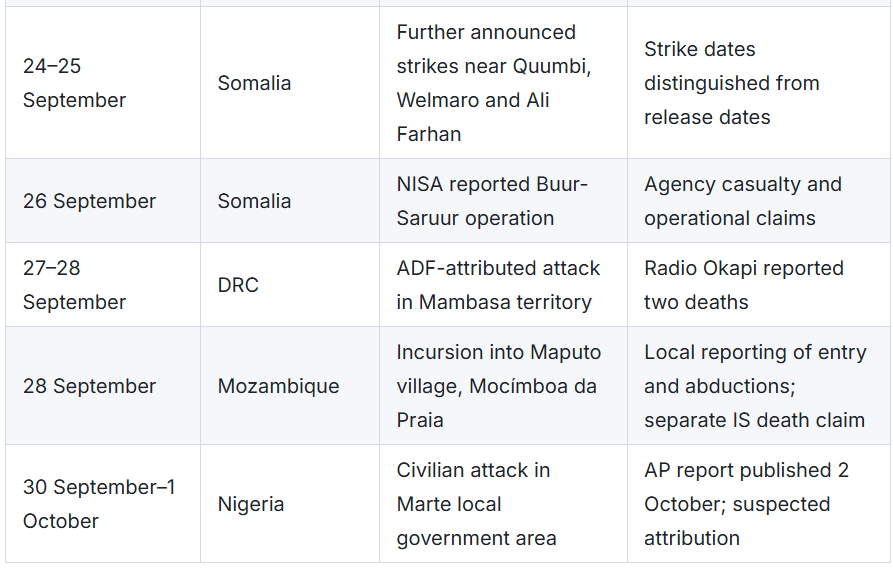
📅 Selected chronology
This is a chronology of selected sourced developments, not a comprehensive attack list. Links and qualifications appear in the regional sections above.
🔎 What does September reveal about Africa’s terrorism threat?
Ujasusi assessment: The strongest cross-regional lesson is that military capability, access to economic targets and control over civilian movement must be measured separately.
Reported losses at Dioura and in western Niger raise questions about force protection. Mozambique’s raid raises questions about mobility and local knowledge. Somalia’s infrastructure strikes raise questions about regeneration. Lake Chad violence and disputed dialogue raise questions about protection beyond defended settlements. Ituri’s reported attack and Cabo Delgado abductions underline civilian exposure. These are connected analytical problems, but the evidence does not establish common command, coordination or a single organisational strategy across theatres.
The same distinction applies to state responses. Announced operations reveal intent and activity. Their effectiveness requires evidence of durable changes in adversary capability and civilian security. Counting announcements, media mentions or automatically classified rows cannot answer that question.
🔭 October outlook: scenarios and indicators
These are analytical scenarios, not forecasts with assigned probabilities.
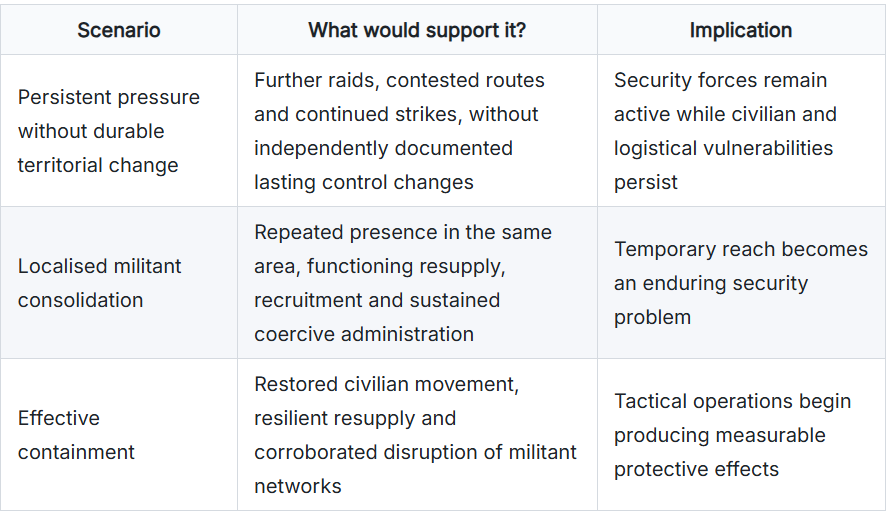
For October, priorities include whether Malian and Nigerien forces can sustain exposed positions and supply routes; whether Kacham produces documented shifts in militant influence; whether Niassa sees repeat incursions; and whether al-Shabaab replaces targeted facilities. Lake Chad monitoring should test the authority and scope of any reported dialogue against civilian protection. In Cabo Delgado and Ituri, repeat abductions, attacks and constraints on movement would be more informative than gaps in the exports.
The decisive evidence will be changes in capability, sustained presence and protection. Another month of high-volume reporting alone will not establish which side is gaining strategic advantage.
📊 Methodology and monitoring-export audit
The reporting window covers five complete monitoring weeks, including one day in August and four in October. It overlaps the previous Ujasusi monitor through 13 September, so the two reports should not be added together as consecutive, non-overlapping datasets.
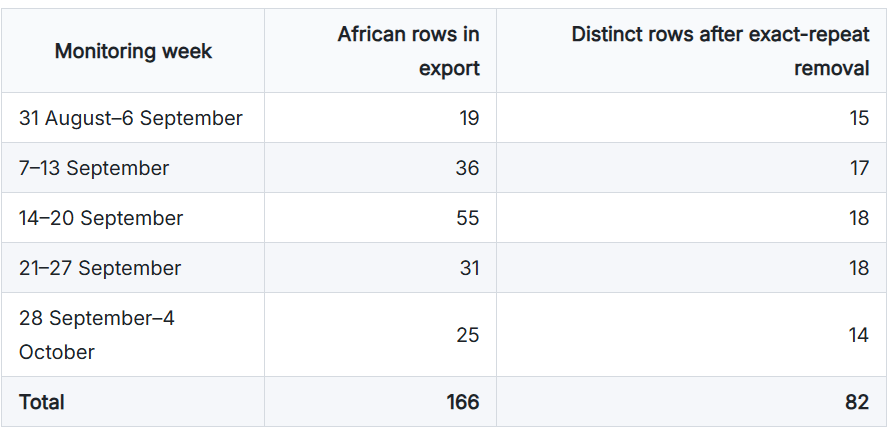
The 166 rows comprise 74 Lake Chad Basin records, 41 Sahel records, 20 Mozambique records, 18 Horn of Africa records and 13 Great Lakes records. These describe the composition of the supplied collection output, not the distribution of verified African attacks.
Exact-repeat removal is a text-level check. It neither proves that identical rows refer to one event nor proves that different rows refer to separate events. Entries require source URLs, event narratives and actor verification before reliable incident deduplication is possible.
Each export labels ACLED as its source near the top but states in the footer that it uses GDELT and would switch to ACLED upon upgrade. Provenance therefore remains unresolved. All casualty fields are zero; independently sourced accounts of lethal events show that those fields cannot serve as a reliable period death toll. No continental fatality total is asserted here.
The regional analysis uses event dates where available and distinguishes them from publication dates. It retains attributed claims, identifies unresolved figures and labels Ujasusi’s own analytical judgements. Official statements confirm what an institution announced; they do not independently verify every operational result.
Source-access limitation: some Zitamar articles were paywalled; only accessible passages and retrieved indexed text were used. Several AP and AFRICOM originals could not be opened directly; the relevant statements were checked through indexed text and, where available, accessible wire-service republications. This establishes support in retrieved reporting, not independent verification on the ground. Republishing the same dispatch does not constitute a second independent source.
The non-African roundup and records explicitly labelled “Non-Terrorist” were excluded. The geographic scope is the principal theatres represented in the supplied files, supplemented by retrieved reporting; this is not exhaustive coverage of every African country.