
Africa Terrorism Monitor - July 2026

Ujasusi Terrorism Monitor | 01 August 2026 | 1630 BST
📋 July at a Glance
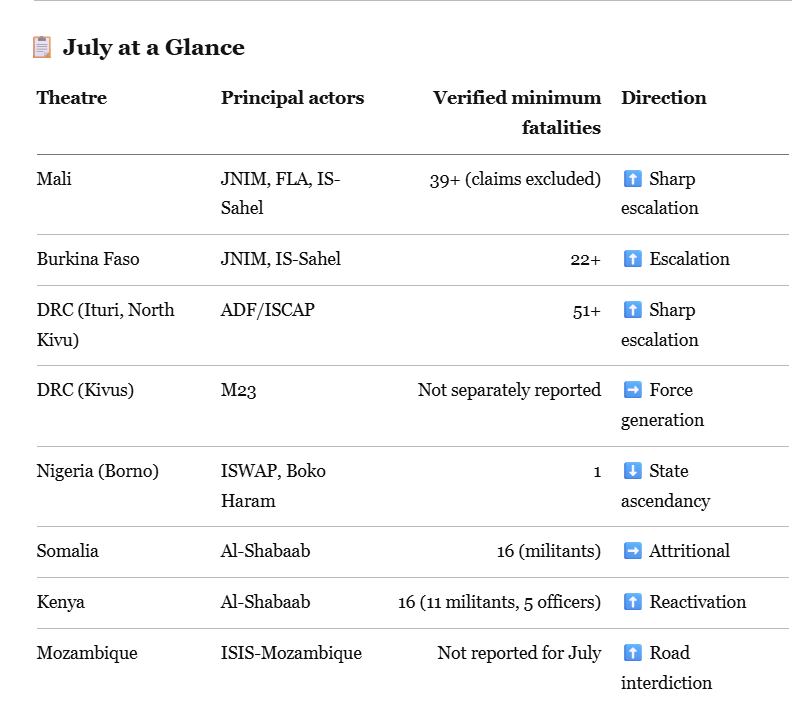
Fatality figures are floors drawn from named reporting. Belligerent claims are excluded from these totals and treated separately in the text.
🔑 Key Judgements
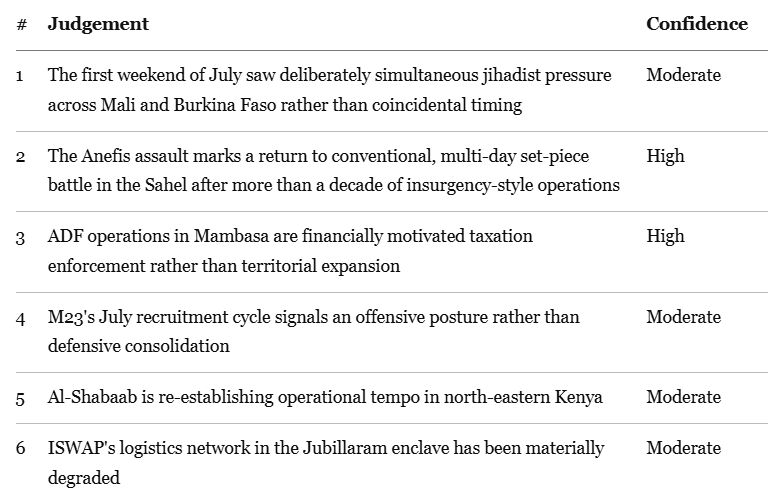
On judgement 1. The JNIM and FLA offensive against Anefis in Mali and the attacks on Di, Solhan and Séguénéga in Burkina Faso occurred within the same 48 hours. JNIM has demonstrated cross-border command capability repeatedly, most recently on 30 June when it struck three Nigerien and three Burkinabè locations on the same day.
On judgement 2. According to the Critical Threats Project, the attackers at Anefis employed at least one Russian BTR-80 armoured personnel carrier alongside artillery, drones, armoured vehicles and pickup trucks. The fighting that followed ranks among the longest sustained engagements in the Mali conflict since the opening years of the 2012 rebellion.
🇲🇱 Mali: The Fall and Recovery of Anefis
The 4 July offensive
Jihadist and separatist forces struck across Mali on 4 July. The army claimed to have thwarted every attack, but AFP reported a regional elected official stating that rebels had taken control of Anefis, with Russian personnel entrenched in the camp and many Malian military personnel taken prisoner. Azawad Liberation Front spokesman Mohamed Elmaouloud Ramadane told the agency that several positions at Anefis had fallen.
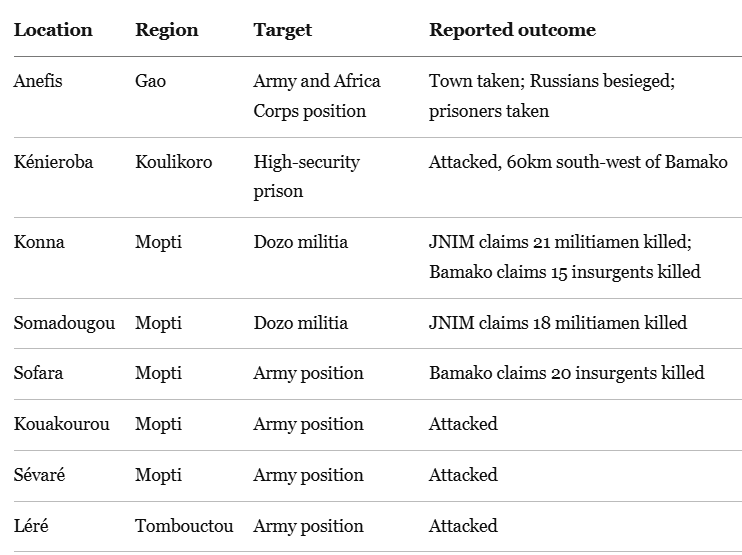
Anefis is operationally critical to controlling Kidal region and central to the ability of Malian and Russian forces to project pressure into it. Anefis and Aguelhok were the last locations where the Malian army maintained a presence in northern Kidal following the April attacks.
The counter-offensive, 5 to 10 July
The offensive ultimately failed. On 5 and 6 July, Malian forces and Africa Corps released video of drone strikes against FLA and JNIM personnel and equipment, and Africa Corps announced that two senior FLA and JNIM commanders were among those killed.
By 10 July, according to the Ghana Peace Journal’s Sahel Diaries chronology, Malian forces were present in Anefis and reported to have retaken the town, with militants withdrawing. The same day, Bamako claimed more than a hundred militants neutralised in 7 July airstrikes near Boulkessi, Fadiola, Marakakoungo and Farabougou. JNIM separately claimed to have killed forty militiamen near Somadougou and Konna, and accused Malian forces and Africa Corps of drone strikes on civilian businesses causing seven casualties among workers at Talhandak in Kidal.
Sustained pressure, 12 to 15 July
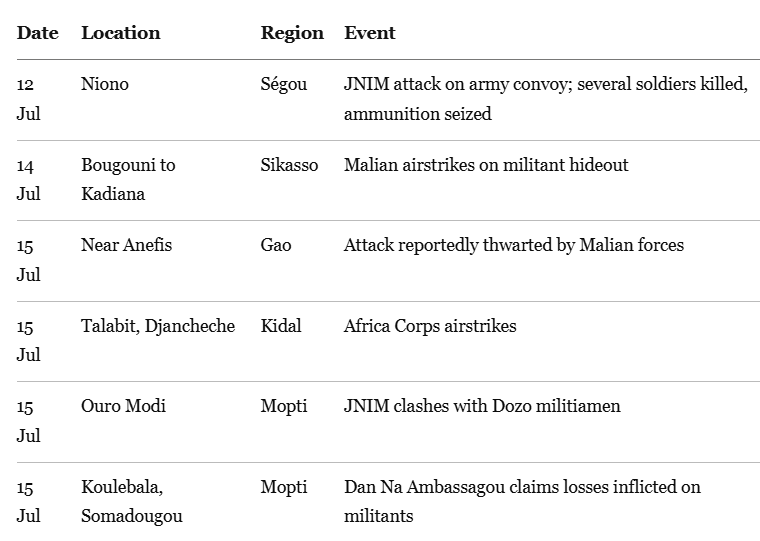
Source: Sahel Diaries No. 17.
Assessment
The state recovered Anefis, but the recovery required Russian air support and took six days. The strategic reading is not that the offensive failed. It is that a jihadist and separatist coalition can now mass armour and artillery against a defended position and hold it for the better part of a week.
Three features distinguish this from the pattern of the past decade. First, the use of a captured armoured personnel carrier alongside artillery indicates a shift from raiding to combined-arms assault. Second, the coalition held ground under drone observation, accepting attrition rather than dispersing. Third, the target set was strategic rather than opportunistic: Anefis controls access to Kidal, and Kénieroba is a prison sixty kilometres from the capital.
The Dozo and Dan Na Ambassagou engagements indicate that the central theatre is increasingly being fought through militia proxies on the government side, which historically precedes communal massacre.
This follows the 25 April coordinated attacks across Bamako, Kati, Gao, Mopti and Sévaré, among the most significant escalations in Mali’s security crisis in recent years, during which Defence Minister General Sadio Camara was killed by a suicide vehicle-borne IED at his residence in Kati.
READ ALSO

🇧🇫 Burkina Faso: Three Positions Struck in One Weekend
Burkinabè forces absorbed the same first-weekend pressure as Mali. AFP reported at least twenty-two soldiers and civilian militia killed in suspected extremist attacks in the north of the country over the weekend of 4 and 5 July, citing security sources.
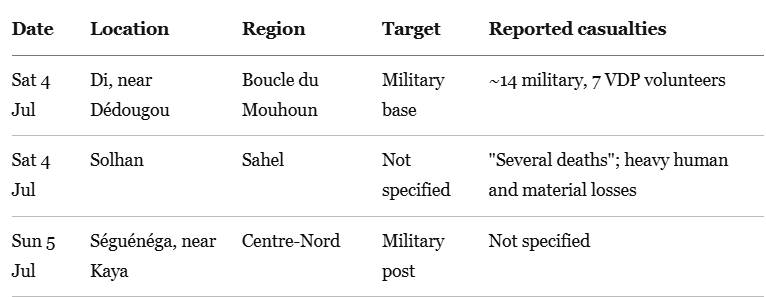
Sources: AFP via The Defense Post; police source via Punch.
Solhan had already been struck on 30 June, in the coordinated cross-border wave described in the baseline section below.
Assessment
Three separate military positions attacked in two days, across three different regions, is a demonstration of simultaneity rather than concentration. The Volunteers for the Defence of the Homeland took a third of the casualties at Di, continuing the pattern in which Burkina Faso’s civilian auxiliary force absorbs disproportionate losses relative to its training and equipment.
Solhan being hit twice in under a week, on 30 June and again on 4 July, indicates a sustained local campaign rather than opportunistic raiding. Solhan carries particular symbolic weight, having been the site of one of the deadliest civilian massacres of the Burkinabè insurgency.
The timing is the significant point. Di, Solhan and Séguénéga fall within the same 48-hour window as Anefis, Kénieroba, Konna and Somadougou. Read together, seven positions across two countries were attacked in a single weekend.
🇨🇩 Democratic Republic of Congo: The Month’s Deadliest Campaign
Wave one: Beni territory, 12 to 15 July
Africanews reported at least twenty killed across North Kivu’s Beni territory between 12 and 15 July.
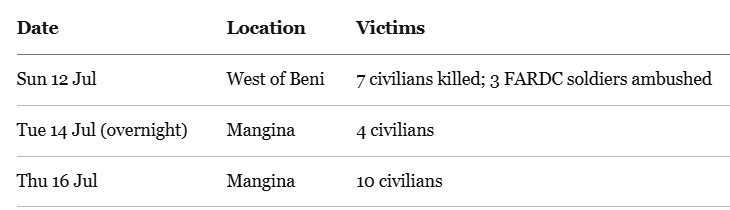
Beni has been the seat of North Kivu’s provincial government since Goma fell to M23. Survivors fled into the town centre, which has so far been spared attack.
Wave two: Mambasa territory, Ituri, 22 to 27 July
Reporting on this wave varies by outlet and window. The figures overlap rather than accumulate, and treating them as separate incidents would inflate the monthly total by roughly a factor of four. The table below reconciles them.
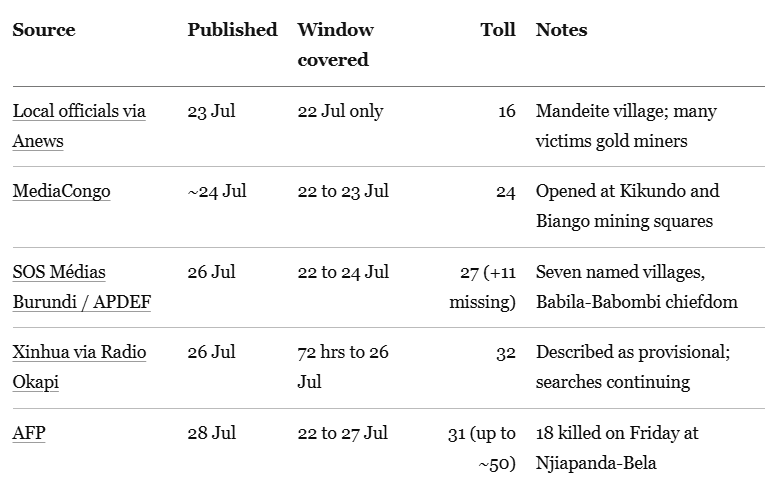
Ujasusi assessment of the wave. Thirty-one is the best-supported floor. It comes from the widest reporting window, is attributed to a named civil society figure, and was independently confirmed by other local sources. Around fifty is the upper bound, from a single security source.
The month in total
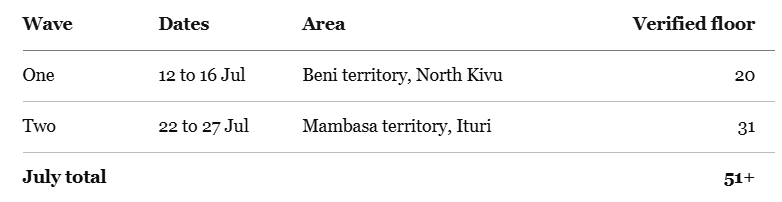
The plausible ceiling is near seventy. For context, the Global Centre for the Responsibility to Protect records at least seventy killed by ADF militants across Ituri and North Kivu in the three months from April to June. July alone approached that figure.
The economic driver
The Mambasa killings are not indiscriminate. AFP reporting establishes that the ADF, broken into mobile groups using the Ituri forests as cover, has spent several months extracting protection payments from communities earning income from cocoa and artisanal mining. Farmers described paying a ten-dollar levy and receiving tokens as receipts. Being found without a token, one said, means death.
The geography confirms it. Kikundo and Biango are artisanal mining squares. Njiapanda-Bela, where eighteen died in a single day, is a mining village. Mandeite’s victims were largely gold miners. Local civil society organisations state the group has killed more than a hundred people across around twenty villages in Mambasa territory since March 2026.
This is a protection racket enforced by massacre, not an insurgency seeking ground.
M23: force generation at scale
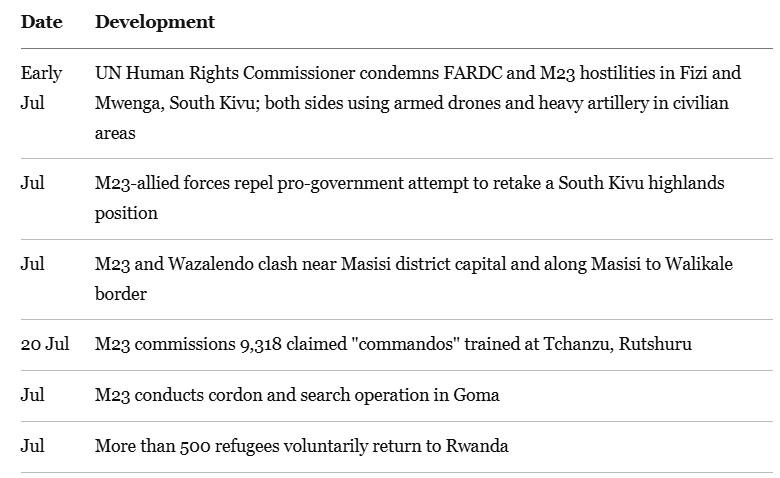
Source: Congo War Security Review. The July intake is the fifth large-scale recruitment cycle since July 2025, following cycles in September 2025, October 2025 and February 2026.
Assessment
Two distinct wars are running in the Kivus and Ituri, and they are routinely reported as one. The ADF campaign is revenue-extraction violence against civilians on cocoa and mining ground. The M23 conflict is a conventional territorial war fought with drones and artillery. Conflating them produces bad analysis and worse policy, because the interventions each requires are entirely different: one demands policing of an extraction economy, the other a ceasefire architecture.
Five recruitment cycles in twelve months is not replacement of losses. It is expansion, and the commissioning ceremony was public, which suggests the signalling was intended.
🇳🇬 Lake Chad Basin: Attrition Against a Degraded Insurgency
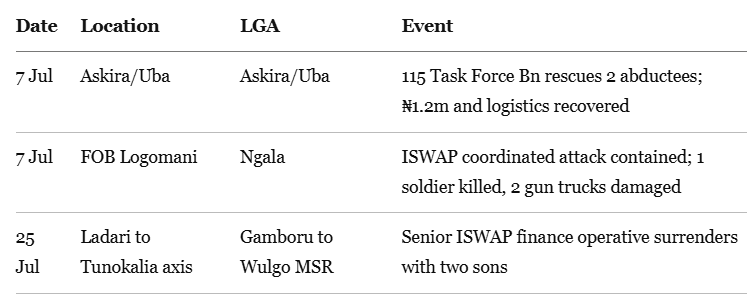
Sources: Vanguard, 9 July; Vanguard, 26 July.
The 25 July defector had served as chief finance operative of the ISWAP enclave at Jubillaram, managing the group’s financial activities and logistics. His surrender followed what Operation Hadin Kai described as a series of coordinated land and air offensives against militant enclaves.
This sits against a changed operational backdrop. A joint United States and Nigeria military operation against ISWAP and Boko Haram began on 16 May 2026, involving special forces raids and multiple rounds of airstrikes. ISWAP senior leader Abu-Bilal al-Minuki was killed alongside several other senior commanders, and by 19 May Nigerian authorities stated that 175 militants had been killed since the offensive began.
The pressure is regionalising. ACLED reports that following increased US military involvement in Nigeria since late 2025, Washington has begun exploring expanded military cooperation with Cameroon’s security forces in the Far North region, where ISWAP and Boko Haram frequently retreat and regroup when fleeing offensives in Nigeria.
Assessment
July’s Lake Chad reporting is dominated by state-initiated actions, namely rescues, contained attacks and a high-value surrender, rather than successful insurgent operations. A single soldier killed at Logomani is the only recorded security fatality.
Note the symmetry with Ituri. Two Islamic State affiliates on opposite sides of the continent, both organised around a finance function, both currently under pressure aimed at that function. In Borno the finance chief defected. In Mambasa the tax collectors are killing to enforce collection. The same organisational logic produces opposite behaviours depending on whether the group is under pressure or unpoliced.
The Far North Cameroon vector is the one to watch. Displaced pressure does not disappear.
🇸🇴 Horn of Africa: Air Campaign and a Reactivated Kenyan Front
Operations in Somalia
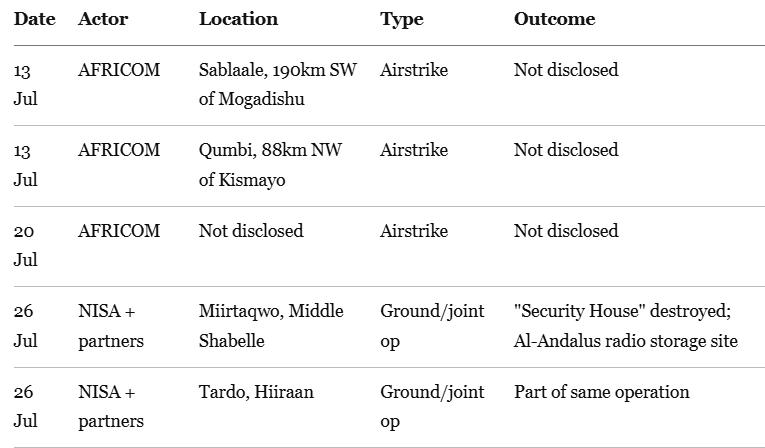
Sources: AFRICOM; GlobalSecurity; Hiiraan Online.
The 26 July operations killed sixteen al-Shabaab militants including two senior members of the group’s media wing, and destroyed a facility used to store equipment for Al-Andalus, the group’s propaganda radio outlet. Targeting information infrastructure rather than fighting positions is a notable shift.
Kenya
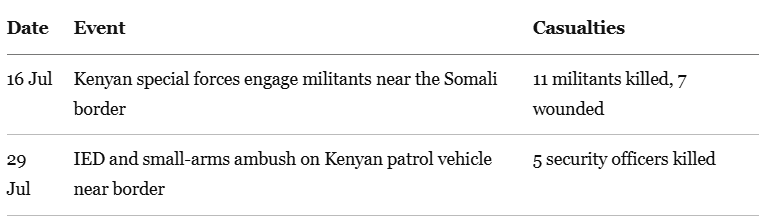
Source: CFR Global Conflict Tracker. Kenyan officials reported the 16 July group had planned attacks on villages in north-eastern Kenya. Following the 29 July ambush Nairobi launched a manhunt. The tracker notes a string of al-Shabaab attacks across north-eastern Kenya in recent weeks.
Political context
Somalia’s principal violence in this period was not jihadist. ACLED documents heavy clashes in Mogadishu from 3 June between state security forces and militias including defected Somali National Army members aligned with the opposition Somali Salvation Forum, triggered by a constitutional amendment granting President Hassan Sheikh Mohamud a one-year term extension after his mandate expired on 15 May. Fighting spread across the Hawl Wadaag, Abdiaziz, Hodan, Wardhigley and Daynile districts before ceasing after negotiations. Tensions remain high between the federal government and Puntland.
Assessment
The 29 July ambush is the significant datum. A coordinated IED and small-arms attack producing five security fatalities represents a capability step beyond the cross-border raiding of preceding weeks. The 16 July interdiction shows Kenyan forces were aware of intent against north-eastern villages, which makes the subsequent success against a patrol more concerning, not less.
Constitutional instability in Mogadishu compounds this. A security establishment fighting itself is not fighting al-Shabaab, and the group’s ability to hold ground at Tardo in Hiiraan, requiring a joint intelligence operation to strike, illustrates what that has cost.
🇲🇿 Mozambique: Road Interdiction in Cabo Delgado
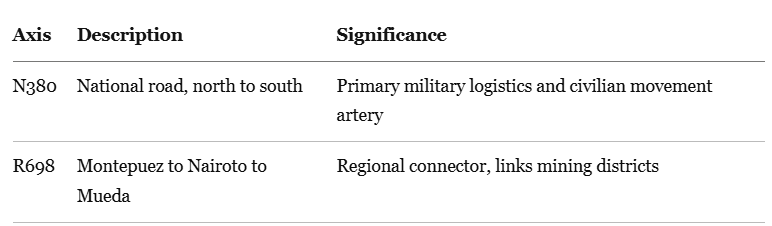
Zitamar News reports that Islamic State-backed fighters stepped up operations across Cabo Delgado throughout July, mounting incursions on the two main roads linking the north and south of the province and threatening road traffic.
The escalation followed successive intense clashes around the Catupa base in Macomia district, contested since June. Insurgents split into several groups, raiding villages and gold mines.
For baseline, UN OCHA recorded the following for June:
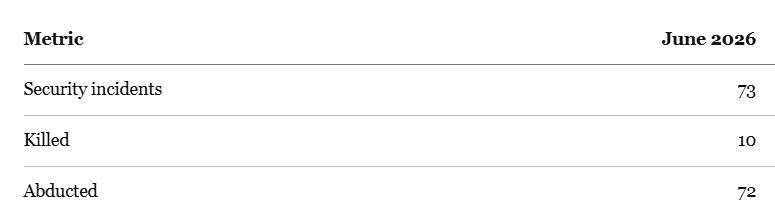
Insecurity expanded into previously less-affected areas, with armed groups attacking the Namuno region for the first time since 2022. Seventy-seven per cent of violent incidents occurred in five districts of highest humanitarian need, with Macomia and Ancuabe accounting for more than half.
Assessment
The shift to road interdiction and gold-mine raiding is revenue-driven and mobility-driven rather than territorial. The same logic is now visible in Ituri, and the parallel is worth stating plainly: three Islamic State affiliates on this continent are currently behaving less like insurgencies seeking ground and more like armed extraction operations seeking rents.
Fragmentation into smaller raiding groups following the Catupa fighting most likely reflects dispersal under pressure rather than expansion. But dispersal makes an insurgency harder to fix and target, and closing the N380 imposes costs on the state well beyond the casualties inflicted.
📊 Sahel Baseline: What July Inherited
June conditions shaped the ground on which the first-weekend offensives landed.
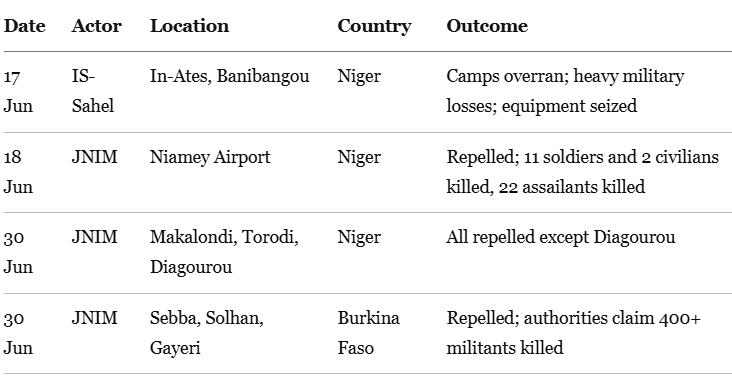
Sources: ACLED; PBS on the Niamey airport attack.
Western Niger is now the contested seam between JNIM and IS-Sahel. Tillabéri is IS-Sahel’s most important area of operations, and the outcome of that rivalry will shape jihadist violence across Mali, Burkina Faso, Benin and north-western Nigeria.
The 30 June pattern, six locations across two countries in one day, is the template that recurred on 4 and 5 July across Mali and Burkina Faso. That recurrence within five days is the basis for Key Judgement 1.
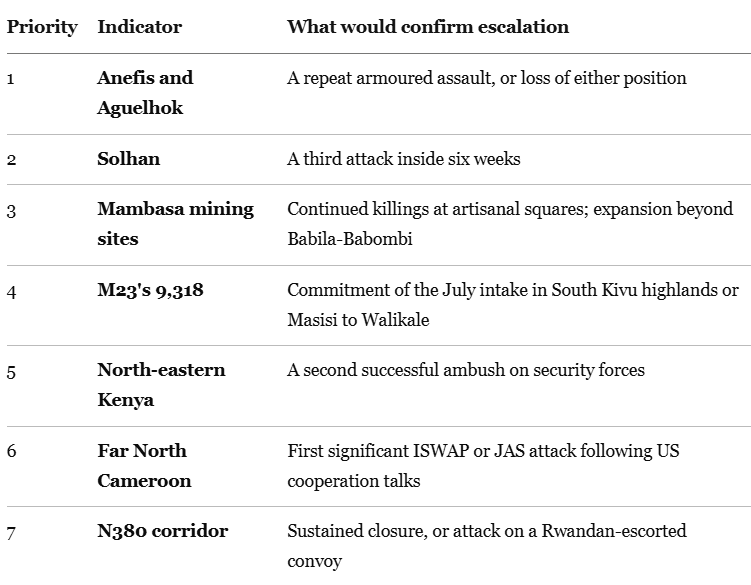
🔭 August Watchlist
📌 Method
Casualty figures are reproduced as reported and attributed to source. Belligerent claims, whether by JNIM, Malian authorities, Burkinabè authorities or M23, are identified as claims and excluded from the fatality floors in the summary table.
Where multiple outlets report the same wave of attacks across different windows, the figures are presented side by side rather than summed, and a floor is stated. This applies particularly to the late-July Mambasa attacks, where reported tolls of 16, 24, 27, 31 and 32 describe overlapping portions of a single campaign between 22 and 27 July, not separate incidents. Summing them would have produced a figure of 130, roughly four times the defensible number.
Figures given as floors will rise as verification continues. Several Ituri tolls were explicitly described as provisional pending search operations.