

Ujasusi Blog’s East Africa Monitoring Team | 10 November 2025 | 0125 GMT
CONTENT NOTICE: This intelligence brief contains an analysis of explicit sexual language from a social media post. While necessary for comprehensive reporting on this politically significant development, readers should be aware that the article includes vulgar terminology and references to sexual conduct. The content is presented in the context of serious allegations of state repression and human rights violations in Tanzania.
Executive Summary
On 9 November 2025, several controversial X (formerly Twitter) posts by Abdul Halim Hafidh Ameir (@AbdulAmeir)—son of Tanzanian President Samia Suluhu Hassan—resurfaced, triggering online outrage in Tanzania and parts of Kenya’s digital sphere. The vulgar tweets, spanning several years and interpreted by critics as sexually explicit content, have intensified existing allegations against Ameir as the alleged orchestrator of state repression, enforced disappearances, and election-related violence. This intelligence brief analyses the tweets’ content, historical context, and political implications, drawing on verified screenshots and public reactions alongside previous analysis of Ameir’s alleged role in state terror. As Tanzania confronts acute post-election instability, this revelation adds another dimension to ongoing regime legitimacy challenges.
🔍 Background: Who is Abdul Halim Hafidh Ameir?
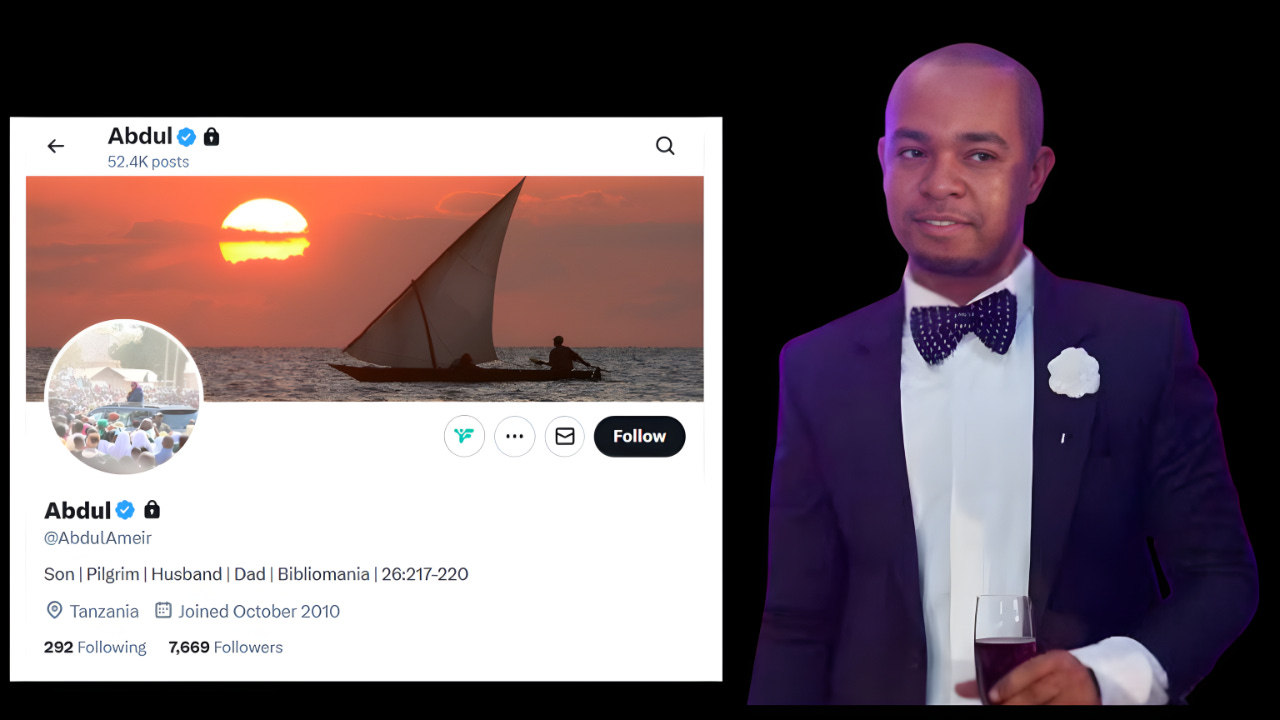
Abdul Halim Hafidh Ameir, commonly known as “Abdul Ameir,” is the son of President Samia Suluhu Hassan, Tanzania’s first female head of state since March 2021. Despite holding no formal government position, Ameir is widely accused of wielding significant influence over the Tanzania Intelligence and Security Service (TISS).
Profile Overview
Age: Early-to-mid 30s (exact birthdate unconfirmed)
Official Role: System Administrator, e-Government Zanzibar
X Handle: @AbdulAmeir (7,653 followers; largely dormant)
Profile Bio: “Son | Pilgrim | Husband | Dad | Bibliomania | 26:217-220” (Quranic verse reference)
Economic Activities: Import-export operations; ownership of commercial properties including an unfinished hotel
Allegations of Security Apparatus Involvement
As detailed previously, based on exposés by Kenyan blogger Cyprian Nyakundi and other sources, Ameir is accused of commanding covert operations responsible for:
Enforced disappearances of opposition figures, journalists, and activists
Torture operations in clandestine detention facilities
Violence during the disputed October 2025 elections, with opposition coalition CHADEMA estimating over 700 civilian deaths
Pre-election intimidation campaigns documented by Amnesty International and Africa Confidential
Public sentiment within Tanzania characterises Ameir as a feared figure within the security establishment. Following President Hassan’s controversial 97% electoral victory on 29 October 2025, protesters targeted his personal assets. Reports indicate tensions within Tanzania’s military establishment, with some officers expressing dissent.
International human rights organisations, including Amnesty International, the UN Human Rights Office, and outlets such as NPR, have documented unprecedented levels of state repression. Online campaigns demanding formal designation of TISS leadership have gained traction across East African social media platforms.
📱 The Discovered Past Tweet: Content and Context
Discovery and Dissemination
One of the resurfaced posts, dated 14 August 2012, was publicly shared via screenshots by Tanzanian activist @bizy94 (known as “Mbishi”) on 9 November 2025. The exposé post rapidly achieved over 33,000 views within 24 hours.
Original Tweet Content
The 2012 post featured crude Swahili slang common among young Zanzibari social media users during that period, containing sexually explicit vulgar language that critics interpreted as references to homosexual conduct.
Original Swahili Text:
“Kweli kumbwe umeishi Unguja ‘@BeeBoyGossi: Bliz Mikundu mitaumu ww ten na ukimpata anayekatika baasi kuma utaki ten na @IBliz14 @MrErr04’”
Approximate English Translation (based on contemporary Swahili slang analysis):
“True, remember you lived in Unguja [Zanzibar]. ‘@BeeBoyGossi: Blitz the anuses—we’re accusing you of being one. If you find someone who fucks a bad pussy, you don’t fear it with @IBliz14 @MrErr04’”
Linguistic and Cultural Analysis
Key Slang Components:
“Bliz Mikundu”: Compound of “blitz” (indicating intense or aggressive action) + “mikundu” (plural vulgar slang for “anuses”). Implies enthusiastic engagement in anal intercourse.
“Baasi Kuma”: “Baasi” (bad/evil/undesirable) + “kuma” (vulgar term for vagina). Expresses disdain or rejection of vaginal intercourse.
Tagged Accounts: @IBliz14, @MrErr04 (identity unverified; likely peer group members engaged in juvenile online banter)
Historical Context
In 2012, Ameir would have been in his early twenties, predating his mother’s vice presidency (2015-2021) and subsequent presidency. The tweet, featuring crude sexual language and apparent boasting about taboo conduct, offers insight into a character marked by vulgarity, recklessness, and disregard for social norms.
Recontextualised in 2025 amid allegations of mass killings, enforced disappearances, and torture, critics argue the post reveals a longstanding pattern of callousness and contempt—a personality willing to transgress boundaries without concern for consequences.
The casual cruelty evident in the 2012 language, opponents suggest, foreshadows the merciless behaviour attributed to him today: a figure operating with utter disregard for human life and dignity.
Rather than youthful indiscretion, many Tanzanians interpret the archived post as early evidence of the character now allegedly orchestrating state terror.
The accompanying screenshot shared by @bizy94 includes a photograph showing Ameir with an infant, creating a juxtaposition between his current cultivated “family man” public persona and the adolescent content of the archived post.
Account Activity and Potential Content Management
Ameir’s @AbdulAmeir account shows minimal recent activity, suggesting either dormancy or systematic content removal. The account’s current state may indicate proactive content management amid intensifying scrutiny. Activists are employing tools such as the Internet Archive’s Wayback Machine to uncover potentially deleted material.
🔥 Public Reaction: Outrage, Amplification, and Political Mobilisation
Social Media Metrics and Engagement
@bizy94’s exposé post generated substantial engagement within 24 hours:
33,452 views
221 likes
62 reposts
29 direct replies
Categorised Public Response

Cross-Border Amplification
Kenyan social media accounts, particularly those associated with blogger Cyprian Nyakundi, rapidly disseminated the screenshots beyond Tanzania’s borders. Opposition party CHADEMA leveraged the revelation: “From vulgar tweets to violent crackdowns—Ameir’s true colours exposed.”
Encrypted Platform Dissemination
Beyond public social media, screenshots circulated extensively through encrypted WhatsApp groups, Telegram channels, and Signal networks used by Tanzanian diaspora communities, opposition organisers, and civil society networks—mirroring information-sharing strategies during October 2025’s internet restrictions.
📊 Strategic Analysis: Implications and Consequences
1. Regime Image Management Challenge
The tweet’s resurfacing compounds the Hassan administration’s image challenges following disputed October 2025 elections. The revelation:
Validates opposition narratives of elite disconnect and moral inconsistency
Contradicts Ameir’s cultivated image as a disciplined family man, undermining public relations strategies
Provides propaganda material for opposition social media campaigns, particularly among younger, digitally-engaged demographics
However, structural power dynamics remain unchanged—Ameir’s alleged influence derives from presidential family ties rather than personal political capital or institutional CCM standing.
2. Opposition Tactical Opportunity
The scandal provides CHADEMA and allied groups with propaganda ammunition for digital campaigns, though translation into actual political leverage remains uncertain. Opposition parties face challenges:
Converting online outrage into sustained mobilisation amid repressive environment
Balancing tactical exploitation with avoiding discriminatory rhetoric that alienates international human rights partners
Operating under severe constraints following post-election crackdowns
3. Digital Platforms as Protest Space
With physical protest spaces heavily restricted, social media increasingly functions as the primary arena for political contestation. The tweet’s viral spread demonstrates:
Resilience of digital activism despite censorship and surveillance
Cross-border networks amplifying domestic dissent through diaspora and regional allies
“Digital archaeology” as emerging tactic—systematically uncovering embarrassing archival content
4. Limited International Attention
Despite human rights organisations’ documentation of October 2025 violence, Western governments have shown limited sustained engagement with Tanzania’s crisis. A social media scandal—even one generating domestic outrage—is unlikely to trigger:
Targeted sanctions (which typically require sustained atrocities with major international media coverage)
High-level diplomatic interventions
Significant policy shifts
Tanzania’s limited strategic importance to Western capitals means crisis response remains largely rhetorical.
⚠️ Risk Assessment: Focused Analysis
Immediate Risks (0-30 days)
HIGH PROBABILITY:
Targeted retaliation against @bizy94 and prominent amplifiers—consistent with documented TISS targeting patterns of activists and journalists
Intensified online censorship through account suspensions, content removal requests, and platform pressure
Regime propaganda offensive portraying criticism as foreign-backed “moral degeneracy” or Western cultural imperialism
MODERATE PROBABILITY:
Isolated small-scale protests if opposition parties actively mobilise, though likely limited given the post-election repression climate
Increased surveillance of opposition digital networks and diaspora organising platforms
Medium-Term Dynamics (30-90 days)
HIGH PROBABILITY:
Continued “digital archaeology” campaigns by opposition activists systematically searching for additional embarrassing archival content from Ameir and associates
Sustained hashtag activism maintains online pressure, though without a clear pathway to structural political change
LOW PROBABILITY:
Erosion of Ameir’s influence within CCM (his position derives from family ties, not institutional standing, vulnerable to PR scandals)
Long-Term Structural Impacts (90+ days)
Ongoing Digital Contestation: Social media will continue serving as primary space for political opposition in Tanzania’s constrained environment. The tweet establishes precedent for archival research tactics likely to be replicated targeting other regime figures.
Personal Embarrassment Without Institutional Consequences: Ameir faces reputational damage within certain elite circles, but absent broader political shifts, this translates to minimal structural impact on power dynamics.
Digital Opposition in Authoritarian Space
The resurfacing of Abdul Halim Hafidh Ameir’s 2012 X post represents a case study in how digital platforms function as contested political space under authoritarian conditions. While generating substantial online outrage and providing opposition propaganda material, the scandal’s structural political impact remains limited—power dynamics in Tanzania derive from institutional control, family networks, and coercive capacity rather than public sentiment or elite reputation.
The incident does, however, illustrate several significant dynamics:
Digital archaeology as an emerging opposition tactic in environments where physical organising faces severe constraints
Cross-border amplification networks leveraging diaspora communities and regional allies to circumvent domestic censorship
Social media’s dual function as both regime surveillance tool and opposition organising space
Risks faced by activists willing to expose regime figures, requiring international attention to their protection
As Tanzania’s political crisis continues following disputed October 2025 elections, such digital contestation will likely persist as primary avenue for opposition expression—even as its capacity to generate structural political change remains constrained by authoritarian realities.
🔑 Upgrade your Ujasusi Blog subscription and get more for less. Switch to Annual and save 17%, or become a Founding Member to make a lasting impact while enjoying full access to exclusive intelligence insights.
You can also donate.